All species › Passerines › Antbirds › Checker-throated Stipplethroat
Position in the tree Birds Aves › Birds with a flexible palate Neognathae › All other modern birds Neoaves › Landbirds Telluraves › Falcons, parrots and passerines Australaves › Falcons and passerines Eufalconimorphae › Parrots and passerines Psittacopasserae
Checker-throated Stipplethroat | Epinecrophylla fulviventris
Marmerkeelmiersluiper | Hormiguerito barbiescamado
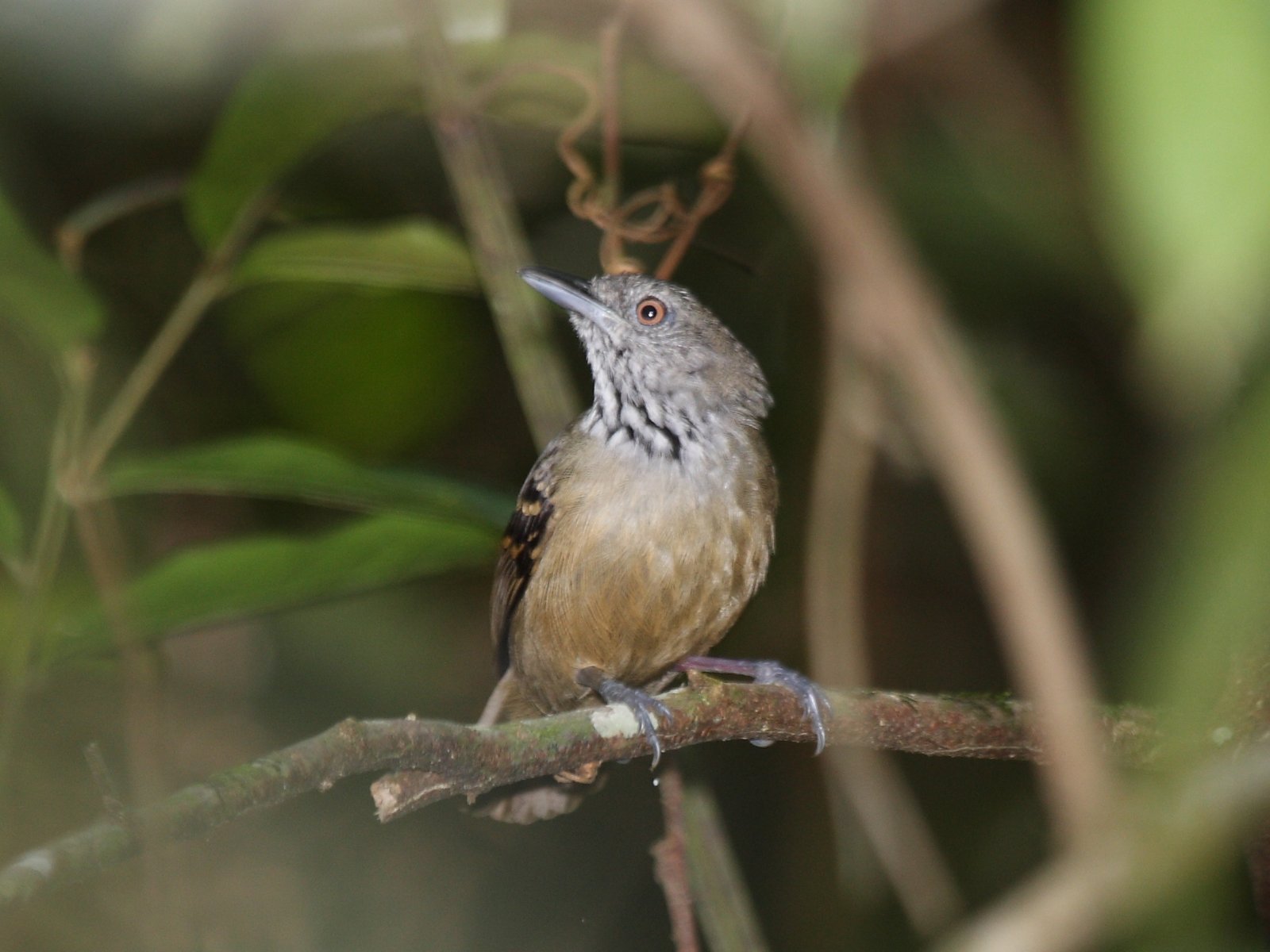
The Checker-throated Stipplethroat is a small, brown antwren of the understorey of humid forest that specialises in probing hanging clusters of dead leaves. The male is recognised by its black-and-white checkered throat. In the guide area it lives from Honduras to Panama.
Voice
The song is a series of high, thin, squeaky notes. The call is a sharp, high tseek, often repeated as the bird travels with a mixed flock.
Recording: Sue Riffe — CC BY-NC-SA 4.0 · converted to mono · xeno-canto
Identification
10 cm; tail fairly short. Upperparts brown, wing coverts dark with buff spots forming two wing bars. Underparts warm ochre-brown. Male with a black-and-white checkered throat; female with a plain pale buff throat.
Confusion species
The female White-flanked Antwren Myrmotherula axillaris has whitish flanks, a greyer head and a slimmer build. Other antwrens in the guide area have black, grey or streaked patterns rather than brown plumage with buff wing spots.
Habitat
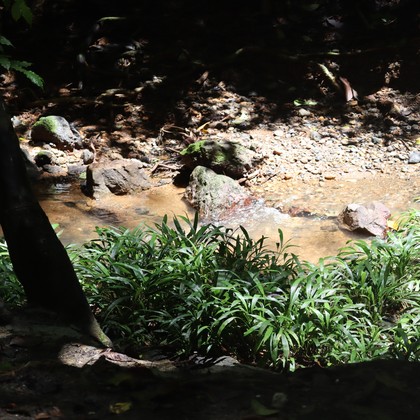
Understorey of humid evergreen lowland and foothill forest, also mature secondary forest, to about 1000 m. It hangs acrobatically from clusters of dead leaves in the understorey and pulls out insects and spiders; nearly always in understorey mixed flocks.
Where the bird is most at home, classified by the vegetation units of Mexico and Central America.



Range and movements
Caribbean slope of Honduras, Nicaragua and Costa Rica; in Panama on both slopes, on the Pacific side mainly in the east. Outside the guide area in western Colombia and Ecuador.
- Resident
- dark = core range, pale = thinly spread
How and when to look
Found in understorey mixed flocks, as a small brown bird hanging from dead leaves; regularly seen in the forests around the Panama Canal.
Conservation status
Not threatened. Fairly common in continuous forest; disappears where the understorey is cleared.
Scientific name
Epinecrophylla fulviventris | (Lawrence, 1862)
Lawrence described the species in 1862 as Myrmetherula fulviventris; because it was later moved to another genus, the author and year stand in brackets. The genus Epinecrophylla was introduced in 2006 by Isler & Brumfield. Epinecrophylla is Greek, from epi 'on', nekros 'dead' and phullon 'leaf', after its habit of foraging in hanging dead leaves. fulviventris is Latin, from fulvus 'tawny' and venter 'belly', after the tawny underparts. The specimen the first description was based on came from Lion Hill on the Panama Railroad, Panama.