All species › Passerines › Antbirds › Moustached Antwren
Position in the tree Birds Aves › Birds with a flexible palate Neognathae › All other modern birds Neoaves › Landbirds Telluraves › Falcons, parrots and passerines Australaves › Falcons and passerines Eufalconimorphae › Parrots and passerines Psittacopasserae
Moustached Antwren | Myrmotherula ignota
Griscoms miersluiper | Hormiguerito bigotudo
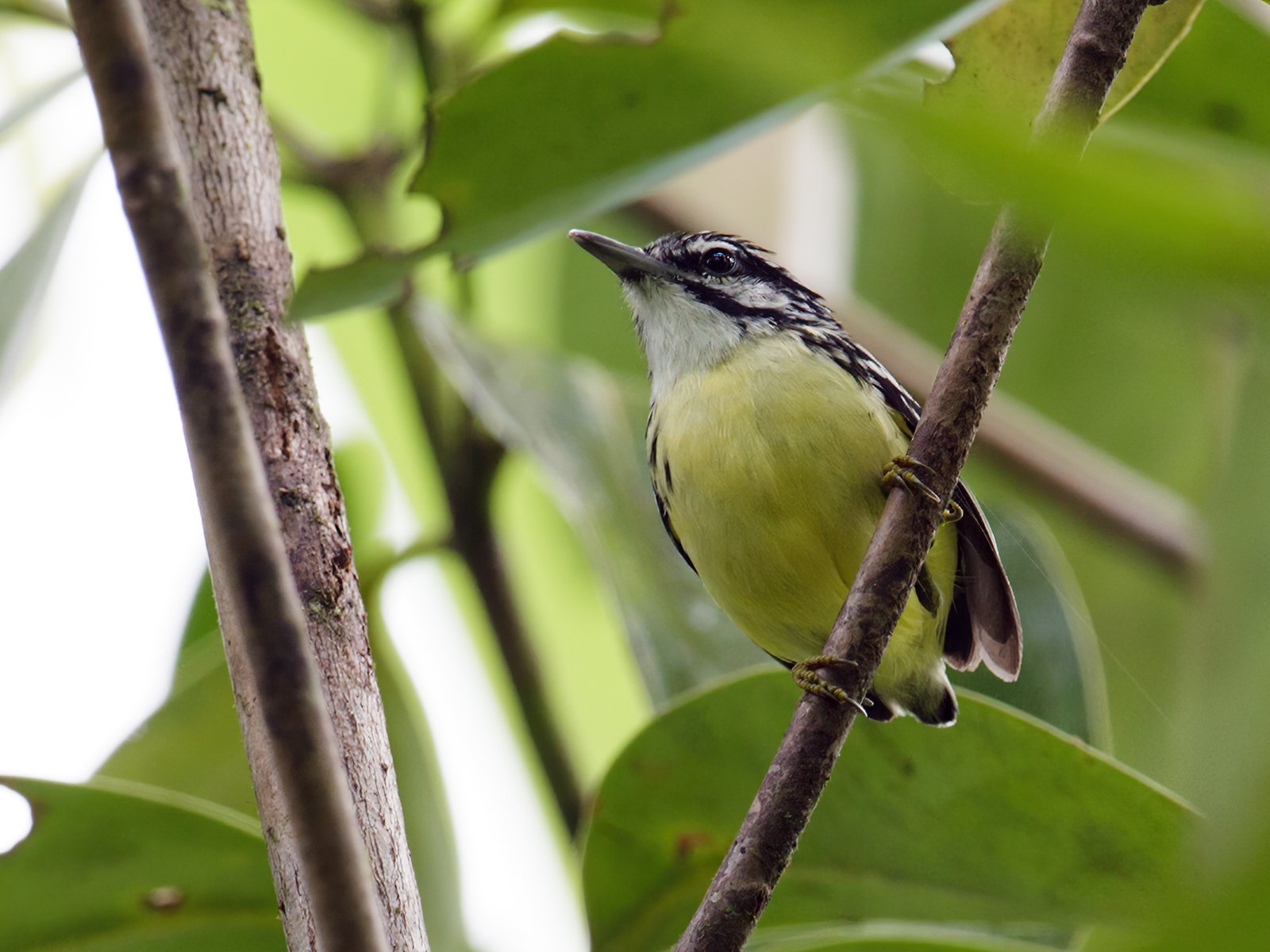
The Moustached Antwren is one of the smallest antbirds: a stubby, almost tailless bird with black-and-white streaked upperparts and pale yellow underparts. It lives high in the canopy of humid lowland forest. In the guide area it occurs only in Panama.
Voice
The song is a series of thin, high notes that accelerates into a short trill. Often heard from the canopy.
Recording: Juan Freile — CC BY-NC-SA 4.0 · converted to mono · xeno-canto
Identification
8 cm; tail very short. Crown and upperparts black with white streaks, wings black with two white wing bars. Throat white with a narrow black moustachial stripe; breast and belly pale yellow, lightly streaked on the breast sides. The female has a buffy wash on the head and breast.
Confusion species
Pacific Antwren Myrmotherula pacifica is slightly larger, has white rather than yellow underparts with black streaks and lives mainly in shrubby growth near water; the female has an orange-buff head. Other small canopy birds, such as warblers, lack the black-and-white streaked back.
Habitat
Canopy and upper middle levels of humid lowland forest, also forest edges and tall second growth, mainly in the lowlands. It gleans small insects from leaves and vines, often in canopy mixed flocks.
Where the bird is most at home, classified by the vegetation units of Mexico and Central America.



Range and movements
Central and eastern Panama. Outside the guide area in western Colombia and Ecuador and, as a different subspecies, in western Amazonia.
- Resident
- dark = core range, pale = thinly spread
How and when to look
Mostly detected by ear; when it sings the accelerating song the bird is usually high in the canopy. Viewpoints over the forest canopy give the best chance of seeing it.
Conservation status
Not threatened. Locally fairly common in the guide area, but little noticed because of its small size and life in the canopy.
Scientific name
Myrmotherula ignota | Griscom, 1929
Griscom described the species in 1929 and placed it straight away in the genus where it still stands. The genus Myrmotherula was introduced in 1858 by Sclater. Myrmotherula is a diminutive of Myrmothera, Greek for 'ant-hunter' (murmos 'ant', -thēras 'hunter'): 'little ant-hunter'. ignota is Latin for 'unknown', probably because this bird had long been overlooked. The specimen the first description was based on came from Jesusito, eastern Panama.