All species › Passerines › Antbirds › Dot-winged Antwren
Position in the tree Birds Aves › Birds with a flexible palate Neognathae › All other modern birds Neoaves › Landbirds Telluraves › Falcons, parrots and passerines Australaves › Falcons and passerines Eufalconimorphae › Parrots and passerines Psittacopasserae
Dot-winged Antwren | Microrhopias quixensis
Spikkelvleugelmiersluiper | Hormiguerito alipunteado
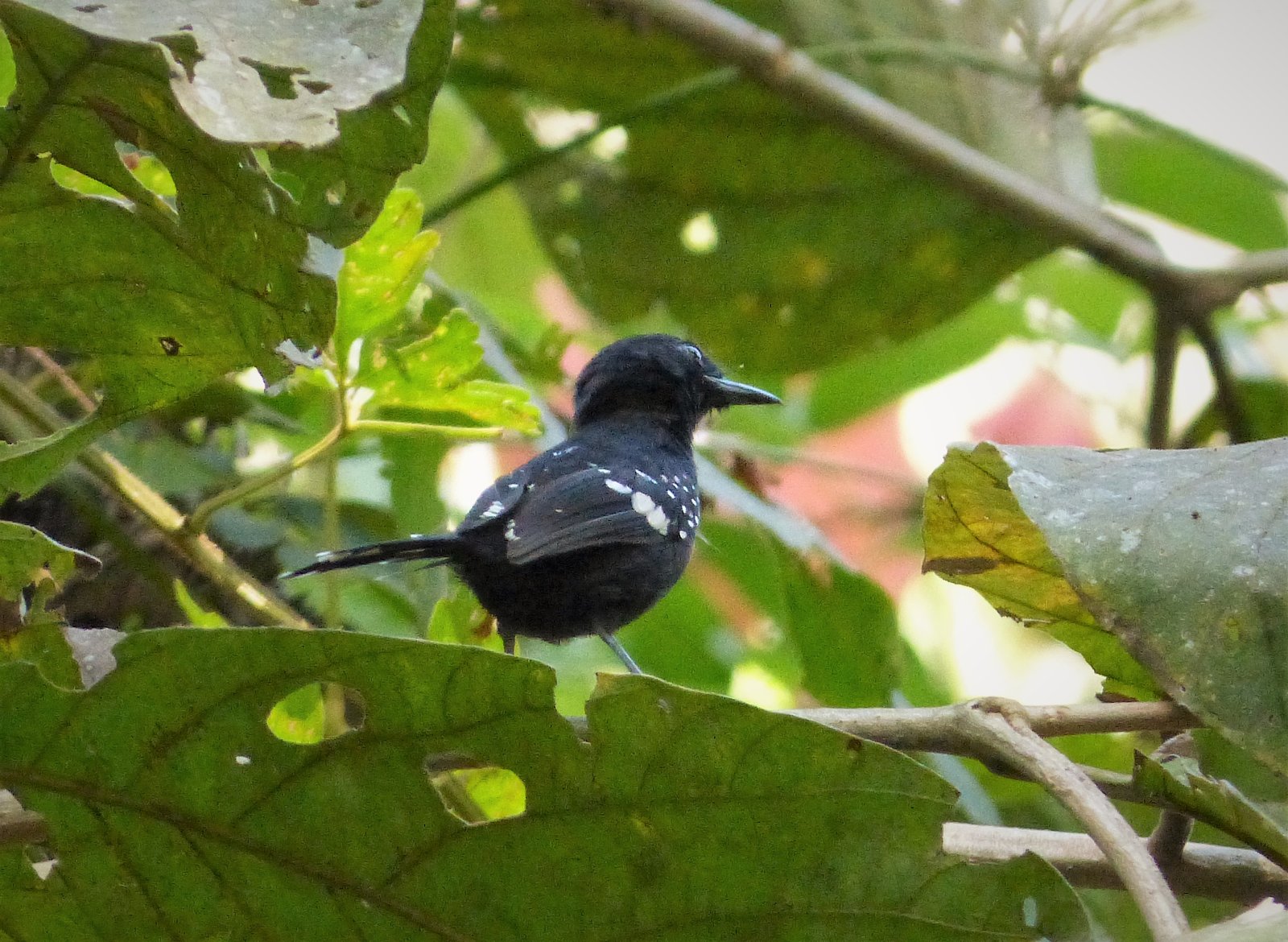
The Dot-winged Antwren is a slender antwren with a fairly long tail, often fanned, that moves through vines and dense growth in pairs or small groups. The black male with white wing dots and the female with rufous underparts are distinctive together. In the guide area it lives from south-eastern Mexico to Panama.
Voice
The song is a series of high, clear notes that speeds up. The call is a soft, plaintive teeyew and a short chatter, often heard as the group moves.
Recording: Juan Freile — CC BY-NC-SA 4.0 · converted to mono · xeno-canto
Identification
11–12 cm; tail fairly long and graduated, with white tips. Male glossy black with a row of white dots on the wing coverts forming a wing bar, and a concealed white patch on the back. Female with blackish-grey upperparts, the same white wing dots and white tail tips, and chestnut to rufous throat and underparts.
Confusion species
The male Slaty Antwren Myrmotherula schisticolor is greyer, with a shorter tail and black throat and breast. The male White-flanked Antwren Myrmotherula axillaris has white flanks and a short tail. The female, with rufous underparts and blackish-grey upperparts, can hardly be confused.
Habitat
Dense understorey and middle levels of humid lowland and foothill forest, especially in vine tangles, forest edges and tall second growth, to about 1000 m. It forages in pairs or family groups among leaves and vines for insects, often with mixed flocks, spreading and moving its tail.
Where the bird is most at home, classified by the vegetation units of Mexico and Central America.




Range and movements
Caribbean slope of south-eastern Mexico through Belize, Guatemala, Honduras and Nicaragua to Costa Rica; in Panama on both slopes. Outside the guide area in western Colombia and Ecuador and widely in Amazonia.
- Resident
- dark = core range, pale = thinly spread
How and when to look
Small groups give themselves away at vine-rich forest edges by their plaintive calls; the fanned, white-tipped tail then quickly identifies the species.
Conservation status
Not threatened. Fairly common in suitable forest and second growth.
Scientific name
Microrhopias quixensis | (Cornalia, 1849)
Cornalia described the species in 1849 as Thamnophilus quixensis; because it was later moved to another genus, the author and year stand in brackets. The genus Microrhopias was introduced in 1862 by Sclater. Microrhopias is Greek, from mikros 'small' and the antwren genus Rhopias (from rhōps 'bush'): 'little Rhopias'. quixensis refers to Quixos (Quijos), a region in eastern Ecuador. The specimen the first description was based on came from eastern Ecuador.