All species › Passerines › Finches, euphonias and allies › Cassin's Finch
Position in the tree Birds Aves › Birds with a flexible palate Neognathae › All other modern birds Neoaves › Landbirds Telluraves › Falcons, parrots and passerines Australaves › Falcons and passerines Eufalconimorphae › Parrots and passerines Psittacopasserae
Cassin's Finch | Haemorhous cassinii
Cassins roodmus | Pinzón de Cassin
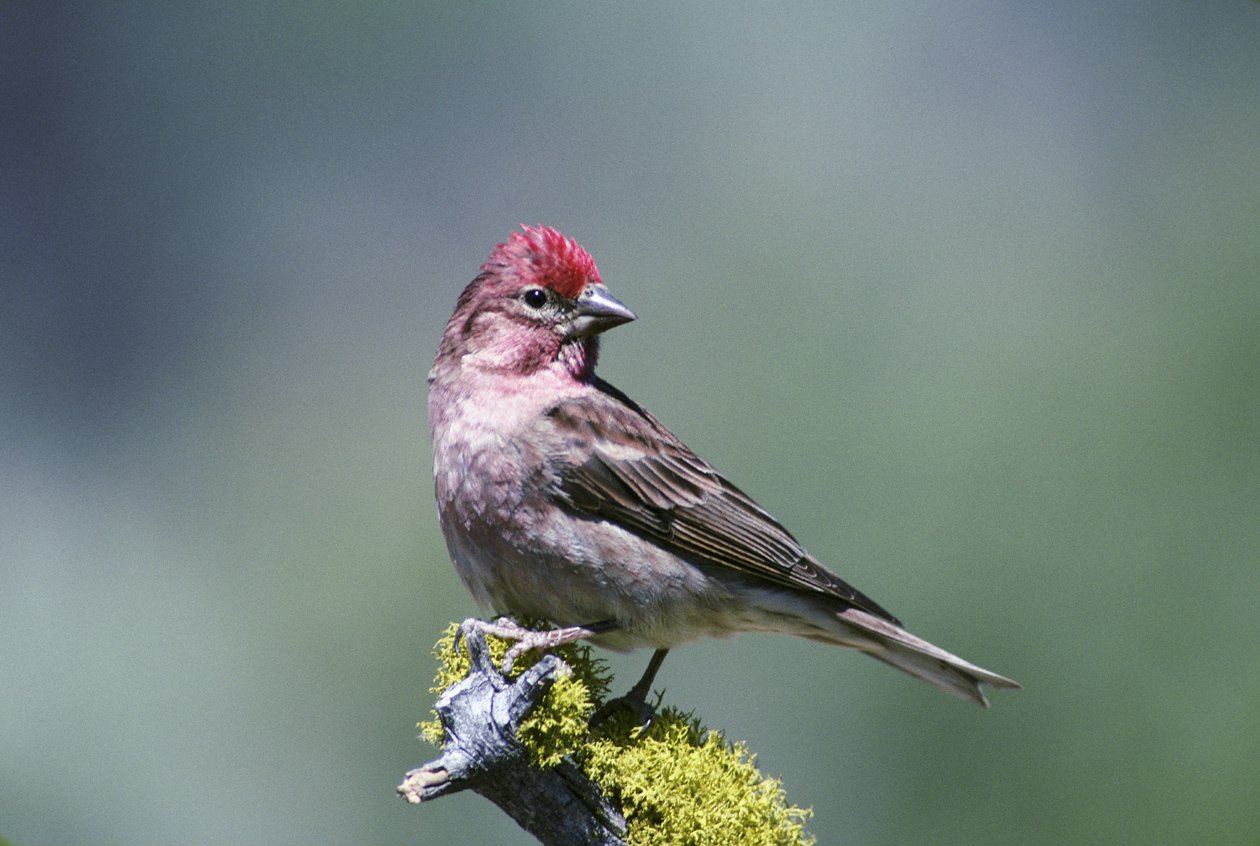
Cassin's Finch is a fairly large, long-winged finch of the high conifer forests of western North America. In the guide area it breeds only in the highest mountains of Baja California; in some winters flocks move to the mountains of northern Mexico.
Voice
The song is a long, rapid and flowing warble, often including imitations of other birds. The call is a clear, two-syllabled kee-up or tidilip, mainly in flight.
Recording: Richard E. Webster — CC BY-NC-SA 4.0 · shortened to the first 60 s, mono · xeno-canto
Identification
15–17 cm. Fairly large, with a long, pointed conical bill with a straight culmen, long wings and a notched tail. The male has a bright red crown that contrasts sharply with the brown nape, a pink throat and breast, a pink wash over the streaked brown back and a white belly with few or no flank streaks. The female is brown with a faint head pattern and fine, crisp black streaks on white underparts, including the undertail coverts.
Confusion species
The male Purple Finch Haemorhous purpureus is more evenly raspberry red over the head and back, without a sharp change from crown to nape; the female has a bolder head pattern, blurrier streaks and unstreaked undertail coverts. House Finch Haemorhous mexicanus is smaller, with a shorter, more curved bill and a longer, square-ended tail; the male has brown-streaked flanks.
Habitat
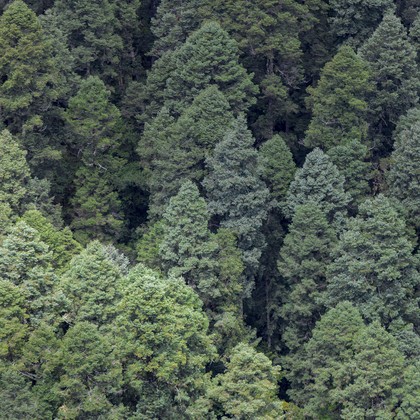
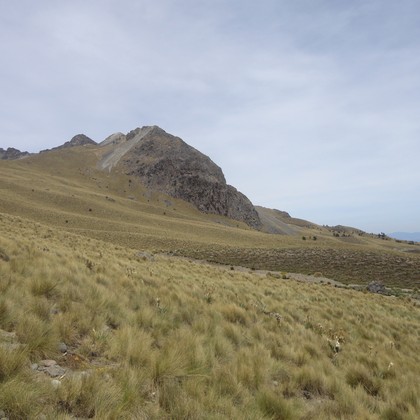
Open conifer forest of pine and fir in high mountains, and mountain meadows at the forest edge. In winter also lower in pine-oak forest and open country. It searches for seeds, buds and berries, often on the ground, and occurs in flocks in winter.
Where the bird is most at home, classified by the vegetation units of Mexico and Central America.

Range and movements
Breeds in the mountains of western North America, from southern British Columbia to northern Baja California, Arizona and New Mexico. In winter many birds move lower and southwards. In the guide area it breeds in the Sierra San Pedro Mártir in Baja California; in winter irregularly in the mountains of northern Mexico, from Sonora and Chihuahua to Durango and Nuevo León.
- Resident
- dark = core range, pale = thinly spread
How and when to look
The two-syllabled flight call is the quickest way to pick out Cassin's Finch among flocks of other finches.
Conservation status
Not threatened (LC). Widespread in western North America, but slowly declining in numbers. The population in the Sierra San Pedro Mártir is small and isolated.
Scientific name
Haemorhous cassinii | (Baird, 1854)
Baird described the species in 1854 as Carpodacus cassinii; because it was later moved to another genus, the author and year stand in brackets. The genus Haemorhous was introduced in 1837 by Swainson. Haemorhous comes from the Greek haimorrhoos 'bleeding', from haima 'blood' and rhoos 'stream', after the red plumage of the males. cassinii honours the American ornithologist John Cassin (1813–1869) of the Academy of Natural Sciences in Philadelphia. The specimen the first description was based on came from Yavapai County, Arizona, USA.