All species › Passerines › Finches, euphonias and allies › Purple Finch
Position in the tree Birds Aves › Birds with a flexible palate Neognathae › All other modern birds Neoaves › Landbirds Telluraves › Falcons, parrots and passerines Australaves › Falcons and passerines Eufalconimorphae › Parrots and passerines Psittacopasserae
Purple Finch | Haemorhous purpureus
Amerikaanse roodmus | Pinzón purpúreo
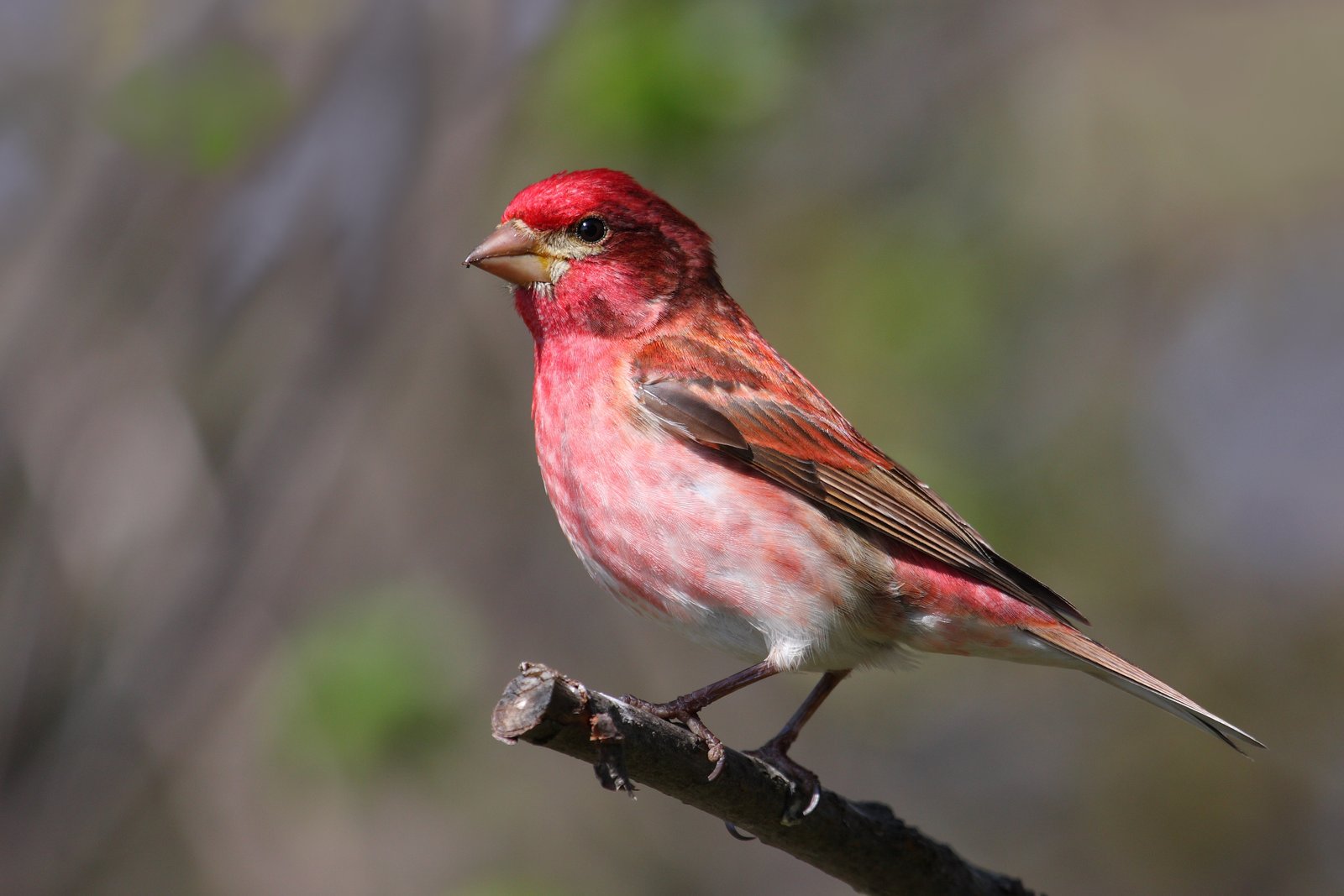
The Purple Finch is a stocky finch with a fairly large head and a short, notched tail. It breeds in the forests of Canada, the north-eastern United States and along the Pacific coast; it reaches the guide area only as a scarce winter visitor to north-western Mexico.
Voice
The song is a rapid, flowing, melodious warble without a descending ending. The call is a short, dry pik or tek, often given in flight.
Recording: Ed Pandolfino — CC BY-NC-SA 4.0 · shortened to the first 60 s, mono · xeno-canto
Identification
14–16 cm. Stocky, with a conical bill and a short tail with a distinct notch. The male is raspberry to pinkish red over the head, breast, back and rump, brightest on the crown; the back is faintly streaked, the belly white and the flanks barely streaked. The female is brown with a bold head pattern: a white supercilium, a dark cheek patch and a dark malar stripe. The underparts are white with broad, blurry brown streaks; the undertail coverts are unstreaked.
Confusion species
House Finch Haemorhous mexicanus is slimmer and longer-tailed; the male has the red restricted to the head, breast and rump and has brown-streaked flanks, and the female has a plain head. Cassin's Finch Haemorhous cassinii is larger, with a longer, straighter bill and longer wings; the male has a sharply defined red crown contrasting with a brown nape, and the female is more finely and crisply streaked, including on the undertail coverts.
Habitat
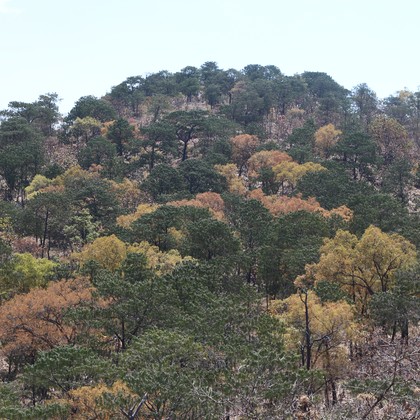
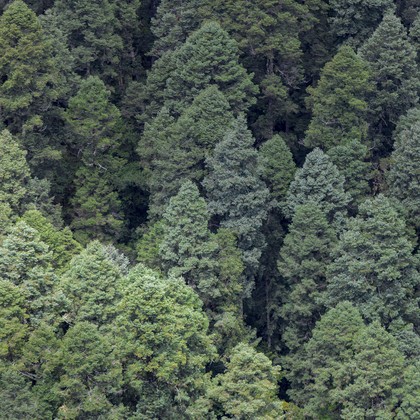
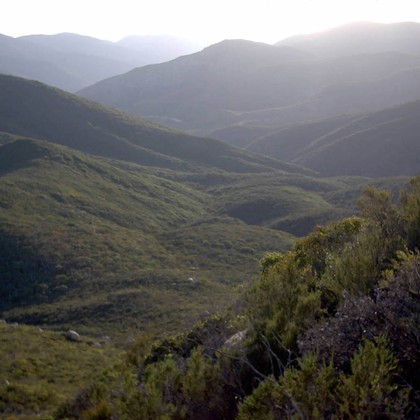
In winter forests and forest edges in lowlands and foothills, oak woodland, riparian woodland, chaparral and gardens with fruiting shrubs. It searches for seeds, buds and berries in trees and shrubs, sometimes on the ground.
Where the bird is most at home, classified by the vegetation units of Mexico and Central America.


Range and movements
Breeds in Canada, the north-eastern United States and along the Pacific coast from British Columbia to California. Winters mainly in the eastern United States and in California. In the guide area a scarce and irregular winter visitor to northern Baja California; exceptional elsewhere in northern Mexico.
- Resident
- Winter visitor (c. Oct–Mar)
- dark = core range, pale = thinly spread
How and when to look
Females can be recognised in winter by the white supercilium and dark cheek patch; the dry pik in flight differs from the chirping of House Finch.
Conservation status
Not threatened (LC). Widespread in North America, but it has declined in the east, possibly through competition with the introduced House Finch. In the guide area a scarce winter visitor.
Scientific name
Haemorhous purpureus | (Gmelin, 1789)
Gmelin described the species in 1789 as Fringilla purpurea; because it was later moved to another genus, the author and year stand in brackets. The genus Haemorhous was introduced in 1837 by Swainson. Haemorhous comes from the Greek haimorrhoos 'bleeding', from haima 'blood' and rhoos 'stream', after the red plumage of the males. purpureus is Latin for 'purple', after the male's wine-red plumage. The specimen the first description was based on came from South Carolina, USA.