All species › Passerines › Finches, euphonias and allies › Red Crossbill
Position in the tree Birds Aves › Birds with a flexible palate Neognathae › All other modern birds Neoaves › Landbirds Telluraves › Falcons, parrots and passerines Australaves › Falcons and passerines Eufalconimorphae › Parrots and passerines Psittacopasserae
Red Crossbill | Loxia curvirostra
Kruisbek | Piquituerto común
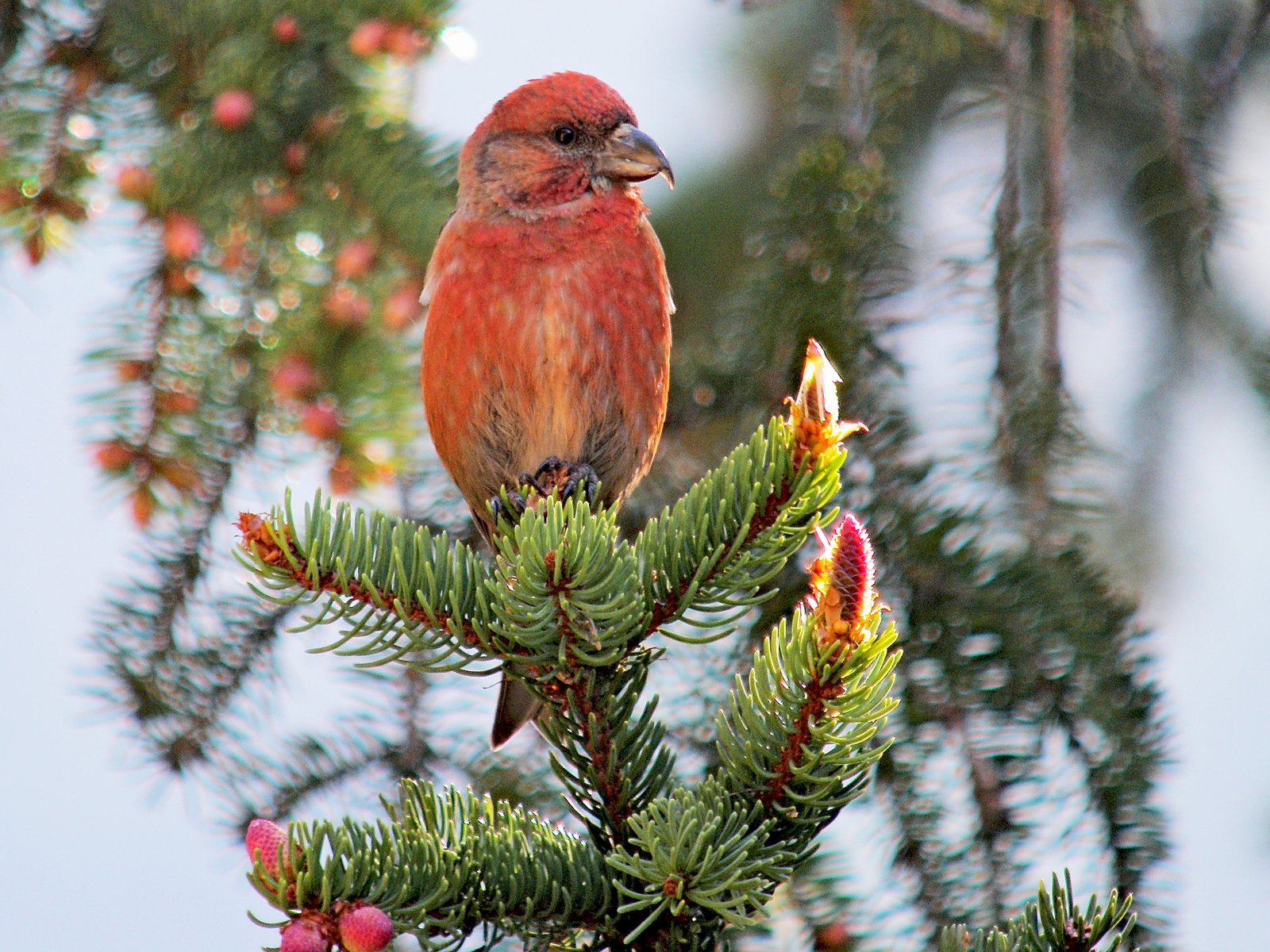
The Red Crossbill is a stocky finch with crossed bill tips, which it uses to extract seeds from pine cones. It occurs in the conifer forests of the whole northern hemisphere; in the guide area it lives in the pine forests of the mountains from Mexico to northern Nicaragua and in the pine savannas of Belize, Honduras and Nicaragua.
Voice
The call is a hard, metallic kip-kip or jip-jip, mainly in flight; the sound differs between populations and call types. The song is a series of repeated call notes, trills and warbling notes.
Recording: Stanislas Wroza — CC BY-NC-SA 4.0 · converted to mono · xeno-canto
Identification
14–17 cm. Stocky, with a large head, a short, notched tail and a heavy bill whose tips cross. The male is brick-red to orange-red, brightest on the head and rump, with dark brown wings without wing bars. The female is greyish green to olive-yellow, with a yellower rump and the same dark wings. Juveniles are brown and heavily streaked. Size and bill thickness vary between populations; birds in the mountains of Mexico have a fairly large bill.
Confusion species
The crossed bill means it cannot be confused with any other species in the guide area, although this feature is not always visible at a distance. Males of House Finch Haemorhous mexicanus and Cassin's Finch Haemorhous cassinii are smaller, have an ordinary conical bill and a white, streaked or pale belly.
Habitat
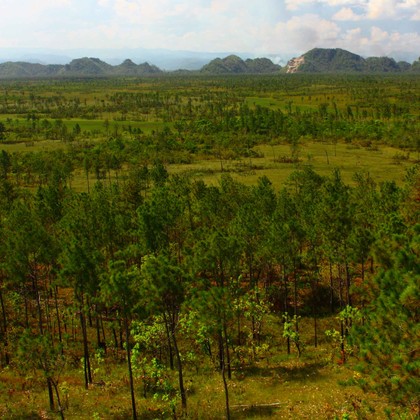
Pine and pine-oak forest in the mountains, and pine savanna in the lowlands of Belize, Honduras and Nicaragua. It depends on ripe pine cones, lives in flocks that wander to where the seed crop is good, and breeds in almost any month when food is plentiful. It drinks regularly and then comes to pools and streams.
Where the bird is most at home, classified by the vegetation units of Mexico and Central America.



Range and movements
Widespread in the conifer forests of Europe, Asia, North Africa and North America. In the guide area a resident in the Sierra San Pedro Mártir in Baja California, the Sierra Madre Occidental and Oriental, the mountains of central and southern Mexico and Chiapas, and further south in the pine forests of Guatemala, Belize, El Salvador, Honduras and northern Nicaragua.
- Resident
- dark = core range, pale = thinly spread
How and when to look
Flocks are often first detected by their hard flight call; in pine forest, watch for falling cone scales beneath birds feeding high in the canopy.
Conservation status
Not threatened (LC). Very widespread. In the guide area it is locally numerous, but depends on pine forests that are shrinking through logging, forest fires and conversion to farmland.
Scientific name
Loxia curvirostra | Linnaeus, 1758
Linnaeus described the species in 1758 and placed it straight away in the genus where it still stands. He introduced the genus Loxia in that same work. Loxia comes from Ancient Greek loxos 'crosswise', after the crossed tips of the bill. curvirostra is Latin for 'curved bill', from curvus 'bent' and rostrum 'bill'. The specimen the first description was based on came from Sweden.