All species › Pigeons and doves › Doves and pigeons › Grey-chested Dove
Position in the tree Birds Aves › Birds with a flexible palate Neognathae › All other modern birds Neoaves › Doves, turacos and allies Columbaves › Doves and sandgrouse Columbimorphae
Grey-chested Dove | Leptotila cassinii
Cassins duif | Paloma pecho gris
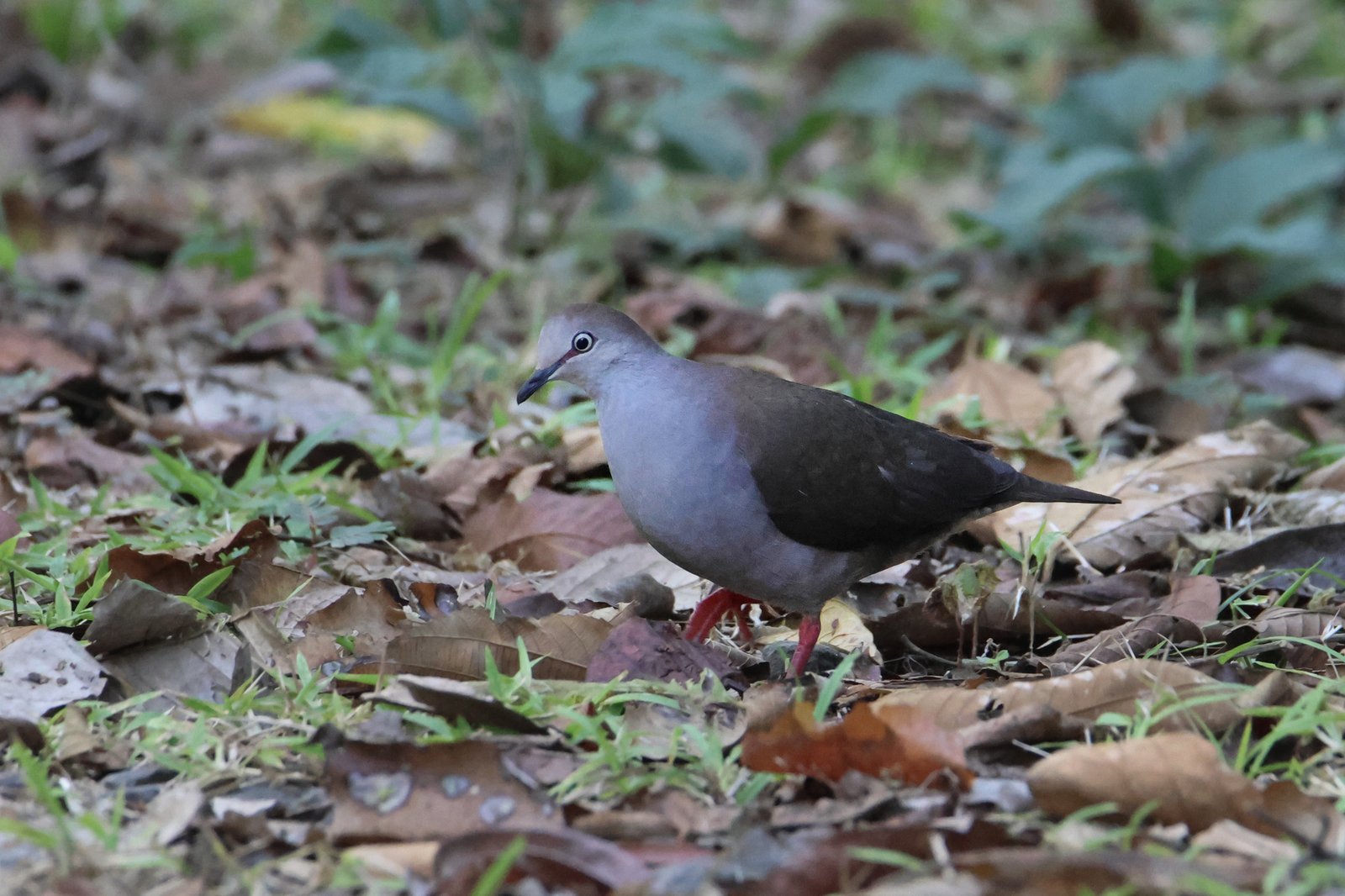
The Grey-chested Dove is a dark ground dove of humid lowland forest, from south-eastern Mexico to northern Colombia. It lives hidden on the forest floor and is noticed mainly by its long, mournful call. A grey breast and head separate it from the other doves of the genus Leptotila.
Voice
A long, low, mournful whistle of about two seconds that slowly drops a little and fades, whoooooooo, without the grace note of White-tipped Dove. The call is repeated at long intervals from the forest floor or a low branch.
Recording: Johan Chaves — CC BY-NC-SA 4.0 · converted to mono · xeno-canto
Identification
24–26 cm. A fairly small, stocky ground dove with a short, rounded tail. The forehead is pale grey, the crown, hindneck and breast grey; the belly is white. The back, wings and tail are dark olive-brown, the outer tail feathers with narrow white tips. The eye is yellow to orange, surrounded by bare red skin; the legs are red. The underwing is rufous. Birds in south-western Costa Rica and western Panama (L. c. rufinucha) have a rufous hindneck. The sexes are alike.
Confusion species
White-tipped Dove Leptotila verreauxi is paler brown, with a pinkish-buff breast and more white in the tail, and lives in drier, more open country. Grey-headed Dove Leptotila plumbeiceps has a blue-grey crown and nape but a pinkish-buff breast. Ruddy Quail-Dove Geotrygon montana is rufous-brown with a pale stripe below the eye. Olive-backed Quail-Dove Leptotrygon veraguensis is dark with a conspicuous white stripe below the eye.
Habitat
The floor of humid lowland and foothill forest, tall second growth, forest edges and shady cacao and banana plantations, from sea level to about 1000 m. Lives alone or in pairs and walks quietly over the leaf litter in search of seeds, fallen fruit and small invertebrates. The nest is a platform of twigs in a shrub or low tree.
Where the bird is most at home, classified by the vegetation units of Mexico and Central America.





Range and movements
The Caribbean lowlands from south-eastern Mexico (Chiapas) through Guatemala, southern Belize, Honduras and Nicaragua to Costa Rica and western Panama (L. c. cerviniventris). In south-western Costa Rica and in Chiriquí on the Pacific side (L. c. rufinucha), and from central Panama to Darién (L. c. cassinii). Absent from El Salvador. Outside the guide area in northern Colombia.
- Resident
- dark = core range, pale = thinly spread
How and when to look
Look on quiet forest trails early in the morning, for example at La Selva and in Corcovado in Costa Rica and along Pipeline Road in Panama. A bird often walks ahead along the trail and then slips silently into the undergrowth; the call gives the species away more often.
Conservation status
Not threatened. Locally fairly common in larger forest tracts. As a forest-floor bird it disappears where lowland forest is cleared, but it persists in second growth and shady plantations.
Scientific name
Leptotila cassinii | Lawrence, 1867
Lawrence described the species in 1867 and placed it straight away in the genus where it still stands. The genus Leptotila was introduced in 1837 by Swainson. Leptotila is Greek, from leptos 'slender' and ptilon 'feather', after the abruptly narrowed outermost primary. cassinii honours the American ornithologist John Cassin (1813–1869). The specimen the first description was based on came from along the Panama Railroad, Panama.