All species › Swifts › Hummingbirds › Calliope Hummingbird
Position in the tree Birds Aves › Birds with a flexible palate Neognathae › All other modern birds Neoaves › Birds of the elements Elementaves › Nightjars and swifts Strisores
Calliope Hummingbird | Selasphorus calliope
Calliopekolibrie | Colibrí garganta rayada
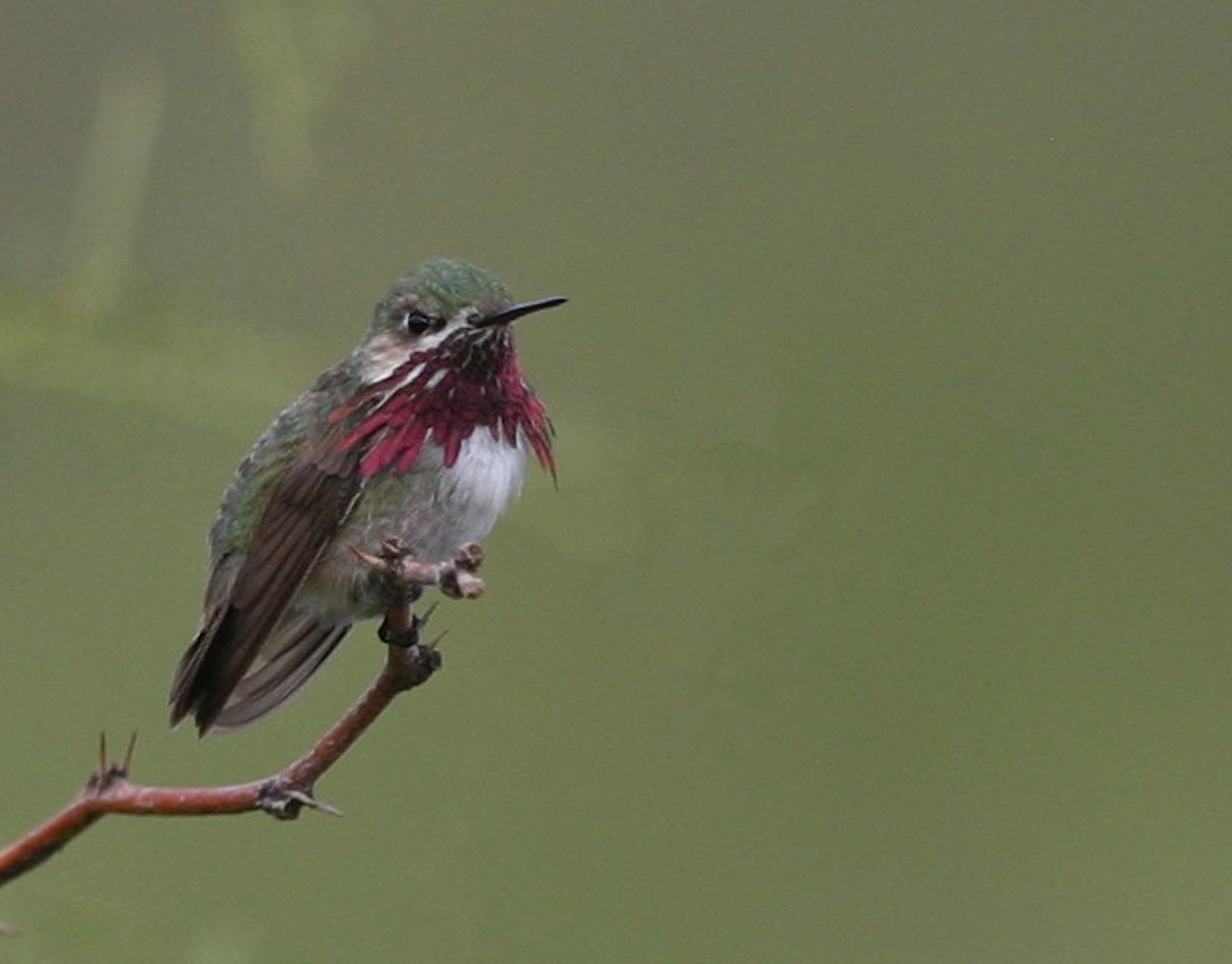
The Calliope Hummingbird is the smallest bird that breeds in Canada and the United States. Almost the entire world population winters in western Mexico, mainly in Jalisco and Nayarit. A small number breed in the high conifer forests of northern Baja California.
Voice
Rather silent. The call is a soft, high tsip. In the display dive the male makes a short, dry buzzing pzzt with its wings and tail, followed by a high tsee-ee.
Recording: Don Profota — CC BY-NC-SA 4.0 · converted to mono · xeno-canto
Identification
7–8 cm, with a short, thin, straight black bill and a short tail; at rest the wing tips reach beyond the tail tip. The male is green above and whitish below with greenish flanks; the white throat has long, narrow magenta streaks that form a streaked, flaring gorget. The female is green above, with a pale throat finely spotted dark, a pale peach-buff wash on the breast and flanks and little rufous at the base of the tail. The pale lores and short bill give the head a soft look.
Confusion species
Females of Rufous Hummingbird Selasphorus rufus and Allen's Hummingbird Selasphorus sasin are larger and longer-tailed, with more rufous on the flanks and much rufous at the base of the tail. Broad-tailed Hummingbird Selasphorus platycercus is larger and clearly longer-tailed. The female Bumblebee Hummingbird Selasphorus heloisa lives in more humid montane forest, has a cinnamon wash on the flanks and a rounded tail with a rufous base.
Habitat
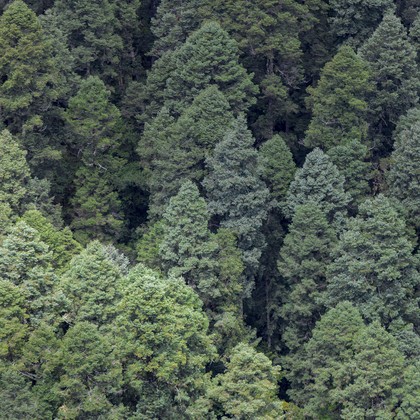
Breeds in open conifer forest, forest edges and flowery clearings in high mountains. In winter in pine-oak and dry forest at middle elevations, along forest edges, in scrub and in gardens with flowering plants; on migration also in mountain meadows. In the guide area mainly between about 500 and 3000 m.
Where the bird is most at home, classified by the vegetation units of Mexico and Central America.




Range and movements
Winters mainly in western Mexico, from Sinaloa through Nayarit and Jalisco to Colima and Michoacán, in smaller numbers to Guerrero, the State of México and Morelos. On spring migration mainly along the Pacific side, and in autumn through the Sierra Madre Occidental in Sonora, Chihuahua and Durango. Breeds in small numbers in the Sierra San Pedro Mártir and Sierra de Juárez in Baja California. Most of the breeding range lies in the western United States and south-western Canada.
- Winter visitor (c. Oct–Mar)
- dark = core range, pale = thinly spread
How and when to look
In winter at flowering shrubs and trees along forest edges in the mountains of Jalisco and Nayarit. The male can be recognised by its streaked throat, which opens like a fan when the feathers are raised.
Conservation status
Least Concern. The world population is fairly large and appears stable. In its wintering area the species depends on flower-rich forest at middle elevations in western Mexico.
Scientific name
Selasphorus calliope | (Gould, 1847)
Gould described the species in 1847 as Trochilus (Calothorax) Calliope; because it was later moved to another genus, the author and year stand in brackets. The genus Selasphorus was introduced in 1832 by Swainson. Selasphorus is Greek, from selas 'light, flame' and -phoros 'bearing': 'light-bearer', after the fiery, glittering throat. calliope refers to Calliope, the Greek muse of epic poetry; the name means 'beautiful voice'. The specimen the first description was based on came from Mexico.