All species › Swifts › Hummingbirds › Costa's Hummingbird
Position in the tree Birds Aves › Birds with a flexible palate Neognathae › All other modern birds Neoaves › Birds of the elements Elementaves › Nightjars and swifts Strisores
Costa's Hummingbird | Calypte costae
Costa's kolibrie | Colibrí cabeza violeta
Costa's Hummingbird is a small, short-tailed hummingbird of the deserts of north-western Mexico and the south-western United States. A large part of the world population lives in Baja California and Sonora. The species breeds mainly in late winter and spring, when the desert is in bloom, and partly leaves the driest areas in the summer heat.
Voice
The male sings a high, thin, swelling whistle, like see-sheeew, often from a perch in a shrub. The call is a light, ticking tik, rapidly repeated in chases. In display flight a long, high whistle is heard.
Recording: Ayala Berger — CC BY-NC-SA 4.0 · converted to mono · xeno-canto
Identification
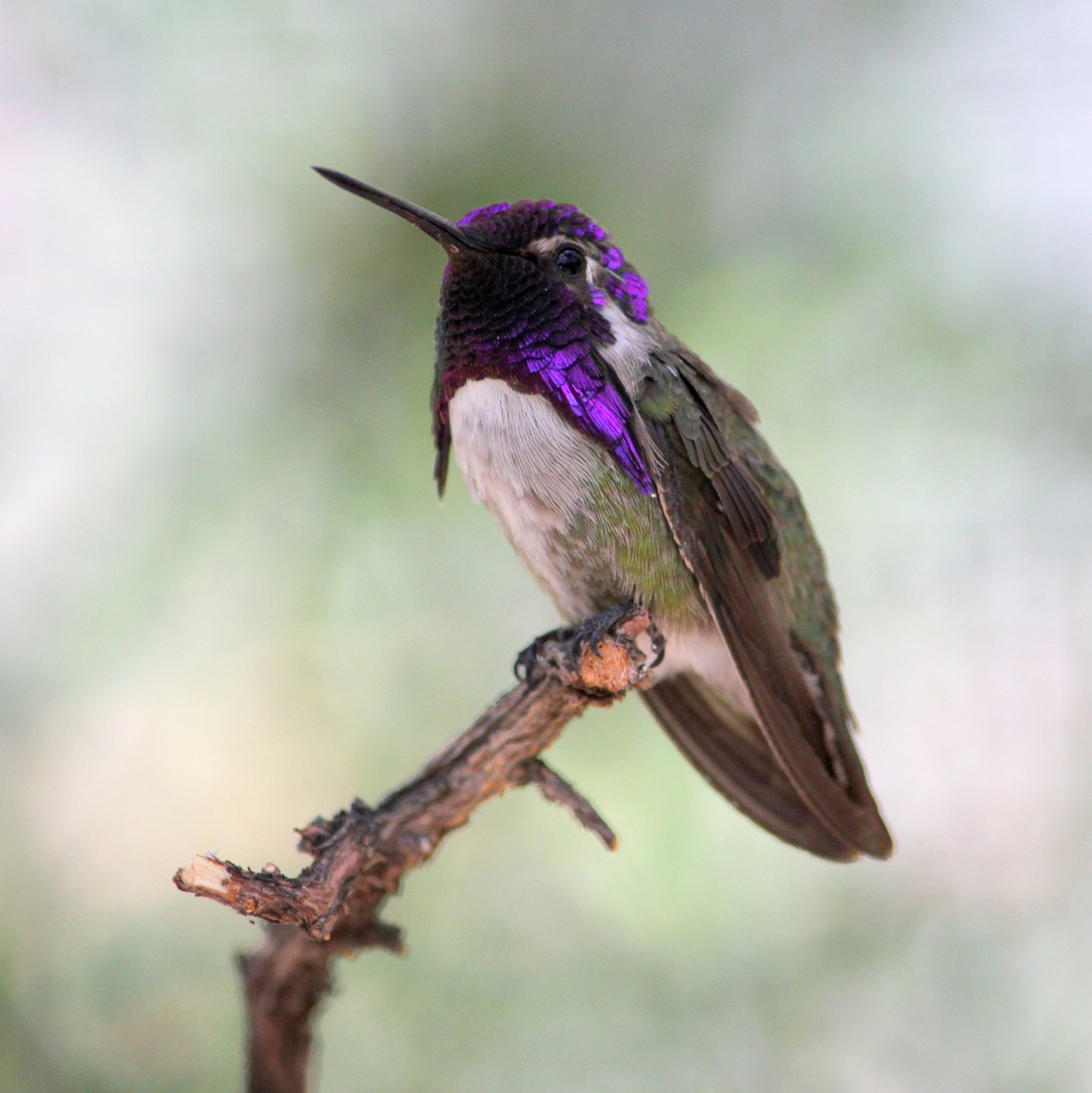
8–9 cm, with a fairly short, slightly decurved black bill and a short tail; at rest the wing tips reach to or beyond the tail tip. The male is green above, with a metallic purple crown and a purple throat whose corners project far down and to the sides; a white stripe runs behind the eye, the breast is white and the flanks are greenish. The female is green above and whitish below, with a pale supercilium, dark cheeks and sometimes a few purple feathers on the throat. Young birds resemble the female.
Confusion species
Anna's Hummingbird Calypte anna is larger and longer-tailed; the male has a rose-red crown and throat, the female is greyer below. Male Black-chinned Hummingbird Archilochus alexandri has a black throat with only a purple lower edge and no purple crown; females are longer-billed and pump their tails. Female Lucifer Sheartail Calothorax lucifer has a clearly decurved bill and a warm buff wash on the flanks.
Habitat
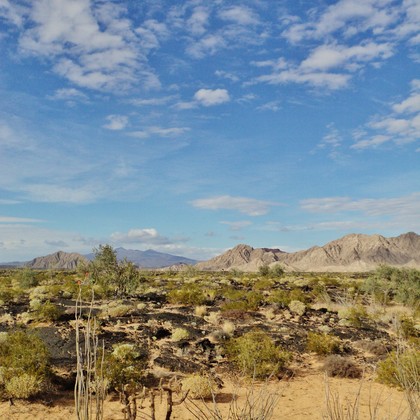
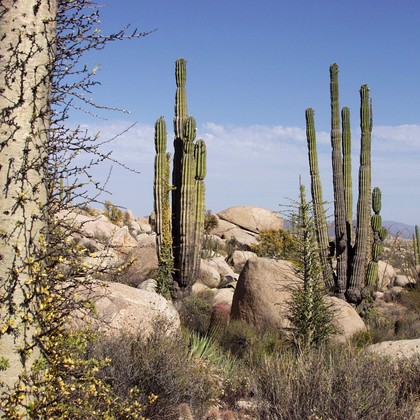
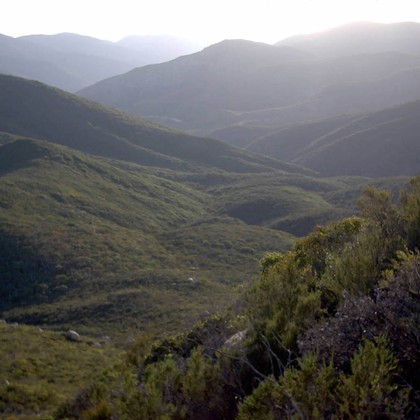
Desert scrub with cacti and ocotillo, dry washes with shrubs, thorn scrub, chaparral and gardens in dry regions, mainly from sea level to about 1500 m. In winter along the Pacific coast also in dry forest, scrub and lowland gardens.
Where the bird is most at home, classified by the vegetation units of Mexico and Central America.


Range and movements
Resident throughout almost all of Baja California and Baja California Sur, on the islands in the Gulf of California and in western Sonora. In winter also south along the Pacific coast through Sinaloa to Nayarit and Jalisco, in small numbers to Colima. Outside the guide area in the deserts of southern California, Arizona, southern Nevada and south-western Utah and New Mexico.
- Resident
- Summer visitor (c. Apr–Sep)
- Winter visitor (c. Oct–Mar)
- Passage (Mar–Apr, Oct–Nov)
- dark = core range, pale = thinly spread
How and when to look
In Baja California Sur at flowering shrubs and feeders in gardens and hotels, and in the desert scrub around La Paz and Los Cabos. From February to May the male sings much from the top of a shrub.
Conservation status
Least Concern. The world population is large and appears stable. The species depends on flowering desert scrub, which is disappearing locally through urban and agricultural expansion.
Scientific name
Calypte costae | (Bourcier, 1839)
Bourcier described the species in 1839 as Ornismya Costae; because it was later moved to another genus, the author and year stand in brackets. The genus Calypte was introduced in 1856 by Gould. Calypte comes from Greek kaluptē 'covered' or kaluptra 'veil', after the male's iridescent hood. costae honours the Savoyard marquis Louis Marie Pantaléon Costa de Beauregard (1806–1864), soldier, statesman, archaeologist and collector of hummingbirds. The specimen the first description was based on came from Magdalena Bay, Baja California Sur, Mexico.