All species › Passerines › Mockingbirds and thrashers › LeConte's Thrasher
Position in the tree Birds Aves › Birds with a flexible palate Neognathae › All other modern birds Neoaves › Landbirds Telluraves › Falcons, parrots and passerines Australaves › Falcons and passerines Eufalconimorphae › Parrots and passerines Psittacopasserae
LeConte's Thrasher | Toxostoma lecontei
Woestijnspotlijster | Cuitlacoche pálido
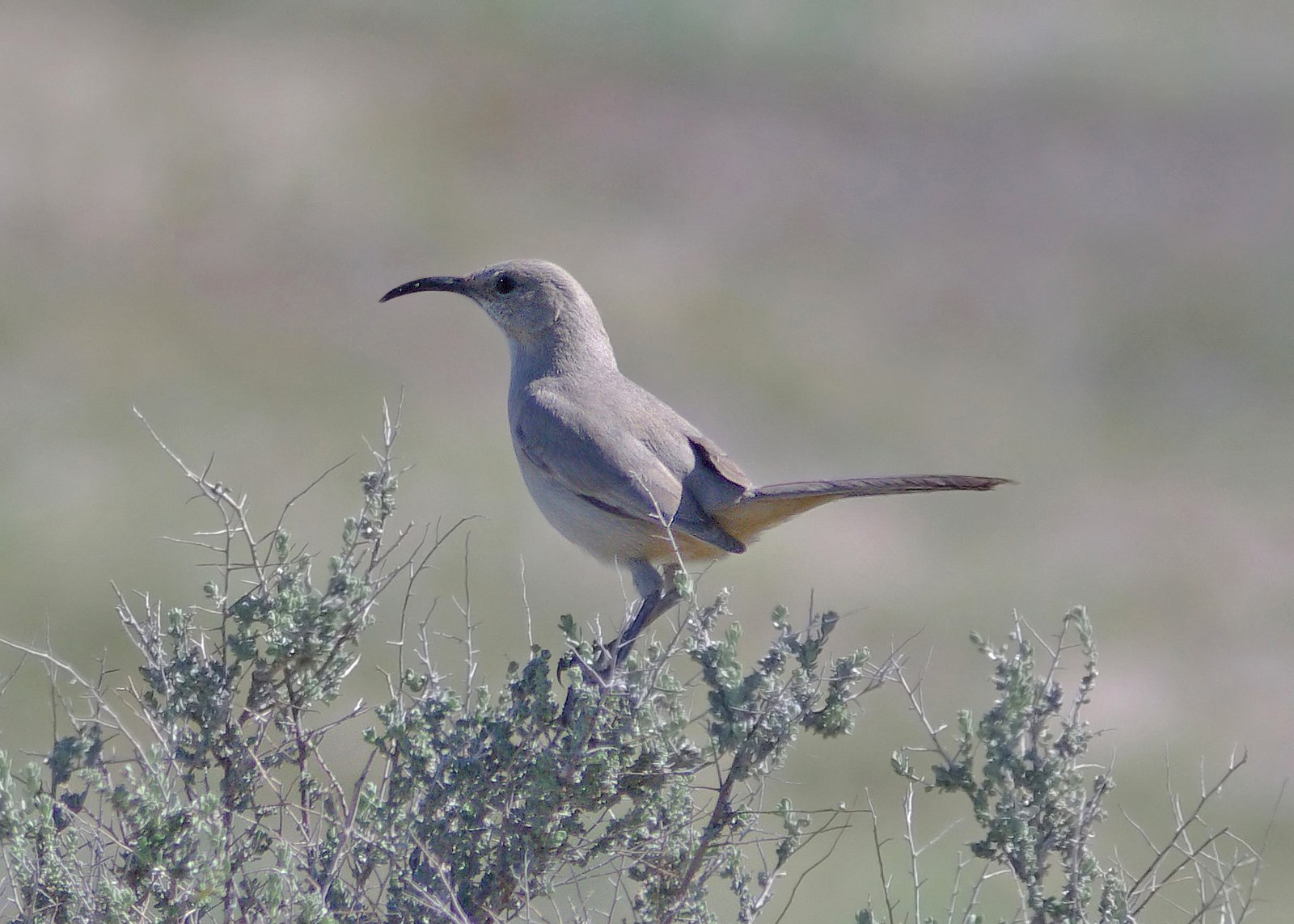
LeConte's Thrasher is the palest thrasher in the guide area, sandy like the bare desert floor on which it lives. It runs quickly between low shrubs with its tail cocked and seldom flies. In the guide area it occurs in north-western Sonora and on the Baja California peninsula.
Voice
A varied, soft and musical song of repeated phrases, often before sunrise and already in midwinter. Call a rising, whistled hoo-eep.
Recording: Scott Olmstead — CC BY-NC-SA 4.0 · shortened to the first 60 s, mono · xeno-canto
Identification
24–28 cm. Upperparts pale sandy grey, underparts paler still, without spots; undertail warm buff. Tail long and dark, contrasting with the pale body. Eye dark. Bill long, black and clearly decurved. A faint dark malar stripe. The sexes are alike.
Confusion species
Crissal Thrasher Toxostoma crissale is darker greyish brown, with a rufous undertail and a clearer malar stripe, and lives in denser scrub. Curve-billed Thrasher Toxostoma curvirostre and Bendire's Thrasher Toxostoma bendirei are darker, with breast spots and an orange or yellow eye. Grey Thrasher Toxostoma cinereum has black-spotted underparts.
Habitat
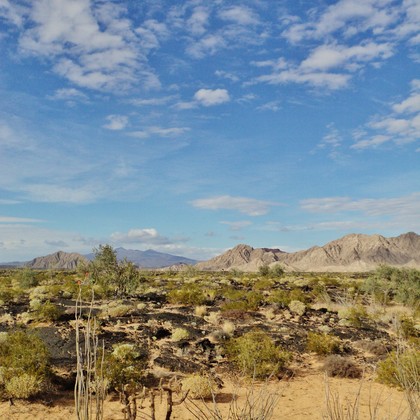
Very open, dry desert with scattered low shrubs such as creosote bush and saltbush, on sandy flats, in dry washes and on gently sloping plains; avoids dense vegetation. It forages on the ground for insects, spiders and small reptiles and digs in the sand with its bill.
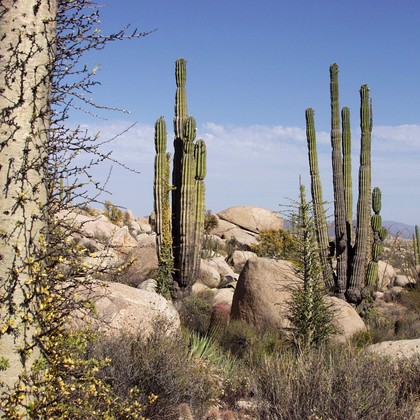
Where the bird is most at home, classified by the vegetation units of Mexico and Central America.
Range and movements
Deserts of the south-western United States (southern California, southern Nevada, extreme south-western Utah and western and southern Arizona). In the guide area in north-western Sonora, north-eastern Baja California and the Vizcaíno Desert in the middle of the peninsula.
- Resident
- dark = core range, pale = thinly spread
How and when to look
Best found early in the morning in late winter and spring, when it sings from the top of a low shrub. A running bird can often be followed only by keeping some distance and waiting until it stops again.
Conservation status
Not threatened (LC). It occurs at low densities and is sensitive to the loss of open desert to agriculture, development and off-road vehicles.
Scientific name
Toxostoma lecontei | Lawrence, 1851
Lawrence described the species in 1851 and placed it straight away in the genus where it still stands. The genus Toxostoma was introduced in 1831 by Wagler. Toxostoma is Greek, from toxon 'bow' and stoma 'mouth', after the long, curved bill. lecontei honours the American entomologist John Lawrence LeConte (1825–1883), who collected the first specimens near the mouth of the Gila. The specimen the first description was based on came from Fort Yuma, at the Gila–Colorado confluence, California.