All species › Parrots › African and New World parrots › Burrowing Parrot
Position in the tree Birds Aves › Birds with a flexible palate Neognathae › All other modern birds Neoaves › Landbirds Telluraves › Falcons, parrots and passerines Australaves › Falcons and passerines Eufalconimorphae › Parrots and passerines Psittacopasserae
Burrowing Parrot | Cyanoliseus patagonus
Holenparkiet | Loro barranquero
The Burrowing Parrot is a vagrant of human origin in the guide area: it does not occur here naturally. Records involve escaped or released cage birds; a small group has been reported regularly in Tijuana, Baja California, since 2021 (isolated reports go back to 2011). In its native range it breeds in colonies, in burrows that it digs into steep banks and cliffs in Argentina and Chile.
Voice
Loud, harsh and shrill: a hard, grating kree-ah, often repeated in flight. Groups are very noisy.
Recording: Paul Marvin — CC BY-NC-SA 4.0 · converted to mono · xeno-canto
Identification
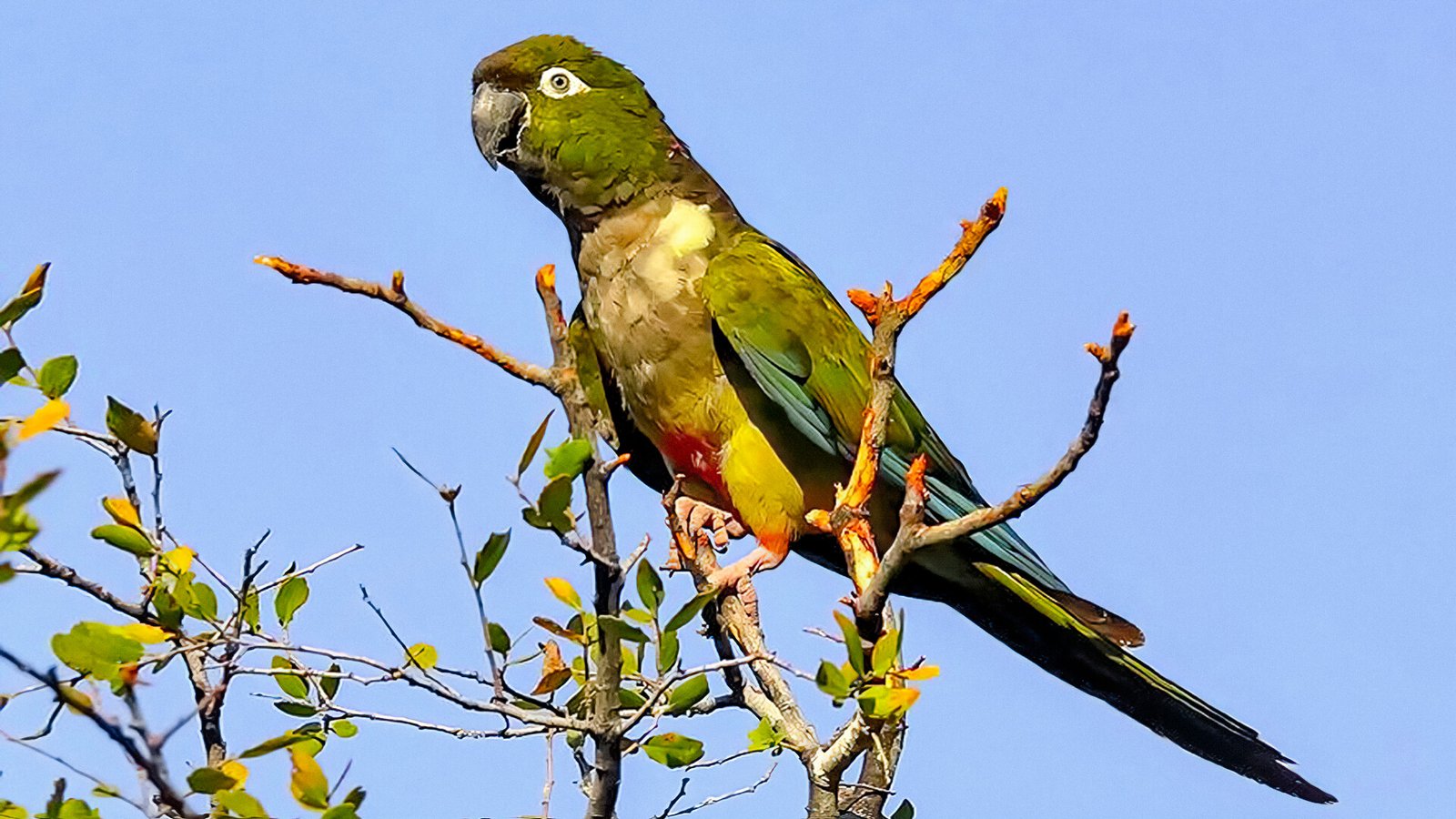
45 cm, with a long, graduated tail. The head, neck and upperparts are olive-brown, the throat and breast greyish brown with a whitish patch on each side of the breast. The lower back, rump and belly are yellow, with an orange-red patch in the centre of the belly and orange thighs. The flight feathers are blue, the tail olive-green with a blue wash. It has a bare white eye-ring; the bill is dark grey. The sexes are almost alike.
Confusion species
The olive-brown colour, yellow rump and belly and red belly patch rule out confusion with any parakeet of the guide area. Monk Parakeet Myiopsitta monachus, also introduced, is smaller and green, with a grey face and breast.
Habitat
In the guide area in city parks and residential districts with large trees and palms. In its native range in dry, open country with scrub and grassland, with steep banks, ravines and cliffs for the nest burrows. It eats seeds, fruit and berries, also in fields.
Where the bird is most at home, classified by the vegetation units of Mexico and Central America.


Range and movements
In the guide area mainly in Tijuana (Baja California), with scattered records elsewhere, including Mexico City, Querétaro and Oaxaca. Native to Argentina and Chile.
How and when to look
In Tijuana in parks and residential areas around the Hipódromo and the Parque de las Américas; the group gives itself away by its loud screeching.
Conservation status
Not globally threatened, but in Argentina it has declined locally through trapping for the cage-bird trade and persecution as a crop pest. The Tijuana group is small; whether it will persist is unclear.
Scientific name
Cyanoliseus patagonus | (Vieillot, 1818)
Vieillot described the species in 1818 as Psittacus patagonus; because it was later moved to another genus, the author and year stand in brackets. The genus Cyanoliseus was introduced in 1854 by Bonaparte. Cyanoliseus is Greek, from kuanos 'dark blue' and halusis 'chain', after the bluish-white band across the breast. patagonus means 'Patagonian', after Azara's name 'Maracaná Patagón', as the bird was said to migrate from Patagonia. The specimen the first description was based on came from Buenos Aires, Argentina.