All species › Passerines › Sapayoa › Sapayoa
Position in the tree Birds Aves › Birds with a flexible palate Neognathae › All other modern birds Neoaves › Landbirds Telluraves › Falcons, parrots and passerines Australaves › Falcons and passerines Eufalconimorphae › Parrots and passerines Psittacopasserae
Sapayoa | Sapayoa aenigma
Breedbekmanakin | Sapayoa
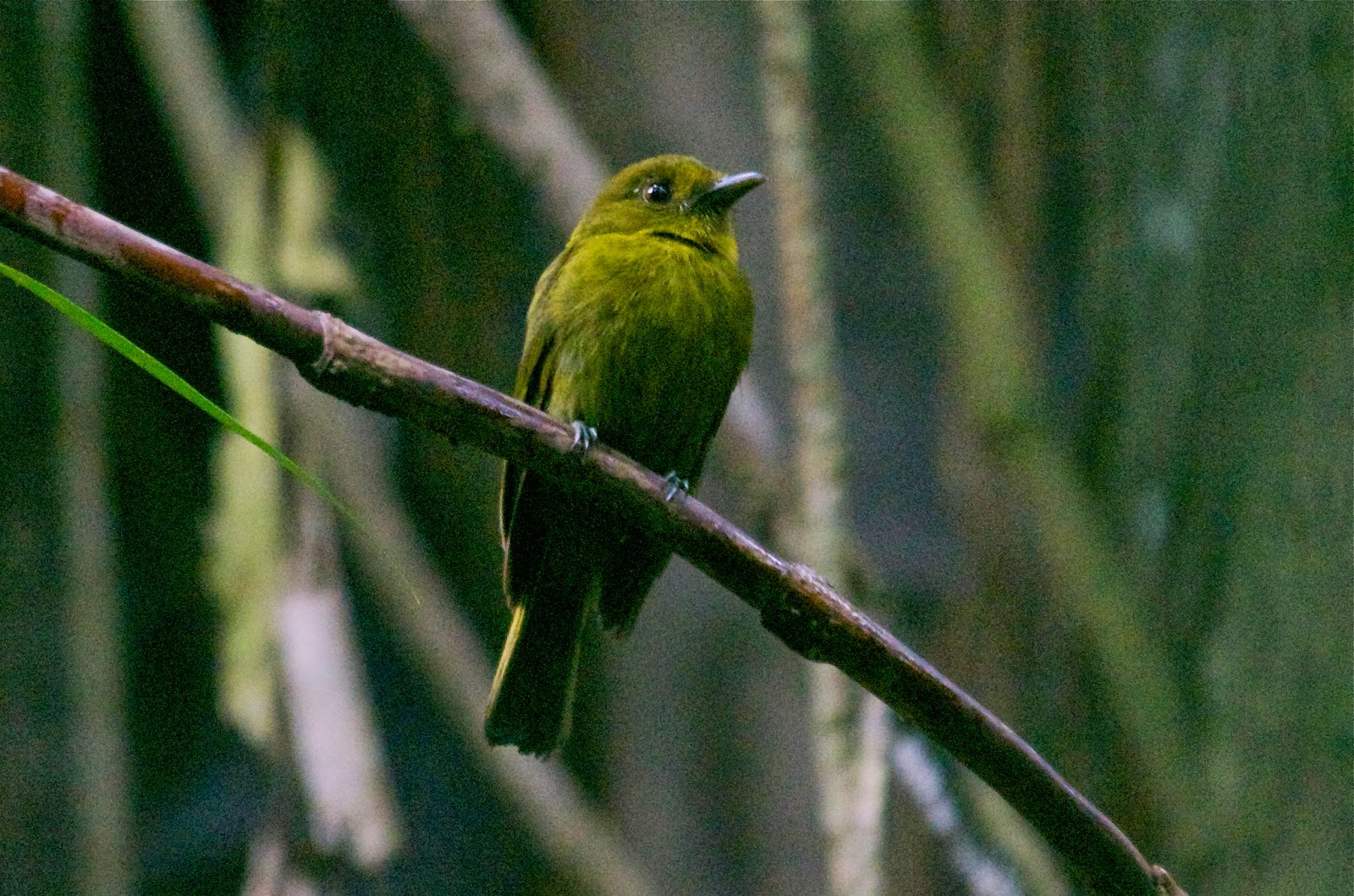
The Sapayoa is a plain olive-green songbird of the understorey of humid lowland forest, with a broad, flat bill. It was long placed with the manakins, but it is the only species of the family Sapayoidae and the only American relative of the broadbills and asities of the Old World. In the guide area it occurs only in eastern Panama.
Voice
Usually silent. A soft, nasal, rattling trill and a short chip.
Recording: Andrew Spencer — CC BY-NC-SA 3.0 · converted to mono · xeno-canto
Identification
15 cm. Fairly slim, with a large head, a broad, flat bill rounded at the tip, and a tail long for a manakin. Upperparts plain olive-green, wings and tail slightly darker without wing bars. Throat and underparts yellowish olive, yellowest in the centre of the belly. The male has a concealed yellow crown stripe that is rarely visible; the female lacks it. Bill dark with a paler lower mandible, legs grey.
Confusion species
Female manakins are smaller, with a shorter tail and a small, narrow bill. Western Olivaceous Flatbill Rhynchocyclus aequinoctialis has an even broader bill, a pale eye-ring and yellow edges to the flight feathers, and perches upright. Ochre-bellied Flycatcher Mionectes oleagineus has an ochre belly and a narrow bill, and constantly flicks one wing.
Habitat
Understorey and lower mid-storey of humid, mature lowland and foothill forest up to about 1000 m, often in shady ravines and along streams. It sits still for long periods and sallies to take insects from leaves; it often joins mixed understorey flocks. The pear-shaped nest, with a side entrance, hangs from a branch over a stream.
Where the bird is most at home, classified by the vegetation units of Mexico and Central America.



Range and movements
Eastern Panama: mainly Guna Yala, Darién and eastern Panamá province, with a few records farther west in Panamá and Colón provinces. Outside the guide area in western Colombia to north-western Ecuador.
- Resident
- dark = core range, pale = thinly spread
How and when to look
Most often reported along the El Llano–Cartí road at Nusagandi and around Cana in Darién. Best found by checking mixed understorey flocks along streams in mature forest.
Conservation status
Not threatened. Scarce and seldom noticed; it depends on large tracts of unbroken humid forest, which are shrinking in eastern Panama through clearance for cattle ranching.
Scientific name
Sapayoa aenigma | Hartert, 1903
Hartert described the species in 1903 and placed it straight away in the genus where it still stands. He introduced the genus Sapayoa in that same work. Sapayoa is named after the Río Sapayo (now Río Zapallo Grande) in Esmeraldas, Ecuador, where the type specimen was collected. aenigma is Latin (from Greek ainigma) for 'riddle', after this bird's long-puzzling relationships. The specimen the first description was based on came from Río Zapallo Grande, Esmeraldas, Ecuador.