All species › Parrots › African and New World parrots › Brown-hooded Parrot
Position in the tree Birds Aves › Birds with a flexible palate Neognathae › All other modern birds Neoaves › Landbirds Telluraves › Falcons, parrots and passerines Australaves › Falcons and passerines Eufalconimorphae › Parrots and passerines Psittacopasserae
Brown-hooded Parrot | Pyrilia haematotis
Roodoorpapegaai | Loro cabeza oscura
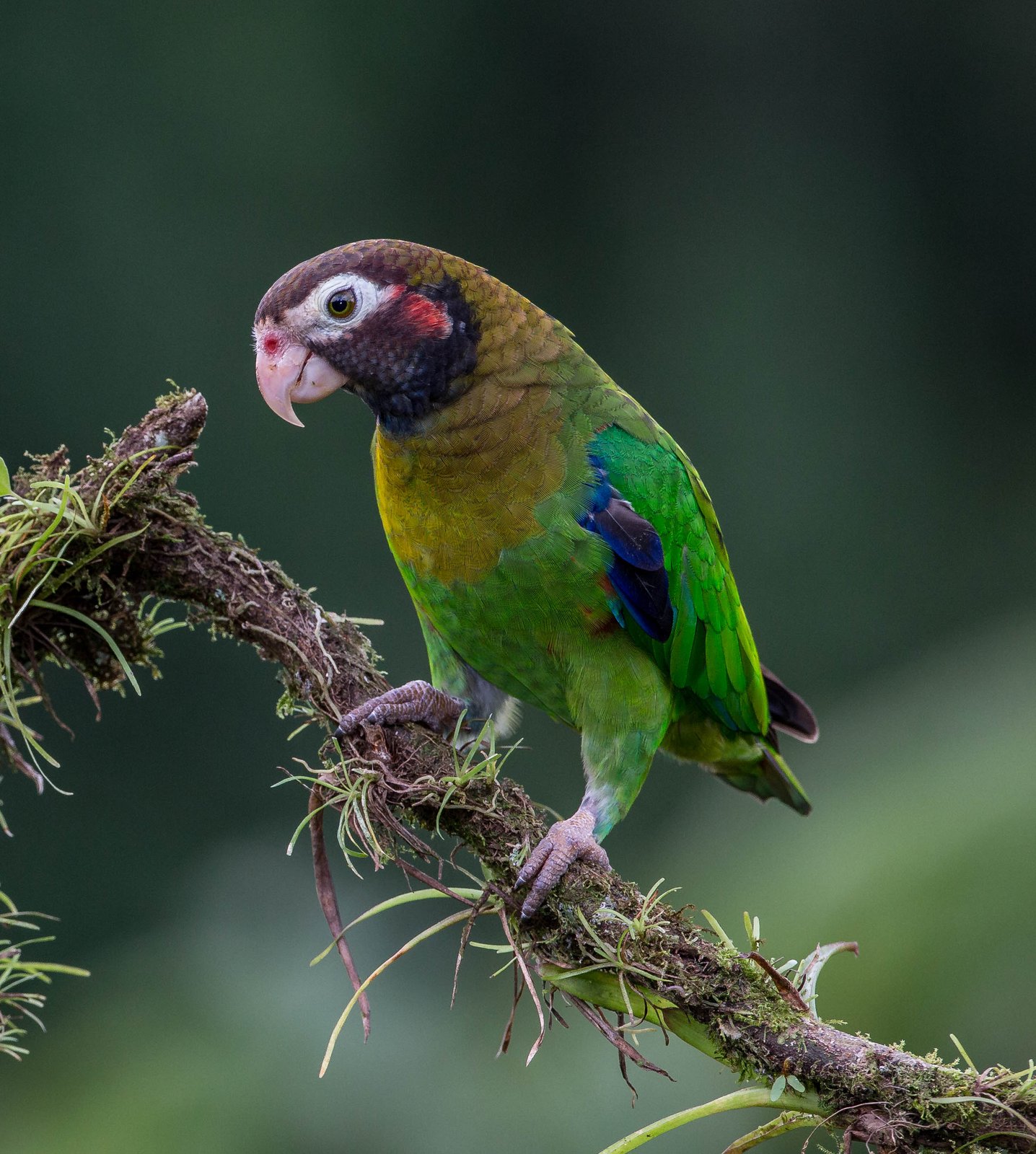
The Brown-hooded Parrot is a medium-sized, stocky parrot with a short tail, a dark, brownish-grey head and a red ear patch. It lives in small groups in the canopy of humid lowland and foothill forest from southern Mexico to Panama, mainly on the Caribbean side, and stands out in flight by its red underwing.
Voice
A high, sharp kreek or cheek and a softer, nasal chuk, often repeated in flight; perched groups give a soft chatter.
Recording: Iván Lau — CC BY-NC-SA 4.0 · converted to mono · xeno-canto
Identification
21 cm. Stocky, with a short, square tail. The head is dark brownish grey with a red patch on the ear coverts and a bare white ring around the eye; the throat and breast are olive-brown, the rest of the body green. The primaries are blue. In flight the red axillaries and underwing coverts are clearly visible. In the female the ear patch is smaller and duller. Birds from eastern Panama (P. h. coccinicollaris) have a red band on the throat. Flight fast with deep wingbeats, in pairs or groups of five to fifteen.
Confusion species
Saffron-headed Parrot Pyrilia pyrilia, in the guide area only in eastern Panama, has a bright yellow head. White-crowned Parrot Pionus senilis has a white crown and throat, a blue head and breast and red undertail coverts. Blue-headed Parrot Pionus menstruus has a blue head with a black ear patch. Both Pionus species lack the red underwing.
Habitat
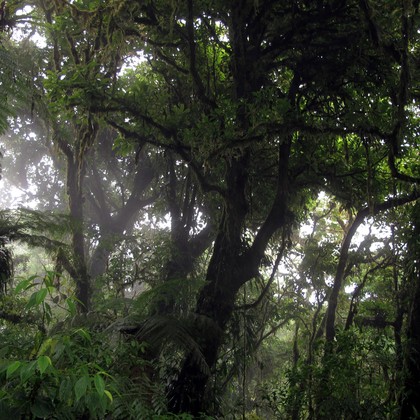
Humid lowland and foothill forest, forest edges and tall secondary forest, locally also shade coffee and cacao and lower cloud forest; from sea level to about 1200 m, sometimes higher. Outside the breeding season birds descend from the slopes to the lowlands. It eats fruit, seeds and flowers in the canopy. It nests in a tree cavity.
Where the bird is most at home, classified by the vegetation units of Mexico and Central America.





Range and movements
From southern Veracruz, northern Oaxaca, Tabasco and Chiapas and the southern Yucatán Peninsula (Campeche, Quintana Roo) through Belize, Guatemala, Honduras and Nicaragua to Costa Rica and Panama; in the north mainly on the Caribbean side, in Costa Rica and Panama also on the Pacific side. Outside the guide area in northwestern Colombia.
- Resident
- dark = core range, pale = thinly spread
How and when to look
In Costa Rica and Belize groups fly fast and low over the forest in the early morning; in flight the red underwing is the best feature. Perched in a fruiting tree they are quiet and blend into the foliage.
Conservation status
Not threatened. Declining locally through deforestation and trapping for the cage-bird trade.
Scientific name
Pyrilia haematotis | (Sclater & Salvin, 1860) (GBIF: Pionopsitta haematotis)
Sclater & Salvin described the species in 1860 as Pionus haematotis; because it was later moved to another genus, the author and year stand in brackets. The genus Pyrilia was introduced in 1856 by Bonaparte. Pyrilia comes from the species name pyrilia: Greek pur 'fire' and Latin ilia 'flanks', after the orange-red underwing and flanks. haematotis is Greek, from haima 'blood' and ous, ōtos 'ear', after the red ear patch. The specimen the first description was based on came from Verapaz, Guatemala.