All species › Passerines › Cardinals and allies › Blue Seedeater
Position in the tree Birds Aves › Birds with a flexible palate Neognathae › All other modern birds Neoaves › Landbirds Telluraves › Falcons, parrots and passerines Australaves › Falcons and passerines Eufalconimorphae › Parrots and passerines Psittacopasserae
Blue Seedeater | Amaurospiza concolor
Indigodikbekje | Semillero azulgris
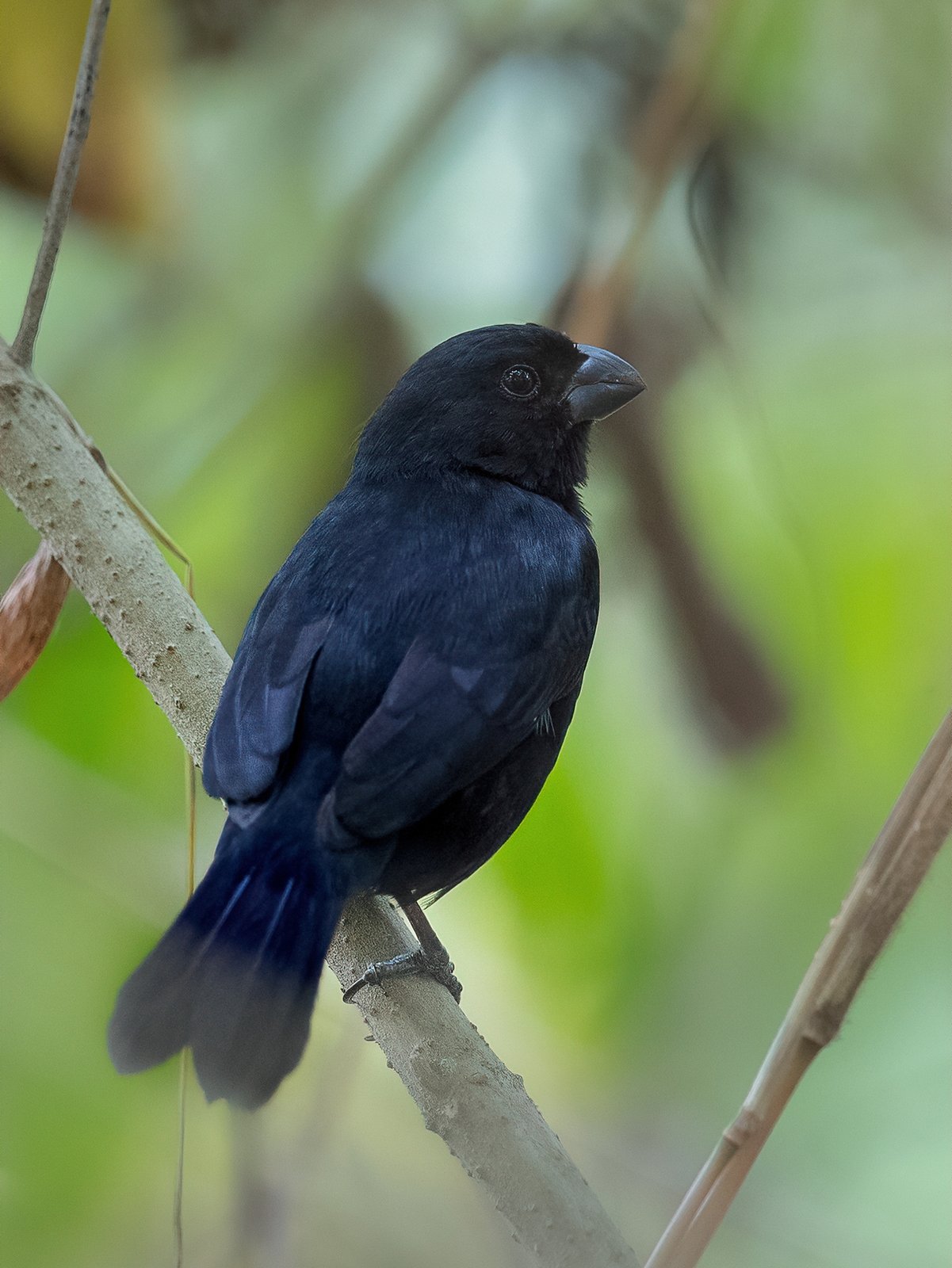
The Blue Seedeater is a small, shy bird of bamboo thickets in montane forest. The male is uniform dark slate blue, the female warm brown. In the guide area the species is rare and very local and often appears where bamboo is flowering and setting seed, only to disappear again afterwards.
Voice
The song is a short, high and clear series of whistled notes, ending in a soft trill. The call is a sharp, metallic tsik.
Recording: Manuel Grosselet — CC BY-NC-SA 4.0 · converted to mono · xeno-canto
Identification
12–13 cm. Short, thick conical bill, blackish in the male, greyish in the female. The male is uniform dark slate blue to indigo, slightly brighter on the forehead and above the eye, with blackish lores; wings and tail are dark with blue edges. The female is uniform warm rufous brown to cinnamon brown, paler below, without streaks or wing bars.
Confusion species
Slaty Finch Haplospiza rustica, also a bird of montane bamboo, has a more pointed bill; the male is grey without a blue tint and the female is olive brown with faint streaks. Slate-colored Seedeater Sporophila schistacea is grey with a white wing patch and, in the male, a yellow bill. Blue Bunting Cyanocompsa parellina is larger, the male with bright pale blue patches, and lives in drier lowlands. Blue-black Grosbeak Cyanoloxia cyanoides is larger, with a much heavier bill, and lives in lowland forest.
Habitat
Undergrowth and edges of cloud forest and montane forest with dense bamboo, especially where bamboo is flowering and setting seed; also dense thickets in forest clearings; mostly between 1000 and 2500 m. Feeds mainly on seeds and stays low and hidden in dense vegetation.
Where the bird is most at home, classified by the vegetation units of Mexico and Central America.




Range and movements
Very local in the mountains of western and southern Mexico (from Jalisco to Oaxaca and Chiapas) and scattered in the highlands of Central America to western Panama. The birds of western Mexico are sometimes treated as a separate species, as are related birds in the Andes of South America.
- Resident
- dark = core range, pale = thinly spread
How and when to look
Chances are best where bamboo in montane forest is flowering; flocks of seed-eaters at such sites are worth checking. Outside such periods the species is seldom seen.
Conservation status
Not threatened (LC). Not evaluated separately in its current limits; the species as a whole is considered not threatened. Rare and irregular in the guide area; dependent on montane forest with bamboo, which is shrinking through deforestation.
Scientific name
Amaurospiza concolor | Cabanis, 1861
Cabanis described the species in 1861 and placed it straight away in the genus where it still stands. He introduced the genus Amaurospiza in that same work. Amaurospiza is Greek, from amauros 'dark, dusky' and spiza 'finch': 'dusky finch'. concolor is Latin for 'uniformly coloured', after the evenly blue-black male. The specimen the first description was based on came from Miravalles, Guanacaste, Costa Rica.