All species › Passerines › Cardinals and allies › Blue Bunting
Position in the tree Birds Aves › Birds with a flexible palate Neognathae › All other modern birds Neoaves › Landbirds Telluraves › Falcons, parrots and passerines Australaves › Falcons and passerines Eufalconimorphae › Parrots and passerines Psittacopasserae
Blue Bunting | Cyanocompsa parellina
Azuurbisschop | Colorín azulnegro
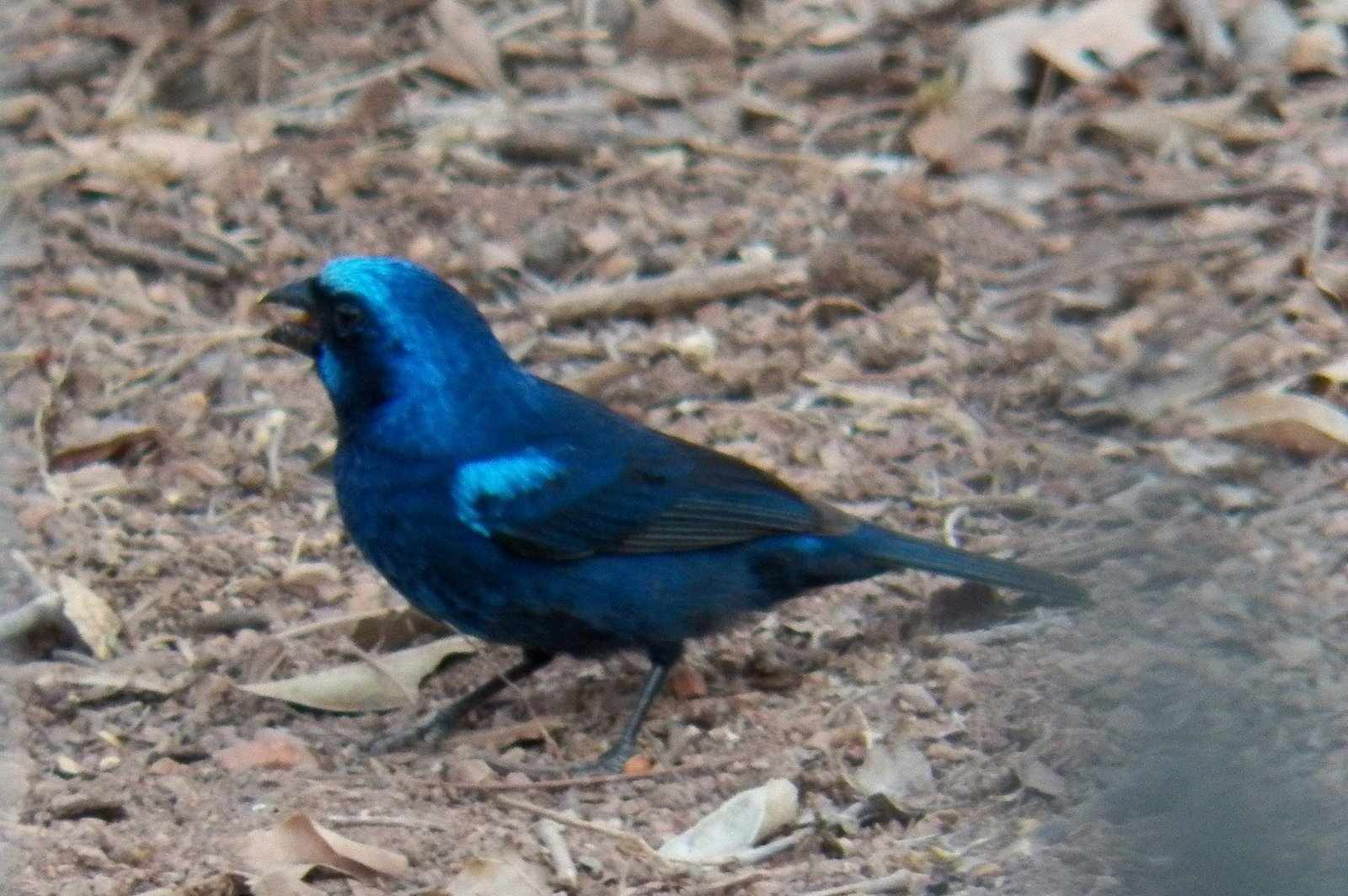
The Blue Bunting is a small, stocky grosbeak of dry and semi-humid forest in Mexico and northern Central America. The male is dark blue-black with bright pale blue patches on the head, shoulder and rump, the female uniform warm brown. It lives hidden in dense undergrowth.
Voice
The song is a clear, sweet series of varied whistled notes that often runs downwards and ends softly. The call is a sharp, metallic chik.
Recording: Aziza Cooper — CC BY-NC-SA 4.0 · converted to mono · xeno-canto
Identification
13–14 cm. Short, thick, blackish conical bill with a curved culmen. The male is dark blue-black, with bright pale blue on the forehead, in a broad eyebrow, on the cheek, the lesser wing coverts and the rump. The female is uniform warm brown, paler and slightly cinnamon below, without streaks or wing bars. Young males resemble the female with scattered blue feathers.
Confusion species
Blue-black Grosbeak Cyanoloxia cyanoides is larger, with a heavier bill; the male is darker with less pale blue, and the species lives in humid forest. The male Indigo Bunting Passerina cyanea is entirely bright blue with a more pointed bill; the female is greyer brown with faint streaks on the breast. Blue Grosbeak Passerina caerulea is larger, with rufous wing bars. The male Varied Bunting Passerina versicolor is dark purplish with a red nape; the female is grey-brown.
Habitat
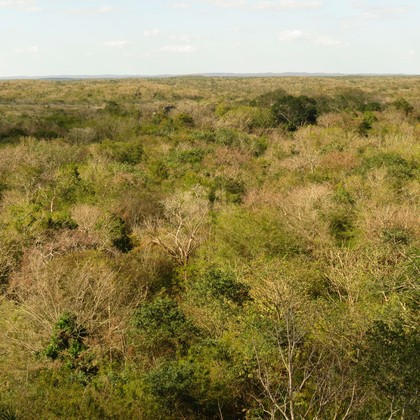
Undergrowth of dry and semi-humid forest, thorn scrub, forest edges, overgrown clearings and secondary forest; also dense hedges in semi-open farmland. Mostly in lowlands and foothills up to about 1500 m. Lives in pairs low in dense vegetation.
Where the bird is most at home, classified by the vegetation units of Mexico and Central America.





Range and movements
Endemic to the guide area. On the Pacific slope of Mexico from Sinaloa and on the Caribbean slope from Nuevo León and Tamaulipas southwards, including the Yucatán Peninsula, through Guatemala, Belize, El Salvador and Honduras to northern Nicaragua. Rare vagrant to southern Texas.
- Resident
- dark = core range, pale = thinly spread
How and when to look
Mostly detected by the song from dense scrub along forest edges and trails in dry forest, especially early in the morning; the male sometimes sings from a slightly higher perch.
Conservation status
Not threatened (LC). Fairly common in most of its range and tolerates secondary growth.
Scientific name
Cyanocompsa parellina | (Bonaparte, 1850)
Bonaparte described the species in 1850 as Cyanoloxia parellina; because it was later moved to another genus, the author and year stand in brackets. The genus Cyanocompsa was introduced in 1861 by Cabanis. Cyanocompsa is Greek, from kuanos 'dark blue' and kompsos 'elegant, pretty'. parellina probably derives from parella, a lichen yielding a blue dye: 'light blue', after the blue male. The specimen the first description was based on came from Alvarado, Veracruz, Mexico.