All species › Passerines › Mockingbirds and thrashers › Blue-and-white Mockingbird
Position in the tree Birds Aves › Birds with a flexible palate Neognathae › All other modern birds Neoaves › Landbirds Telluraves › Falcons, parrots and passerines Australaves › Falcons and passerines Eufalconimorphae › Parrots and passerines Psittacopasserae
Blue-and-white Mockingbird | Melanotis hypoleucus
Blauw-witte spotlijster | Mulato pechiblanco
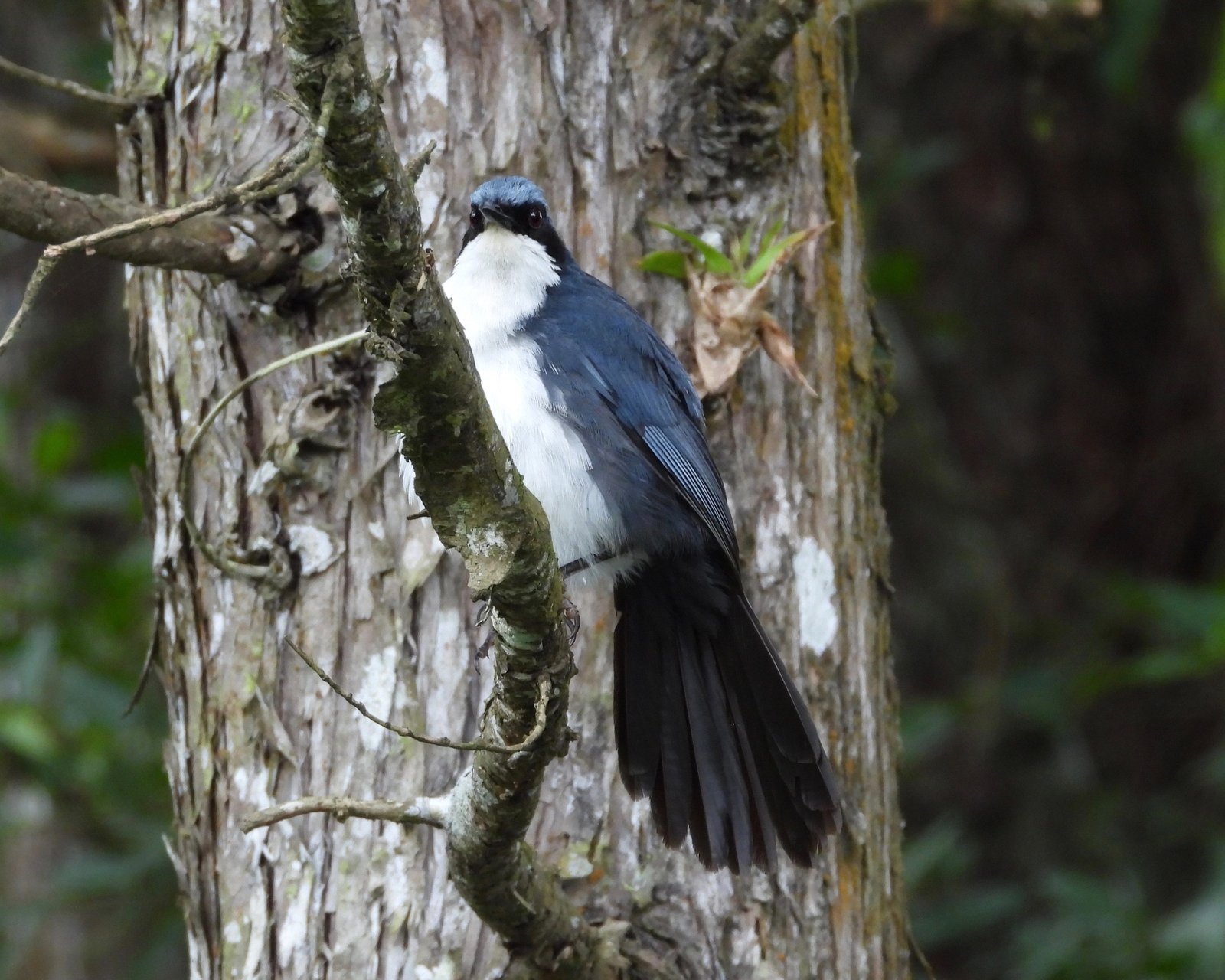
The Blue-and-white Mockingbird is a large, shy mockingbird of highland scrub in northern Central America. The slaty-blue upperparts, black mask, red eye and white underparts make it distinctive, but it is usually heard rather than seen. It occurs only in the guide area, from Chiapas to northern Nicaragua.
Voice
A long, powerful song of varied, rich and hoarse phrases, often repeated two or three times, including imitations of other birds. Calls a hard chak and a liquid, rising choo-weet.
Recording: Guillermo Funes — CC BY-NC-SA 4.0 · converted to mono · xeno-canto
Identification
24–26 cm. Upperparts, head and flanks slaty blue, finely streaked paler blue on crown and nape. Black mask from bill to behind the eye; eye red. Throat, breast and centre of belly clean white, sharply contrasting with the blue flanks. Tail long and dark blue, bill black and slightly decurved. The sexes are alike. Juveniles are duller greyish blue with a dark eye and little white.
Confusion species
Blue Mockingbird Melanotis caerulescens, found west and north of the Isthmus of Tehuantepec, is entirely blue without white underparts. A male Blue Bunting Cyanocompsa parellina is much smaller, with a thick conical bill. Unicolored Jay Aphelocoma unicolor is larger, entirely blue without a mask, and lives higher in the canopy.
Habitat
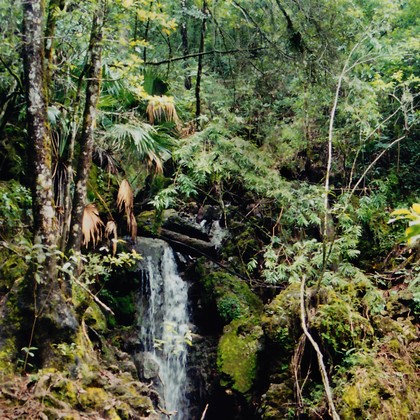
Dense undergrowth and scrub in the mountains, especially at the edges of pine-oak and cloud forest, in overgrown secondary forest, hedgerows and thickets between fields and in shade coffee, mostly between 900 and 3000 m. It feeds on and just above the ground on insects, other invertebrates and fruit.
Where the bird is most at home, classified by the vegetation units of Mexico and Central America.



Range and movements
Highlands of Chiapas in south-eastern Mexico, through Guatemala, El Salvador and Honduras to the mountains of northern Nicaragua. It does not occur outside the guide area.
- Resident
- dark = core range, pale = thinly spread
How and when to look
Best located by its song, given mainly early in the morning from a hidden perch. In the Chiapas highlands around San Cristóbal de las Casas and in the highlands of Guatemala it is regularly found in thickets along forest edges.
Conservation status
Not threatened (LC). Fairly common in suitable scrub and tolerant of small-scale farmland.
Scientific name
Melanotis hypoleucus | Hartlaub, 1852
Hartlaub described the species in 1852 and placed it straight away in the genus where it still stands. The genus Melanotis was introduced in 1850 by Bonaparte. Melanotis is Greek, from melas 'black' and ous, ōtos 'ear', after the black mask across the ear-coverts. hypoleucus is Greek, from hupo 'below' and leukos 'white', after the white underparts. The specimen the first description was based on came from Guatemala.