All species › Passerines › Wrens › Rufous-and-white Wren
Position in the tree Birds Aves › Birds with a flexible palate Neognathae › All other modern birds Neoaves › Landbirds Telluraves › Falcons, parrots and passerines Australaves › Falcons and passerines Eufalconimorphae › Parrots and passerines Psittacopasserae
Rufous-and-white Wren | Thryophilus rufalbus
Rood-witte winterkoning | Chivirín rojizo
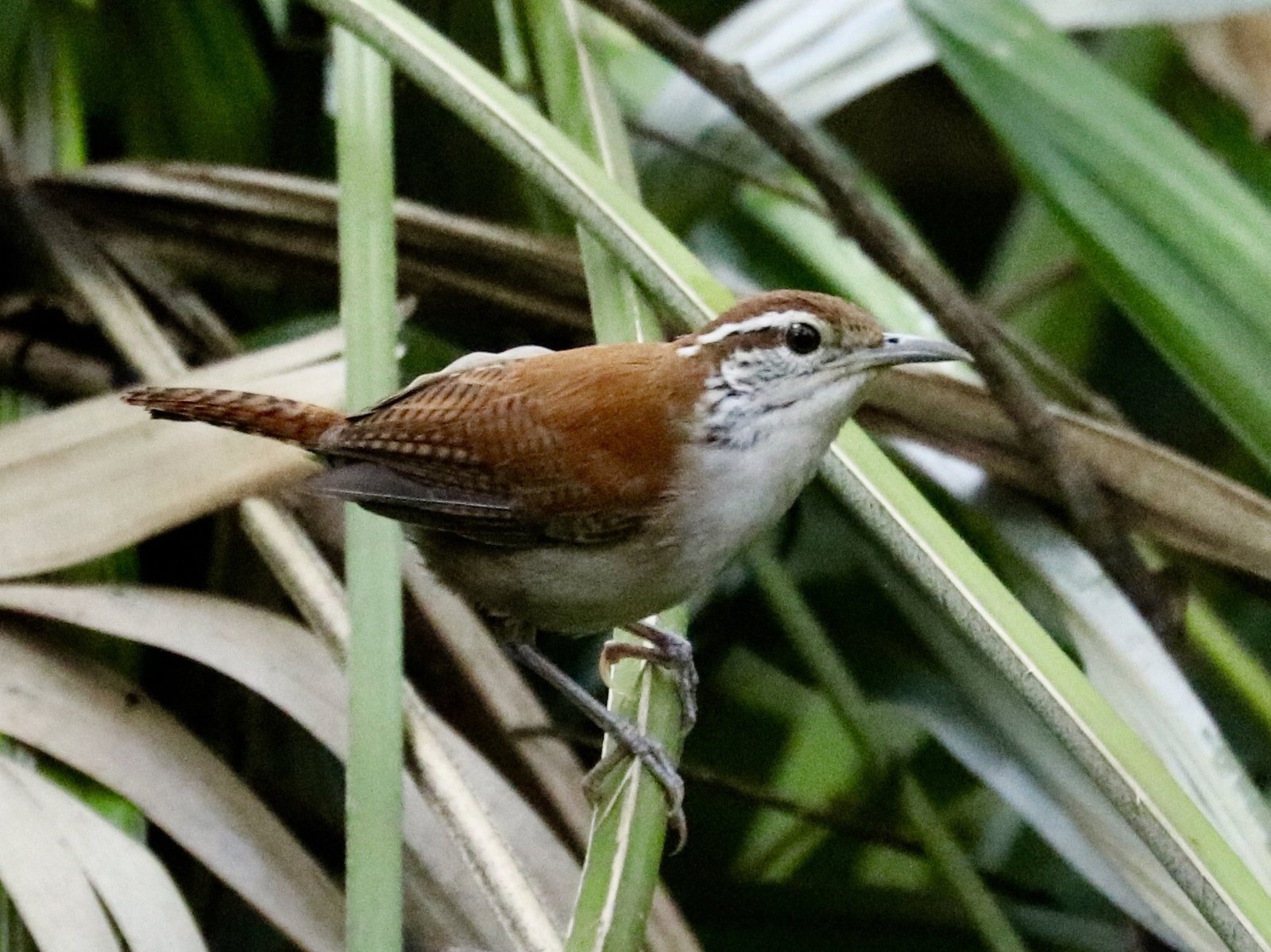
The Rufous-and-white Wren is a fairly large wren with bright rufous upperparts and white underparts. It lives in the undergrowth of dry and semi-humid forest on the Pacific slope of Central America and is noted for its low, hollow whistles.
Voice
A series of low, hollow, whistled notes, often starting with a short trill; it sounds more like an owl or dove than a wren. Pairs sing in duet. Call a dry rattle.
Recording: Manuel Grosselet — CC BY-NC-SA 4.0 · converted to mono · xeno-canto
Identification
14–15 cm. Upperparts bright rufous, wings and tail with narrow black bars. White supercilium, cheeks streaked black and white. Throat and breast white, flanks and lower belly brownish. Sexes alike.
Confusion species
Banded Wren Thryophilus pleurostictus is duller brown above and has black bars on the flanks. Cabanis's Wren Cantorchilus modestus is smaller and less rufous above, with buff flanks. Buff-breasted Wren Cantorchilus leucotis has a buff breast and belly.
Habitat
Undergrowth and dense scrub in dry deciduous, gallery and flooded forest, semi-humid forest and secondary forest, from the lowlands into the lower mountains. It forages on and just above the ground for insects and spiders.
Where the bird is most at home, classified by the vegetation units of Mexico and Central America.





Range and movements
Pacific slope of southern Mexico (Chiapas) through Guatemala, El Salvador, Honduras, Nicaragua and Costa Rica to Panama. Outside the guide area in northern Colombia and Venezuela.
- Resident
- dark = core range, pale = thinly spread
How and when to look
Regularly heard in the dry and gallery forest of Guanacaste in Costa Rica. The low, hollow whistles are the best clue; the bird itself often stays low in the undergrowth.
Conservation status
Not threatened. Fairly common in dry and semi-humid forest; declines where forest disappears entirely.
Scientific name
Thryophilus rufalbus | (de Lafresnaye, 1845)
De Lafresnaye described the species in 1845 as Thryothorus rufalbus; because it was later moved to another genus, the author and year stand in brackets. The genus Thryophilus was introduced in 1864 by Baird. Thryophilus is Greek, from thruon 'reed, rush' and philos 'lover': 'reed-lover'. rufalbus is Latin, from rufus 'rufous' and albus 'white', after the rufous upperparts and white underparts. The specimen the first description was based on came from Guatemala (originally given in error as Mexico).