All species › Passerines › Mockingbirds and thrashers › Blue Mockingbird
Position in the tree Birds Aves › Birds with a flexible palate Neognathae › All other modern birds Neoaves › Landbirds Telluraves › Falcons, parrots and passerines Australaves › Falcons and passerines Eufalconimorphae › Parrots and passerines Psittacopasserae
Blue Mockingbird | Melanotis caerulescens
Blauwe spotlijster | Mulato azul
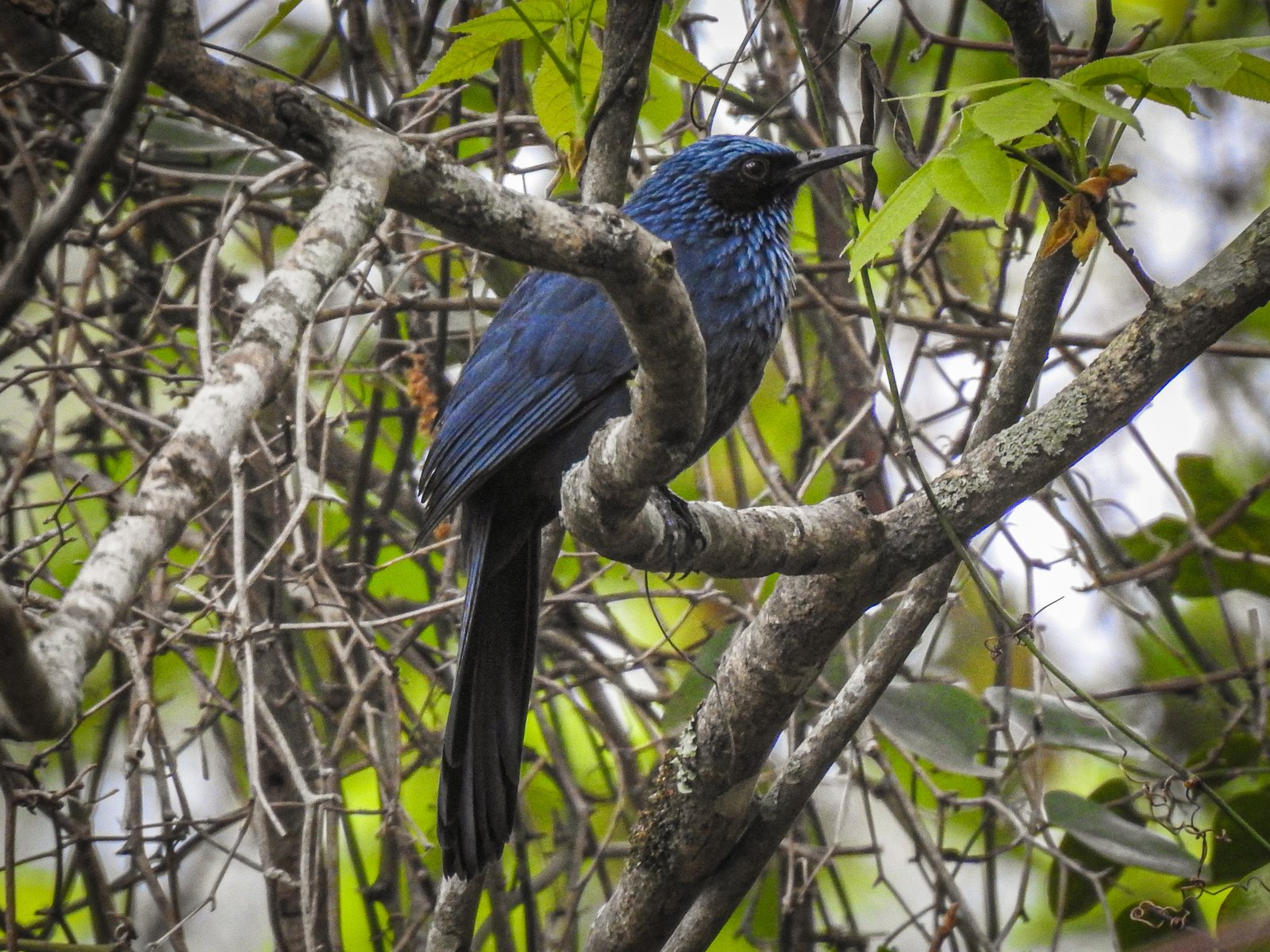
The Blue Mockingbird is a dark blue, long-tailed mockingbird with a black mask and a red eye. It lives hidden in dense scrub and mainly reveals itself by its loud, varied song and liquid call. The species occurs only in Mexico, from sea level to high in the mountains.
Voice
A loud, long series of rich, whistled and hoarse phrases, often repeated two or three times, with much mimicry. The call is a liquid, descending choo-wee or wee-oo; also a hard chak.
Recording: Manuel Grosselet — CC BY-NC-SA 4.0 · shortened to the first 60 s, mono · xeno-canto
Identification
24–27 cm. Entirely deep cobalt to slaty blue, finely streaked pale blue on head, throat and breast. Black mask from bill to behind the eye; eye red. Tail long and rounded, bill black and slightly decurved, legs dark. The sexes are alike. Juveniles are dull sooty grey with a blue wash and a dark eye.
Confusion species
Blue-and-white Mockingbird Melanotis hypoleucus of Chiapas and Central America has white underparts. A male Blue Bunting Cyanocompsa parellina is much smaller with a thick conical bill. Unicolored Jay Aphelocoma unicolor is larger, lacks the black mask and keeps more to the tree canopy.
Habitat
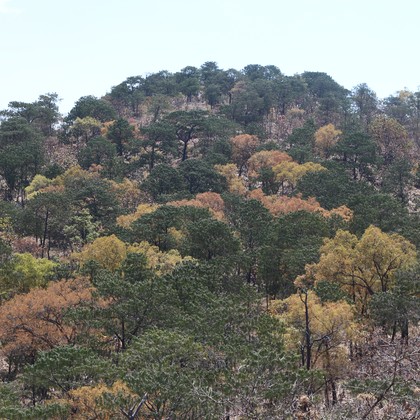
Dense shrub layer and undergrowth in a wide range of forest types: pine-oak, oak and cloud forest in the mountains, dry forest and forest edges in the lowlands, also overgrown secondary forest, hedgerows, parks and large gardens; from sea level to about 3000 m. It forages on the ground among leaf litter for insects and also eats fruit.
Where the bird is most at home, classified by the vegetation units of Mexico and Central America.





Range and movements
Endemic to Mexico: from southern Sonora and south-western Chihuahua along the Pacific slope and through the western and central highlands to Oaxaca, and in the east in the Sierra Madre Oriental from San Luis Potosí to Veracruz. A rare vagrant to the south-western United States.
- Resident
- dark = core range, pale = thinly spread
How and when to look
Most quickly found by its call and song from dense shrubs. It often appears briefly at the edge of a thicket before slipping back in; waiting patiently at a forest edge or a garden with berry-bearing shrubs usually produces a sighting.
Conservation status
Not threatened (LC). Fairly common and widespread; adapts well to secondary forest and gardens.
Scientific name
Melanotis caerulescens | (Swainson, 1827)
Swainson described the species in 1827 as Orpheus caerulescens; because it was later moved to another genus, the author and year stand in brackets. The genus Melanotis was introduced in 1850 by Bonaparte. Melanotis is Greek, from melas 'black' and ous, ōtos 'ear', after the black mask across the ear-coverts. caerulescens is Latin for 'bluish', from caeruleus 'sky-blue', after the slaty-blue plumage. The specimen the first description was based on came from Mexico (not further specified).