All species › Passerines › Wrens › Black-throated Wren
Position in the tree Birds Aves › Birds with a flexible palate Neognathae › All other modern birds Neoaves › Landbirds Telluraves › Falcons, parrots and passerines Australaves › Falcons and passerines Eufalconimorphae › Parrots and passerines Psittacopasserae
Black-throated Wren | Pheugopedius atrogularis
Zwartkeelwinterkoning | Cucarachero gorjinegro
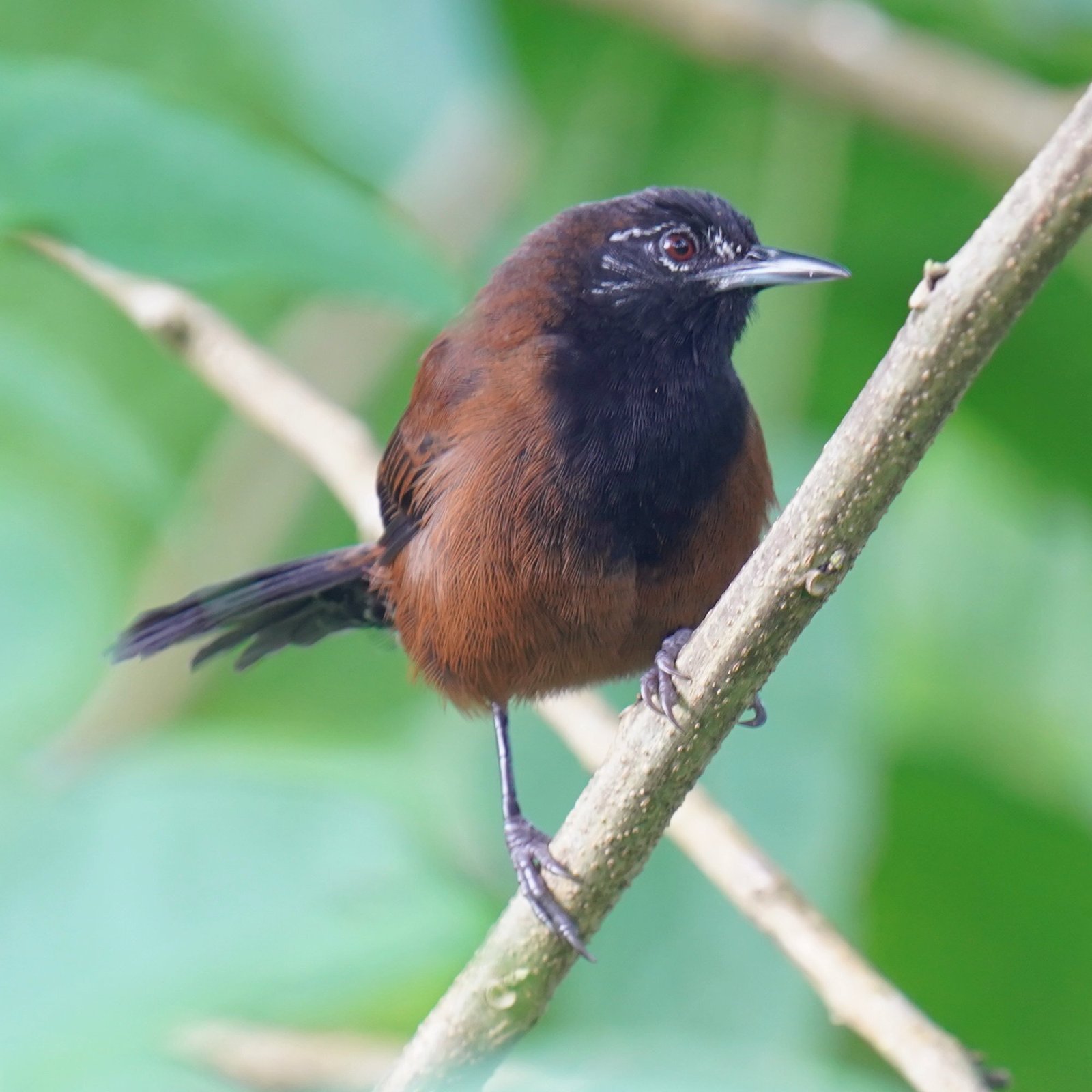
The Black-throated Wren is a large, dark wren of the Caribbean lowlands of southern Central America, recognised by the black throat and breast in an otherwise dark rufous-brown plumage. It lives hidden in dense thickets at forest edges and is usually noticed by its rich whistled song.
Voice
A rich, clear song of short whistled phrases, each repeated a few times. The call is a dry, rattling scold.
Recording: Jelle Scharringa — CC BY-NC-SA 4.0 · converted to mono · xeno-canto
Identification
14–15 cm. Upperparts dark rufous-brown, tail with narrow black bars. Cheeks black with fine white streaks. Throat and breast black, merging into dark rufous-brown belly and flanks. Bill fairly long and blackish. Sexes alike.
Confusion species
Bay Wren Cantorchilus nigricapillus has a black head with white markings and a white or pale throat. Black-bellied Wren Pheugopedius fasciatoventris has a white throat and breast and a black belly instead. Sooty-headed Wren Pheugopedius spadix (eastern Panama) has a greyer head and a rufous breast below the black throat.
Habitat
Dense thickets and vine tangles at the edges of humid lowland and foothill forest, overgrown clearings, mature secondary forest and riverside vegetation; mainly in the lowlands and foothills. It forages close to the ground for insects.
Where the bird is most at home, classified by the vegetation units of Mexico and Central America.




Range and movements
Caribbean slope of Nicaragua, Costa Rica and western Panama. Endemic to the guide area.
- Resident
- dark = core range, pale = thinly spread
How and when to look
Heard in the Caribbean lowlands of Costa Rica, for example at La Selva. It usually stays deep in dense cover; the black throat is often visible only when the bird briefly comes out onto an open branch.
Conservation status
Not threatened. Fairly common within its limited range; also occurs at forest edges and in overgrown clearings.
Scientific name
Pheugopedius atrogularis | (Salvin, 1865)
Salvin described the species in 1865 as Thryothorus atrogularis; because it was later moved to another genus, the author and year stand in brackets. The genus Pheugopedius was introduced in 1851 by Cabanis. Pheugopedius is Greek, from pheugō 'to shun, flee' and pedion 'plain, open country': a bird that shuns the open ground. atrogularis is Latin, from ater 'black' and gula 'throat', after the black throat and breast. The specimen the first description was based on came from Tucurrique, Costa Rica.