All species › Passerines › Wrens › Stripe-breasted Wren
Position in the tree Birds Aves › Birds with a flexible palate Neognathae › All other modern birds Neoaves › Landbirds Telluraves › Falcons, parrots and passerines Australaves › Falcons and passerines Eufalconimorphae › Parrots and passerines Psittacopasserae
Stripe-breasted Wren | Cantorchilus thoracicus
Streepborstwinterkoning | Cucarachero pechirrayado
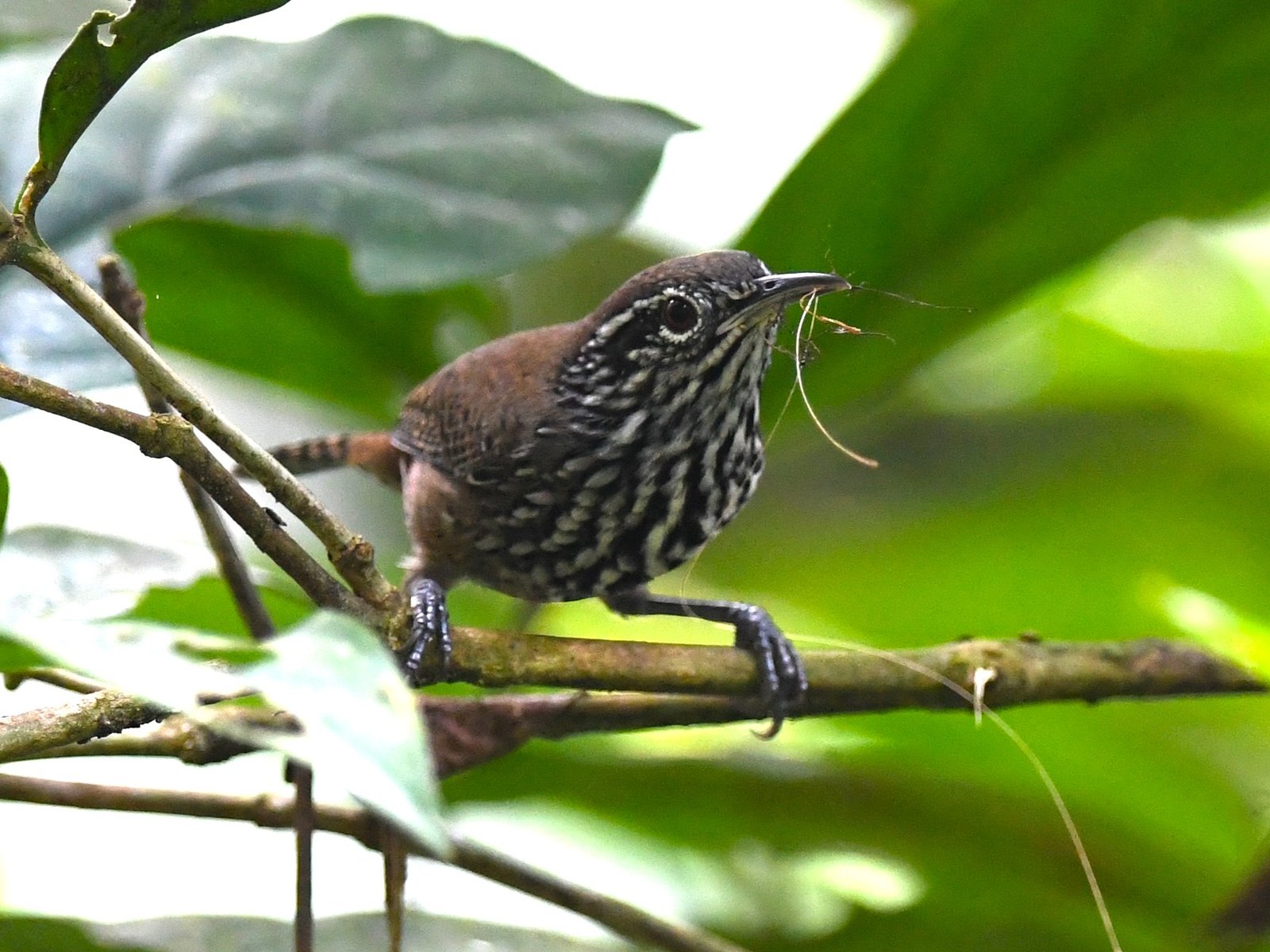
The Stripe-breasted Wren is a small wren of the humid Caribbean lowlands of southern Central America, with a black-and-white streaked throat and breast. It often forages higher in the trees than many relatives, in vine tangles at forest edges, and is most noticeable by its clear whistled song.
Voice
An unhurried song of clear, rather slow whistled phrases, often repeated several times before a new phrase follows. The call is a dry rattle.
Recording: Scott Olmstead — CC BY-NC-SA 4.0 · converted to mono · xeno-canto
Identification
11–13 cm. Upperparts brown, tail with narrow black bars. White supercilium; face streaked black and white. Throat and breast white with dense black streaks; belly and flanks brownish grey to dull buff. Bill dark. Sexes alike.
Confusion species
Stripe-throated Wren Cantorchilus leucopogon (eastern Panama) has a streaked throat only and an unstreaked, buffy-brown breast. Spot-breasted Wren Pheugopedius maculipectus (further north) has round black spots instead of streaks on the breast and rufous flanks.
Habitat
Forest edges, clearings and the middle and lower canopy of humid lowland and foothill forest, also mature secondary forest. It forages at mid-levels to fairly high in vine tangles and dense foliage for insects, regularly with mixed flocks.
Where the bird is most at home, classified by the vegetation units of Mexico and Central America.



Range and movements
Caribbean slope of Nicaragua, Costa Rica and western and central Panama. Endemic to the guide area.
- Resident
- dark = core range, pale = thinly spread
How and when to look
Best found by listening for the song at forest edges in the Caribbean lowlands and foothills of Costa Rica; the bird often sits higher than expected for a wren.
Conservation status
Not threatened. Fairly common in suitable forest.
Scientific name
Cantorchilus thoracicus | (Salvin, 1865)
Salvin described the species in 1865 as Thryothorus thoracicus; because it was later moved to another genus, the author and year stand in brackets. The genus Cantorchilus was introduced in 2006 by Mann, Barker, Graves, Dingess-Mann & Slater. Cantorchilus combines Latin cantus 'song' with Greek orkhilos 'wren': 'song wren'. thoracicus is Latin for 'of the breast', from Greek thōrax 'chest', after the boldly streaked breast. The specimen the first description was based on came from Tucurrique, Costa Rica.