All species › Passerines › New World sparrows › Black-throated Sparrow
Position in the tree Birds Aves › Birds with a flexible palate Neognathae › All other modern birds Neoaves › Landbirds Telluraves › Falcons, parrots and passerines Australaves › Falcons and passerines Eufalconimorphae › Parrots and passerines Psittacopasserae
Black-throated Sparrow | Amphispiza bilineata
Zwartkeelgors | Zacatonero garganta negra
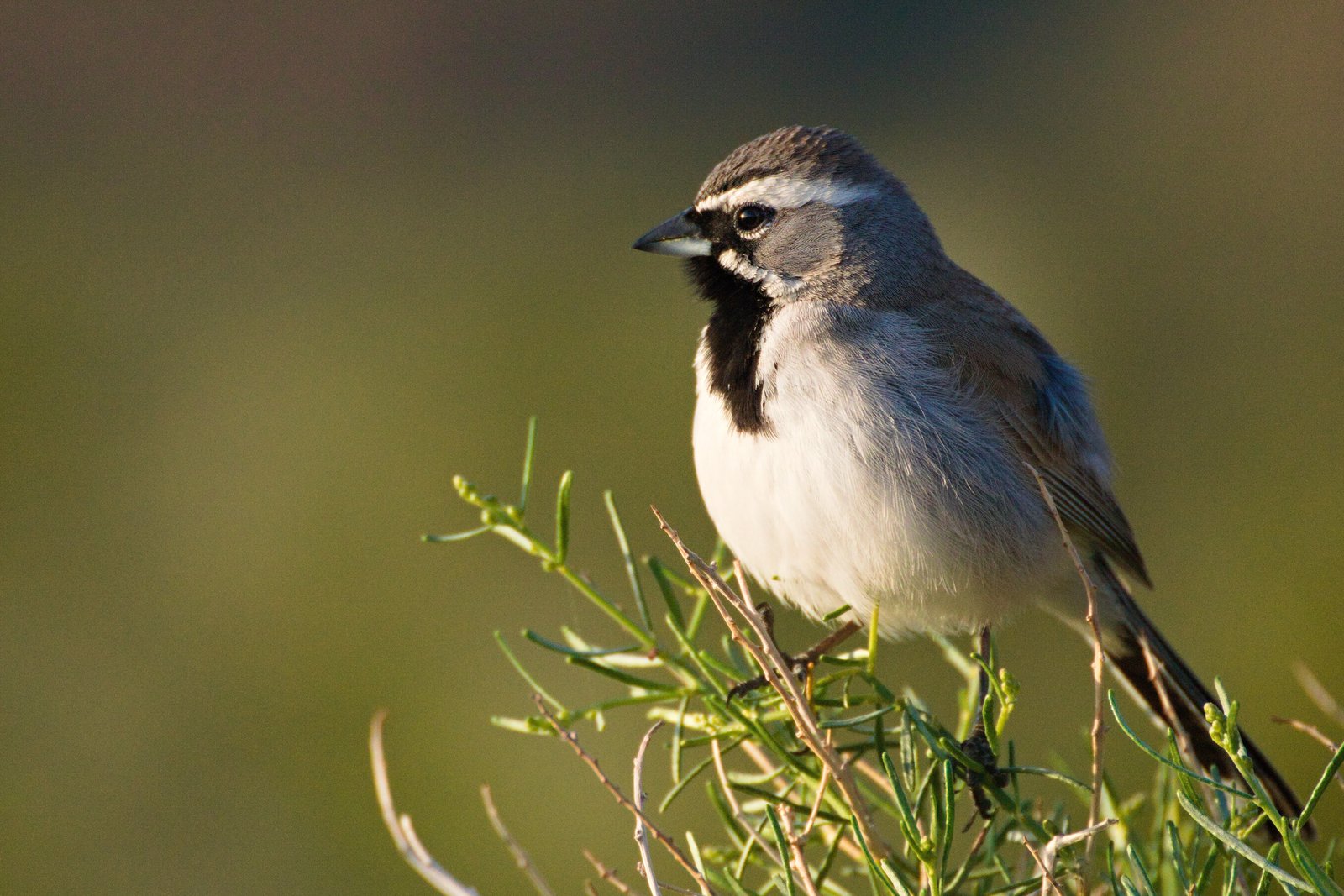
The Black-throated Sparrow is a slim, grey sparrow of dry desert and semi-desert, with a black throat and crisp white stripes on the head. It ranges from the south-western United States to central Mexico and can go a long time without drinking water.
Voice
The song is clear and tinkling: two or three short, high notes followed by a trill, such as tink tink trrrrrr, in many variations. The call consists of soft, high, tinkling chip notes, often in short series.
Recording: Pat Goltz — CC BY-NC-SA 4.0 · shortened to the first 60 s, mono · xeno-canto
Identification
12–14 cm. Slim, with a fairly long, black tail with white outer edges and corners. Head grey with a crisp white supercilium and a white malar stripe framing a black throat and bib. Upperparts plain grey-brown, underparts white to pale grey, flanks slightly browner. Bill grey. The sexes are alike. Juveniles lack the black throat and are finely streaked on breast and back, but already show the white supercilium.
Confusion species
Five-striped Sparrow Amphispizopsis quinquestriata is darker, has a grey breast with a black central spot and lives on steep, scrub-covered rocky slopes. Juvenile Black-throated Sparrows without a black throat may resemble Sagebrush Sparrow Artemisiospiza nevadensis and Bell's Sparrow Artemisiospiza belli; these have a white eye-ring, a white spot in front of the eye, a dark malar stripe and a dark central breast spot, but no long white supercilium.
Habitat
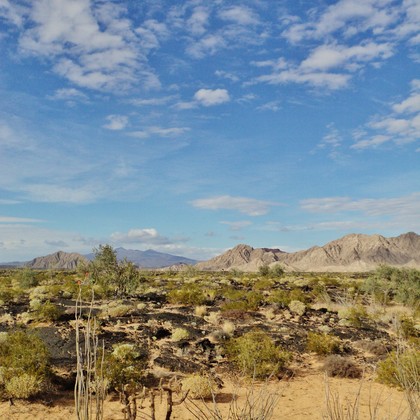
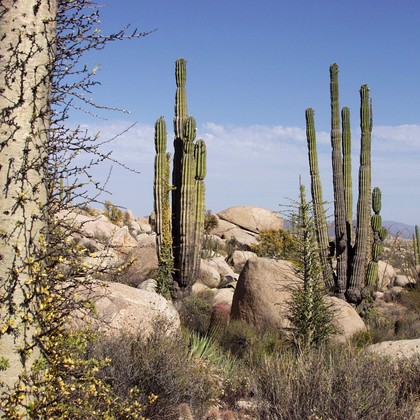
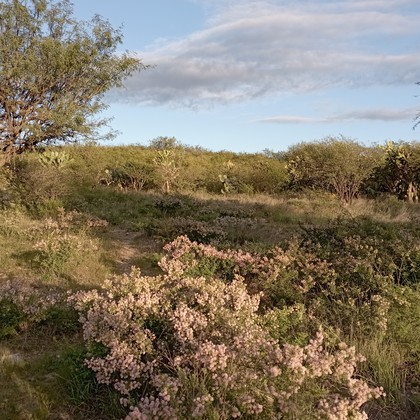
Dry, open desert and semi-desert with scattered shrubs such as creosote bush, mesquite and acacia and with cacti, on plains, alluvial fans and rocky slopes. It obtains most of its moisture from seeds and insects. Outside the breeding season in small groups, sometimes with other sparrows.
Where the bird is most at home, classified by the vegetation units of Mexico and Central America.

Range and movements
From the south-western United States to central Mexico. In the guide area throughout Baja California and on several islands in the Gulf of California, in Sonora and across the dry plateau of Chihuahua and Coahuila to Nuevo León and Tamaulipas, and south to Zacatecas, San Luis Potosí, Guanajuato, Querétaro and Hidalgo. The northernmost breeders, from the Great Basin, move south in winter and then join the resident birds of northern Mexico.
- Resident
- dark = core range, pale = thinly spread
How and when to look
In the early morning males sing from the tops of shrubs; at waterholes and irrigation water in the desert small groups often appear.
Conservation status
Not threatened (LC). Widespread and locally common in arid areas. The decline in North America is linked to the conversion of desert scrub to farmland and built-up areas and to non-native grasses that promote fires.
Scientific name
Amphispiza bilineata | (Cassin, 1850)
Cassin described the species in 1850 as Emberiza bilineata; because it was later moved to another genus, the author and year stand in brackets. The genus Amphispiza was introduced in 1874 by Coues. Amphispiza is Greek, from amphi 'near' and spiza 'finch', as the genus seemed closely related to Junco and Peucaea. bilineata is Latin for 'two-lined', after the white eyebrow and moustachial stripe. The specimen the first description was based on came from Rio Grande, Texas (USA).