All species › Passerines › New World warblers › Black-throated Blue Warbler
Position in the tree Birds Aves › Birds with a flexible palate Neognathae › All other modern birds Neoaves › Landbirds Telluraves › Falcons, parrots and passerines Australaves › Falcons and passerines Eufalconimorphae › Parrots and passerines Psittacopasserae
Black-throated Blue Warbler | Setophaga caerulescens
Blauwe zwartkeelzanger | Chipe azulnegro
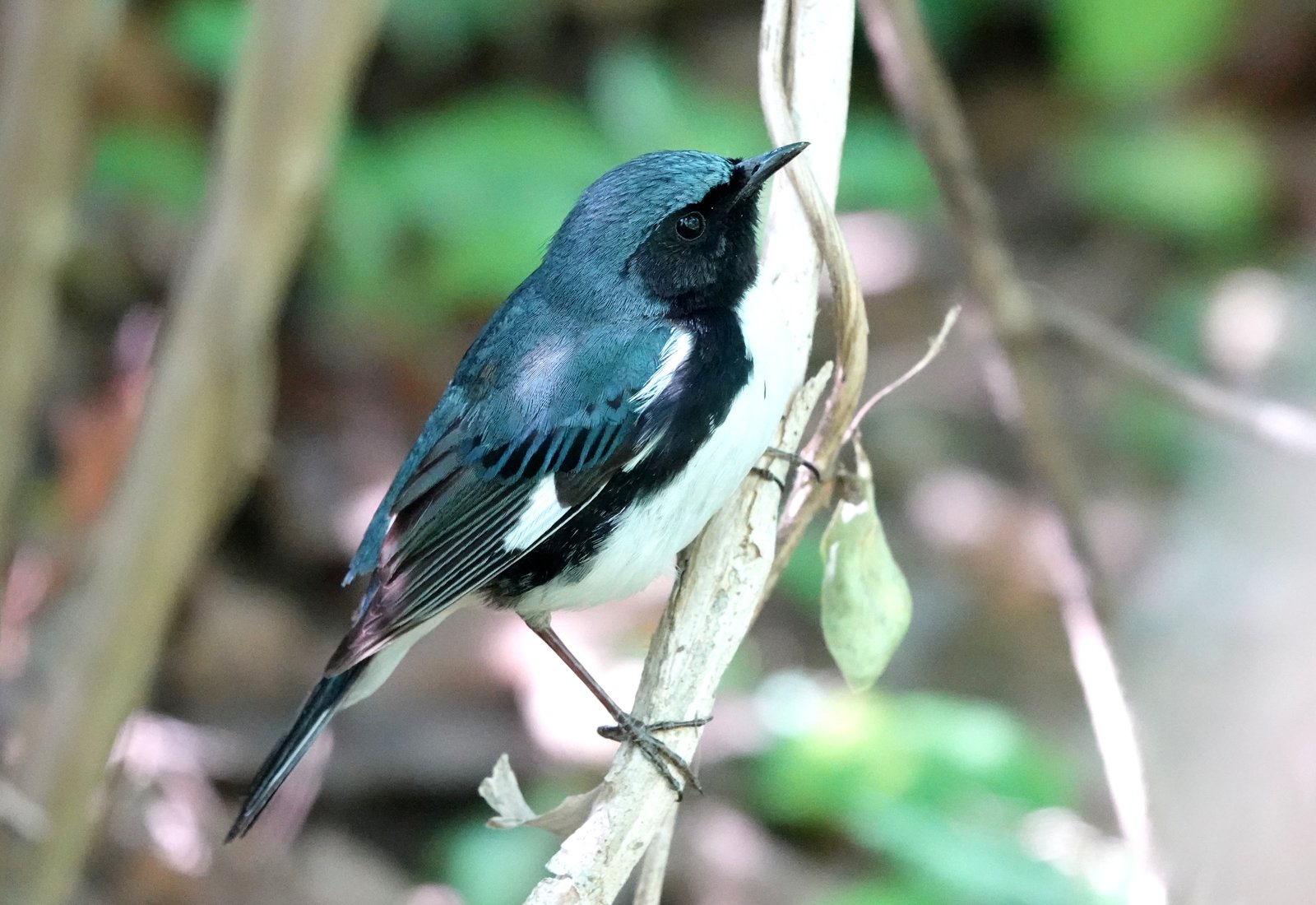
The Black-throated Blue Warbler is a warbler from eastern North America that winters almost entirely in the Caribbean. In the guide area it is scarce, mainly on the Yucatán Peninsula, the offshore islands and in Belize. Males and females differ greatly, but both usually have a small white spot at the base of the primaries.
Voice
The song is a slow series of buzzy notes rising at the end, roughly zwee-zwee-zweee; in the guide area heard mainly in spring. The call is a dull, short tchek.
Recording: Jeff Stewart — CC BY-NC-SA 4.0 · converted to mono · xeno-canto
Identification
12–14 cm. The male is dark slate-blue above, with a black face, black throat and black flanks; the rest of the underparts is clean white. On the closed wing a square white spot at the base of the primaries. The female is plain brownish olive above and dull buff below, with a narrow pale eyebrow, a dark cheek and usually a small white wing spot, which may be small or absent in young females. No wing bars.
Confusion species
Black-throated Grey Warbler Setophaga nigrescens has a black-and-white striped head, white wing bars and a yellow spot in front of the eye, and winters mainly in western and central Mexico. The male Cerulean Warbler Setophaga cerulea is paler sky-blue, has white wing bars and a white throat with a narrow dark breast band. The female resembles a vireo or a female Tennessee Warbler Leiothlypis peregrina, but has a darker cheek and usually the white wing spot.
Habitat
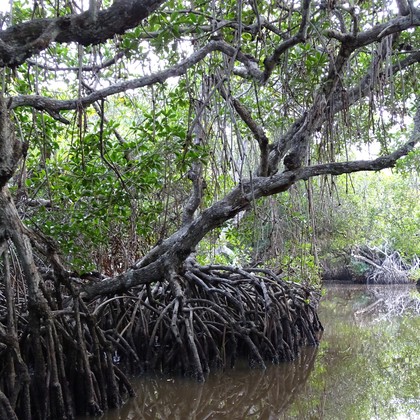
In winter the interior and edges of dry and humid lowland forest, scrub and mangroves, mainly near the coast. It searches the lower and middle levels for insects and also eats fruit and nectar.
Where the bird is most at home, classified by the vegetation units of Mexico and Central America.



Range and movements
Breeds in south-eastern Canada, the north-eastern United States and the Appalachian Mountains. Winters mainly in the Greater Antilles and the Bahamas. In the guide area scarce on the Yucatán Peninsula, especially in Quintana Roo and on Cozumel, and in Belize; elsewhere in Mexico and Central America a rare passage migrant or winter visitor.
- Resident
- Summer visitor (c. Apr–Sep)
- Winter visitor (c. Oct–Mar)
- Passage (Mar–Apr, Oct–Nov)
- dark = core range, pale = thinly spread
How and when to look
Most records in the guide area come from Cozumel and the coast of Quintana Roo, mainly during migration in October and April.
Conservation status
Not threatened (LC). The breeding population is stable to increasing. Only a small part of the world population occurs in the guide area.
Scientific name
Setophaga caerulescens | (Gmelin, 1789)
Gmelin described the species in 1789 as Motacilla caerulescens; because it was later moved to another genus, the author and year stand in brackets. The genus Setophaga was introduced in 1827 by Swainson. Setophaga is Greek, from sēs, sētos 'moth' and -phagos '-eating': 'moth-eater'. caerulescens is Latin for 'bluish', after the male's blue upperparts. The specimen the first description was based on came from Hispaniola.