All species › Trogons › Trogons › Black-tailed Trogon
Position in the tree Birds Aves › Birds with a flexible palate Neognathae › All other modern birds Neoaves › Landbirds Telluraves › Raptors, owls, kingfishers and woodpeckers Afroaves › Mousebirds, rollers and woodpeckers Coraciimorphae › Trogons and cavity nesters Cavitaves
Black-tailed Trogon | Trogon melanurus
Zwartstaarttrogon | Trogón colinegro
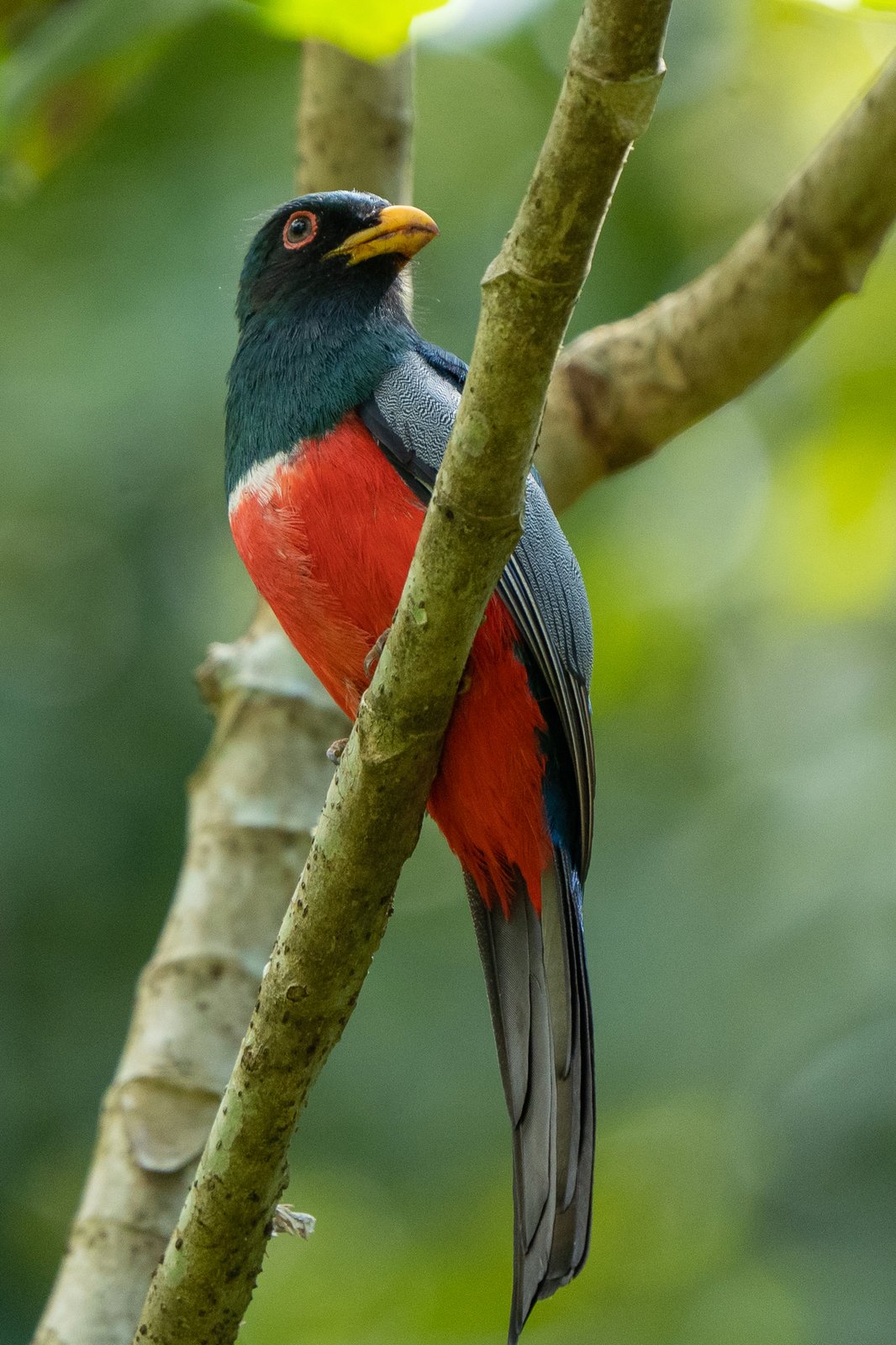
The Black-tailed Trogon is a large, red-bellied trogon of South America that in the guide area occurs only in central and eastern Panama. It resembles Slaty-tailed Trogon but has a narrow white band between the green breast and the red belly, a yellow bill and a black underside to the tail.
Voice
A series of hollow kow notes, similar to the song of Slaty-tailed Trogon but often shorter and slightly lower and slower. Also a soft cackling chatter.
Recording: Jacob Wijpkema — CC BY-NC-SA 4.0 · converted to mono · xeno-canto
Identification
28–32 cm. The male is metallic green on the head, back and breast, with a black face and throat, a narrow white band across the breast and a red belly. The bill is yellow, the bare eye-ring orange-red. The underside of the tail is plain blackish. The female is grey where the male is green, with a red belly, a yellow lower mandible and a dark upper mandible.
Confusion species
Slaty-tailed Trogon Trogon massena has no white breast band, an orange-red bill and a slate-grey undertail. Collared Trogon Trogon collaris is smaller, lives mainly in the mountains and has a black-and-white barred undertail with broad white tips.
Habitat
Humid lowland forest, gallery forest and tall secondary forest, mainly below about 500 m, locally higher. It sits still for long periods in the middle and upper tree layers, often near water, and eats fruit and large insects. It nests in a cavity in a termite nest or rotting wood.
Where the bird is most at home, classified by the vegetation units of Mexico and Central America.



Range and movements
In the guide area only in central and eastern Panama: on the Caribbean slope from the Panama Canal area eastwards, and on the Pacific slope from Panamá province through Darién to the Colombian border. Outside the guide area in northern Colombia and through much of Amazonia to Bolivia and Brazil.
- Resident
- dark = core range, pale = thinly spread
How and when to look
Found along Pipeline Road (Camino del Oleoducto) in Soberanía and in the forest of Darién. On Pipeline Road it lives alongside Slaty-tailed Trogon; the white breast band and yellow bill are decisive.
Conservation status
Not threatened. It has a large range in South America; in Panama it is sensitive to clearance of lowland forest.
Scientific name
Trogon melanurus | Swainson, 1838
Swainson described the species in 1838 and placed it straight away in the genus where it still stands. The genus Trogon was introduced in 1760 by Brisson. Trogon is Greek, from trōgōn 'gnawing, fruit-eating'. melanurus is Greek, from melas 'black' and oura 'tail', after the dark tail. The specimen the first description was based on came from Demerara, Guyana.