All species › Trogons › Trogons › Slaty-tailed Trogon
Position in the tree Birds Aves › Birds with a flexible palate Neognathae › All other modern birds Neoaves › Landbirds Telluraves › Raptors, owls, kingfishers and woodpeckers Afroaves › Mousebirds, rollers and woodpeckers Coraciimorphae › Trogons and cavity nesters Cavitaves
Slaty-tailed Trogon | Trogon massena
Massena's trogon | Trogón cola oscura
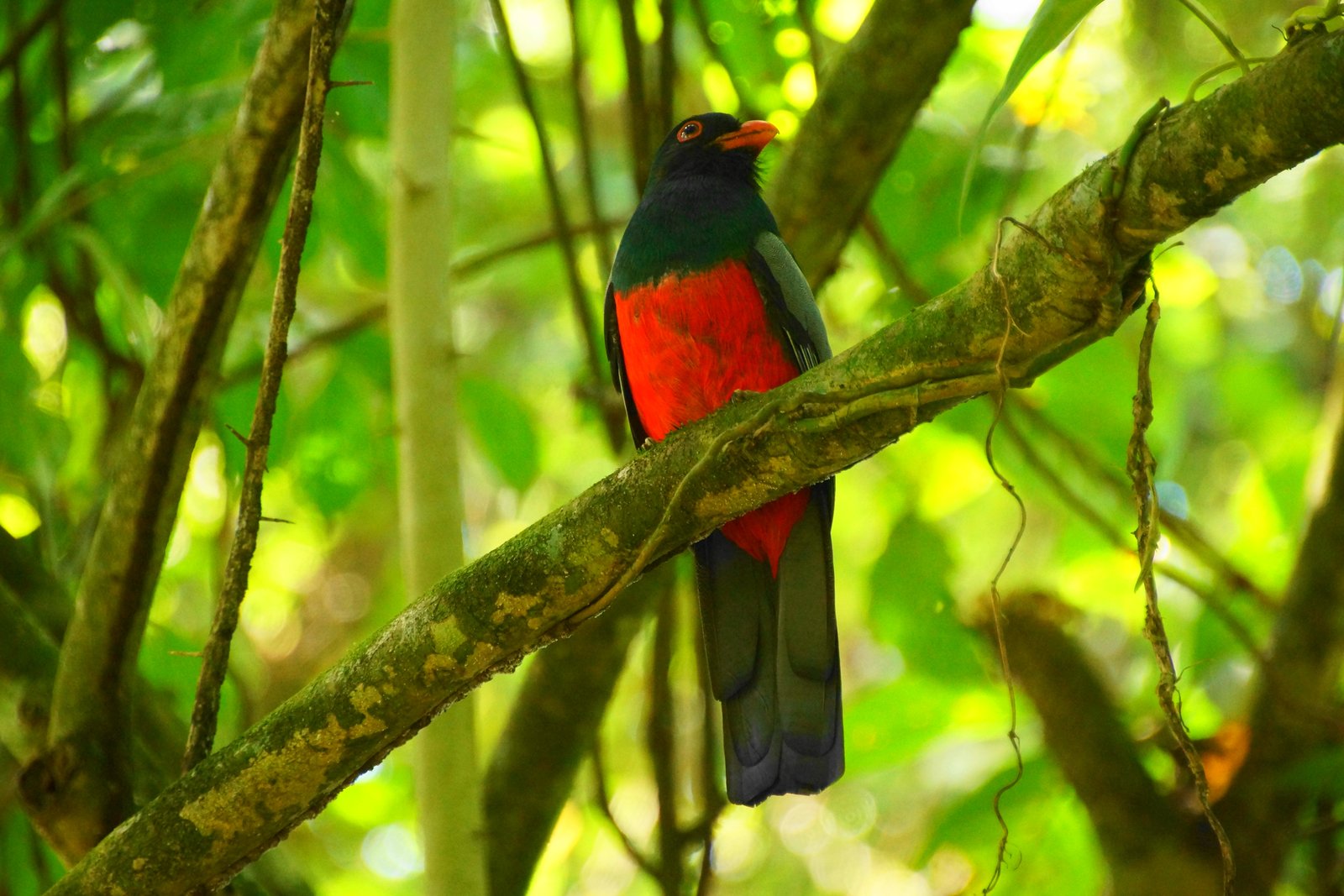
The Slaty-tailed Trogon is the largest red-bellied trogon of the lowlands of the guide area and a common resident of humid forest from southern Mexico to Panama. It can be recognised by its orange-red bill and the plain slate-grey underside of the tail. Its scientific name honours the French bird collector Victor Masséna.
Voice
A long, even series of hollow, clucking kow or kook notes, ten to more than twenty in a row, without obvious acceleration. Also a soft cackling chatter.
Recording: Manuel Grosselet — CC BY-NC-SA 4.0 · shortened to the first 60 s, mono · xeno-canto
Identification
30–35 cm. The male is metallic green on the head, back and breast, with a blackish face and throat, a red belly and undertail coverts and no white breast band. The bill and the bare eye-ring are orange-red, the eye dark. The underside of the tail is plain dark slate grey. The female is slate grey where the male is green, with a red belly, an orange-red lower mandible and a dark upper mandible.
Confusion species
Lattice-tailed Trogon Trogon clathratus (Costa Rica and western Panama) has a pale iris, a yellow bill and a finely barred black-and-white undertail. Black-tailed Trogon Trogon melanurus (Panama) has a white band between the green breast and the red belly, a yellow bill and a black undertail. Collared Trogon Trogon collaris and Baird's Trogon Trogon bairdii are smaller; the first has a white breast band and a barred undertail, the second a blue eye-ring and a white undertail.
Habitat
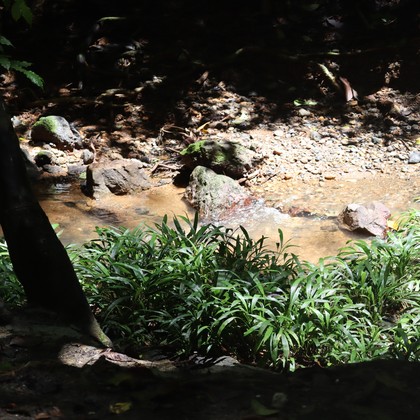
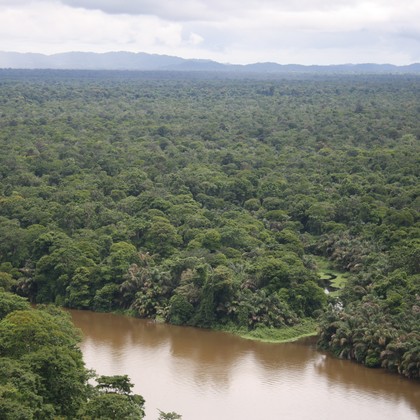
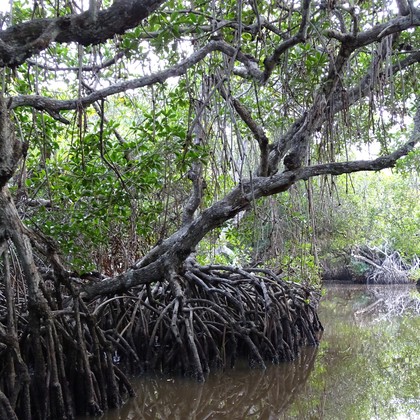
Humid lowland and foothill forest up to about 1200 m, tall secondary forest, forest edges, swamp forest, gallery forest and mangroves. It perches upright and still for long periods in the middle and upper tree layers and eats fruit and large insects, snatched from a branch or leaf in a short flight. It excavates its nest in an arboreal termite nest or in rotting wood.
Where the bird is most at home, classified by the vegetation units of Mexico and Central America.




Range and movements
Caribbean and Gulf lowlands from southern Veracruz and northern Oaxaca through Tabasco, Chiapas, southern Campeche and Quintana Roo, Belize and Guatemala to Honduras, Nicaragua and Costa Rica; in south-western Costa Rica also on the Pacific side. In Panama on both slopes east to Darién. Outside the guide area in western Colombia and north-western Ecuador.
- Resident
- dark = core range, pale = thinly spread
How and when to look
Common along Pipeline Road (Camino del Oleoducto) in Soberanía in Panama, at La Selva in Costa Rica and at Tikal in Guatemala. The series of hollow kow notes often carries far through the forest.
Conservation status
Not threatened. It disappears where lowland forest is cleared but also occurs in tall secondary forest.
Scientific name
Trogon massena | Gould, 1838
Gould described the species in 1838 and placed it straight away in the genus where it still stands. The genus Trogon was introduced in 1760 by Brisson. Trogon is Greek, from trōgōn 'gnawing, fruit-eating'. massena honours the French bird collector Victor Masséna (1799–1863), Duke of Rivoli and Prince of Essling. The specimen the first description was based on came from Mexico.