All species › Trogons › Trogons › Black-headed Trogon
Position in the tree Birds Aves › Birds with a flexible palate Neognathae › All other modern birds Neoaves › Landbirds Telluraves › Raptors, owls, kingfishers and woodpeckers Afroaves › Mousebirds, rollers and woodpeckers Coraciimorphae › Trogons and cavity nesters Cavitaves
Black-headed Trogon | Trogon melanocephalus
Zwartkoptrogon | Trogón cabeza negra
The Black-headed Trogon is a yellow-bellied trogon of dry and semi-humid lowland forest from eastern Mexico to north-western Costa Rica, and does not occur outside the guide area. It is often seen in pairs or small groups, including in open woodland and at forest edges. It was formerly treated as one species together with Citreoline Trogon.
Voice
An accelerating series of clucking chuk or kow notes running into a rattle. Also a dry, clucking chak and soft chatter, often between members of a group.
Recording: Paul Driver — CC BY-NC-SA 4.0 · converted to mono · xeno-canto
Identification
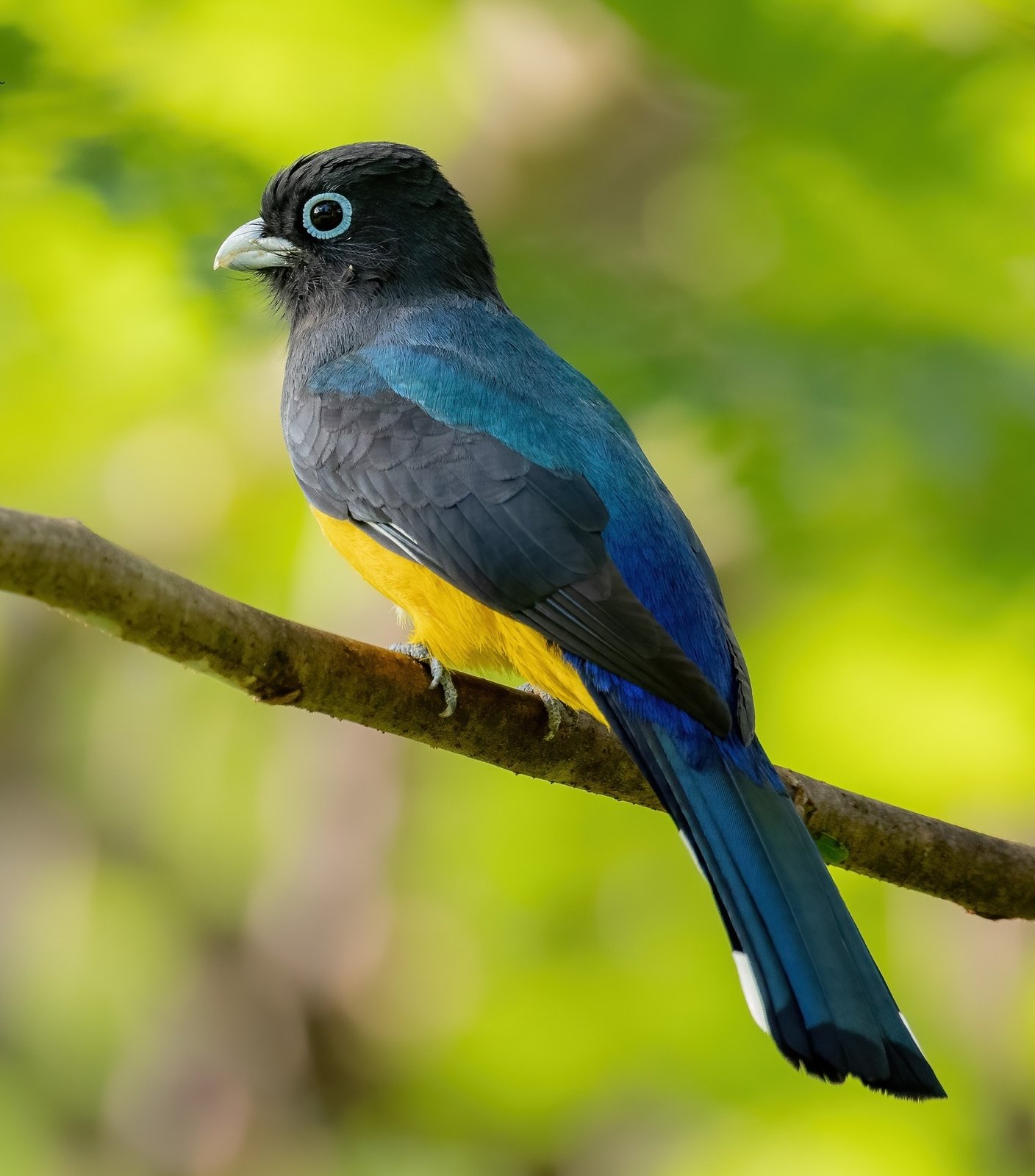
27–28 cm. The male has a blackish head and breast, a dark eye with a pale blue bare eye-ring, a blue-grey bill, a green back with a violet-blue rump and a yellow belly, separated from the breast by a narrow, indistinct pale line. The underside of the tail is white with a black base, the white tips of the tail feathers forming broad bands. The female is duller, with a grey instead of green back.
Confusion species
Citreoline Trogon Trogon citreolus has a pale yellow iris, a greyer head and breast and lives on the Pacific slope of western Mexico, where Black-headed Trogon is absent. Gartered Trogon Trogon caligatus is smaller, has a yellow eye-ring and, in the male, a violet-blue head and a finely barred undertail. Male Graceful Black-throated Trogon Trogon tenellus has a green head.
Habitat
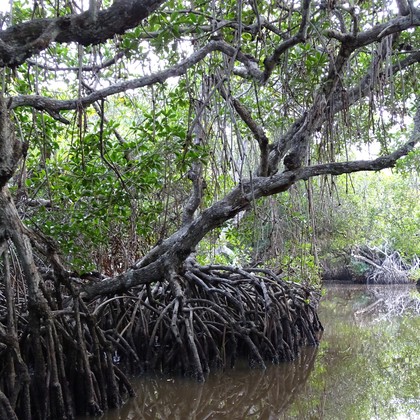
Dry and semi-humid lowland forest, seasonal forest, forest edges, gallery forest, open woodland with scattered trees, mangroves and shade plantations, mainly below about 500 m and locally to about 1000 m. It eats fruit and insects. It nests in a cavity excavated in an arboreal termite nest.
Where the bird is most at home, classified by the vegetation units of Mexico and Central America.






Range and movements
Gulf and Caribbean lowlands from central and southern Veracruz and northern Oaxaca through Tabasco, Chiapas and the Yucatán Peninsula to Belize, Guatemala, Honduras and Nicaragua; on the Pacific side from El Salvador and Honduras through Nicaragua to Guanacaste and the Gulf of Nicoya area in north-western Costa Rica. The species does not occur outside the guide area.
- Resident
- dark = core range, pale = thinly spread
How and when to look
Common at Tikal and Calakmul, on the Yucatán Peninsula and in Belize, and in the dry forest of Palo Verde and Santa Rosa in Guanacaste. Pairs often perch conspicuously on an open branch at the forest edge.
Conservation status
Not threatened. It tolerates disturbed forest and also occurs in plantations and open woodland with scattered trees.
Scientific name
Trogon melanocephalus | Gould, 1836
Gould described the species in 1836 and placed it straight away in the genus where it still stands. The genus Trogon was introduced in 1760 by Brisson. Trogon is Greek, from trōgōn 'gnawing, fruit-eating'. melanocephalus is Greek, from melas 'black' and kephalē 'head', after the blackish head and breast. The specimen the first description was based on came from Tamaulipas, Mexico.