All species › Passerines › Gnatwrens and gnatcatchers › Black-tailed Gnatcatcher
Position in the tree Birds Aves › Birds with a flexible palate Neognathae › All other modern birds Neoaves › Landbirds Telluraves › Falcons, parrots and passerines Australaves › Falcons and passerines Eufalconimorphae › Parrots and passerines Psittacopasserae
Black-tailed Gnatcatcher | Polioptila melanura
Zwartstaartmuggenvanger | Perlita del desierto
The Black-tailed Gnatcatcher is a small grey gnatcatcher of deserts and dry scrub, with a tail that is largely black below. Pairs live together year-round in a fixed territory. In the guide area it occurs in northern Mexico.
Voice
A rasping, repeated chee-chee-chee as an alarm call and a dry, sharp chet. The song is a simple series of identical rasping notes.
Recording: Barry Edmonston — CC BY-NC-SA 4.0 · converted to mono · xeno-canto
Identification
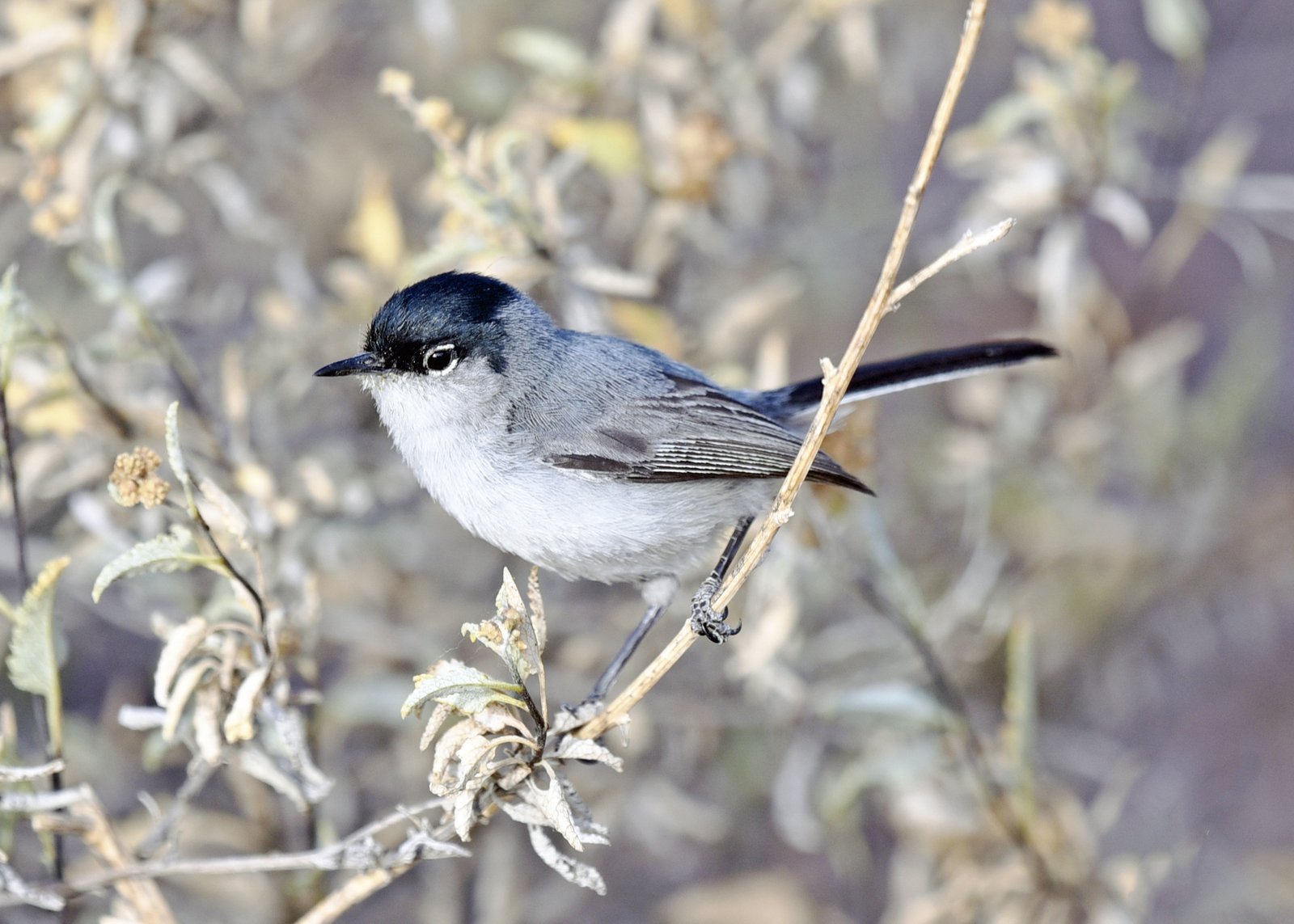
10–11 cm, with a long tail. Upperparts grey, underparts dull white to pale grey. Narrow white eye-ring. In the breeding season the male has a glossy black cap reaching just above the eye; outside the breeding season often only a short black line above the eye. The female is greyer and browner, without black on the head. Tail black; seen from below almost entirely black with narrow white edges and white tips to the outer feathers.
Confusion species
Blue-grey Gnatcatcher Polioptila caerulea is bluer and has an almost entirely white underside to the tail. California Gnatcatcher Polioptila californica is darker grey with browner flanks and even less white in the tail; it lives mainly in coastal sage scrub. Black-capped Gnatcatcher Polioptila nigriceps has a longer bill and more white under the tail.
Habitat
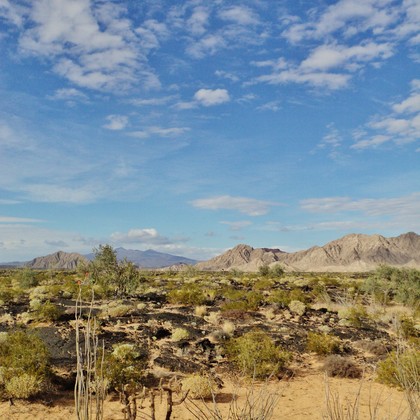
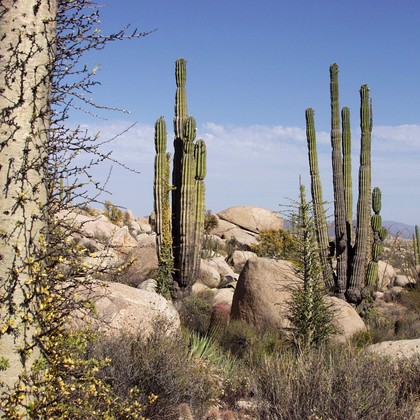
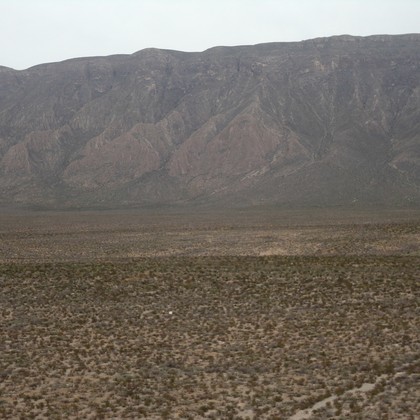
Desert scrub with mesquite, acacia and creosote bush, dry washes and thorn scrub in lowlands and on low slopes. It searches shrubs for small insects and spiders, usually in pairs.
Where the bird is most at home, classified by the vegetation units of Mexico and Central America.


Range and movements
Northern Mexico, from Baja California and Sonora east to Coahuila and Nuevo León, and south in the arid interior of northern Mexico. Outside the guide area in the south-western United States.
- Resident
- dark = core range, pale = thinly spread
How and when to look
In desert scrub best found by its rasping call; pairs keep in touch with short calls as they move through the shrubs.
Conservation status
Not threatened. Locally common in suitable desert scrub; declines where scrub gives way to agriculture and development.
Scientific name
Polioptila melanura | Lawrence, 1856
Lawrence described the species in 1856 and placed it straight away in the genus where it still stands. The genus Polioptila was introduced in 1855 by Sclater. Polioptila is Greek, from polios 'grey' and ptilon 'feather': 'grey-feathered'. melanura is Greek, from melas 'black' and oura 'tail', after the largely black tail. The specimen the first description was based on came from the Rio Grande valley, Texas.