All species › Trogons › Trogons › Citreoline Trogon
Position in the tree Birds Aves › Birds with a flexible palate Neognathae › All other modern birds Neoaves › Landbirds Telluraves › Raptors, owls, kingfishers and woodpeckers Afroaves › Mousebirds, rollers and woodpeckers Coraciimorphae › Trogons and cavity nesters Cavitaves
Citreoline Trogon | Trogon citreolus
Grijskoptrogon | Trogón citrino
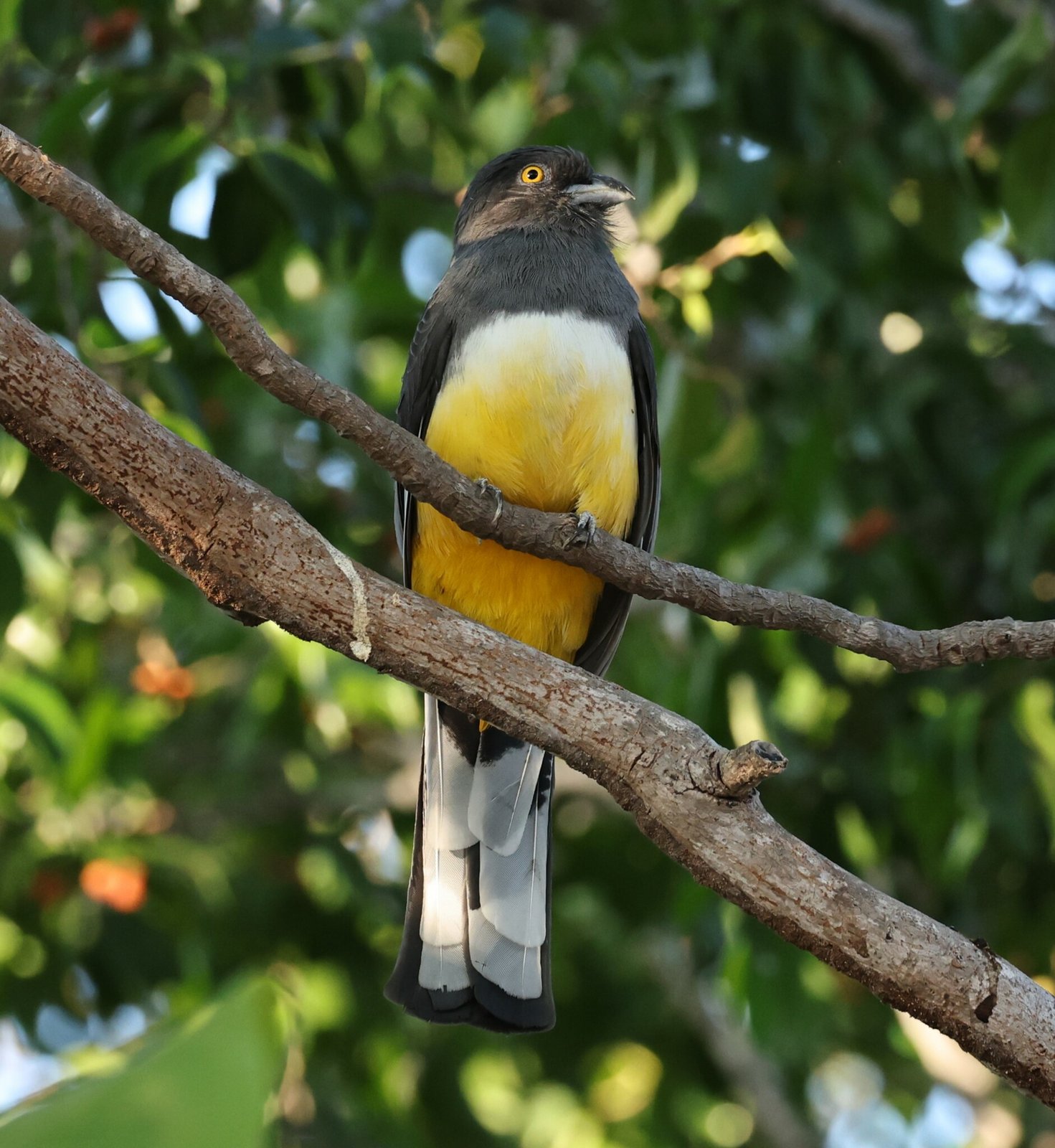
The Citreoline Trogon is a yellow-bellied trogon of the dry forest on the Pacific slope of western Mexico, from Sinaloa to the Isthmus of Tehuantepec, and does not occur outside Mexico. It is the only trogon in the guide area with a pale yellow iris and a yellow belly. Black-headed Trogon was formerly treated as a subspecies of this species.
Voice
A long, accelerating series of clucking kow or chuk notes ending in a rattle, often given by several birds at once. Also a dry chak.
Recording: Manuel Grosselet — CC BY-NC-SA 4.0 · shortened to the first 60 s, mono · xeno-canto
Identification
26–28 cm. The male has a dark grey head and breast, a pale yellow iris with a dark bare eye-ring, a blue-grey bill, a green back and a lemon-yellow belly. The underside of the tail is largely white, with a black base and broad white tips to the tail feathers. The female is duller, with a grey back and less gloss; she also has a pale iris.
Confusion species
Black-headed Trogon Trogon melanocephalus has a dark eye with a pale blue eye-ring and a blacker head and breast, and lives on the Gulf and Caribbean slope; the two species hardly overlap anywhere. Gartered Trogon Trogon caligatus is smaller and has a yellow eye-ring and a dark eye. Elegant Trogon Trogon elegans and Coppery-tailed Trogon Trogon ambiguus have a red belly.
Habitat
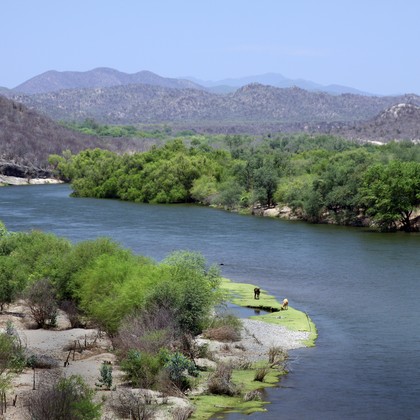
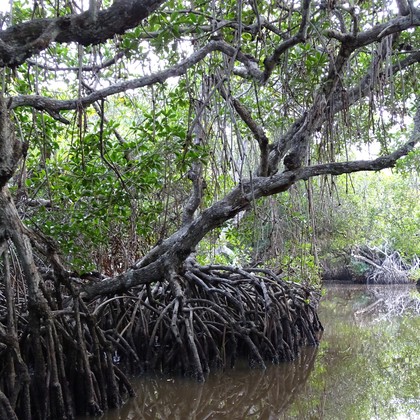
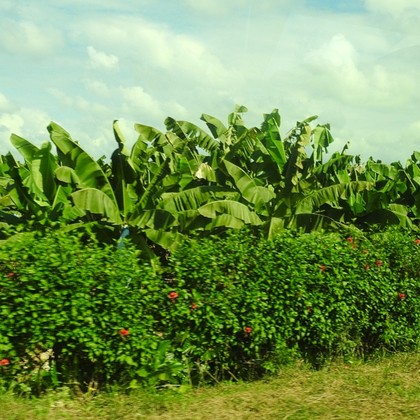
Tropical dry and deciduous forest, thorn scrub with taller trees, gallery forest, mangroves, and plantations and gardens with trees, from sea level to about 1000 m. It often lives in pairs or small groups that move noisily through the forest. It eats fruit and insects. It nests in a cavity excavated in an arboreal termite nest.
Where the bird is most at home, classified by the vegetation units of Mexico and Central America.



Range and movements
Pacific lowlands and lower slopes of western Mexico, from Sinaloa south through Nayarit, Jalisco, Colima, Michoacán, Guerrero and Oaxaca to the Isthmus of Tehuantepec and extreme western Chiapas; also inland along the Balsas basin. The species does not occur outside Mexico; reports from Guatemala and further south usually refer to Black-headed Trogons.
- Resident
- dark = core range, pale = thinly spread
How and when to look
Common around San Blas in Nayarit, in the dry forest of Colima and Jalisco and around Huatulco in Oaxaca. Groups give themselves away with their loud, clucking series, often early in the morning.
Conservation status
Not threatened. It tolerates disturbed forest and also occurs in plantations and gardens with trees, but Pacific dry forest is disappearing in large parts of western Mexico.
Scientific name
Trogon citreolus | Gould, 1835
Gould described the species in 1835 and placed it straight away in the genus where it still stands. The genus Trogon was introduced in 1760 by Brisson. Trogon is Greek, from trōgōn 'gnawing, fruit-eating'. citreolus is Latin for 'lemon-yellow', after the yellow belly. The specimen the first description was based on came from Mexico (not specified).