All species › Gamebirds › New World quail › Black-eared Wood Quail
Position in the tree Birds Aves › Birds with a flexible palate Neognathae › Fowl Galloanserae
Black-eared Wood Quail | Odontophorus melanotis
Zwartoortandkwartel | Corcovado orejinegro
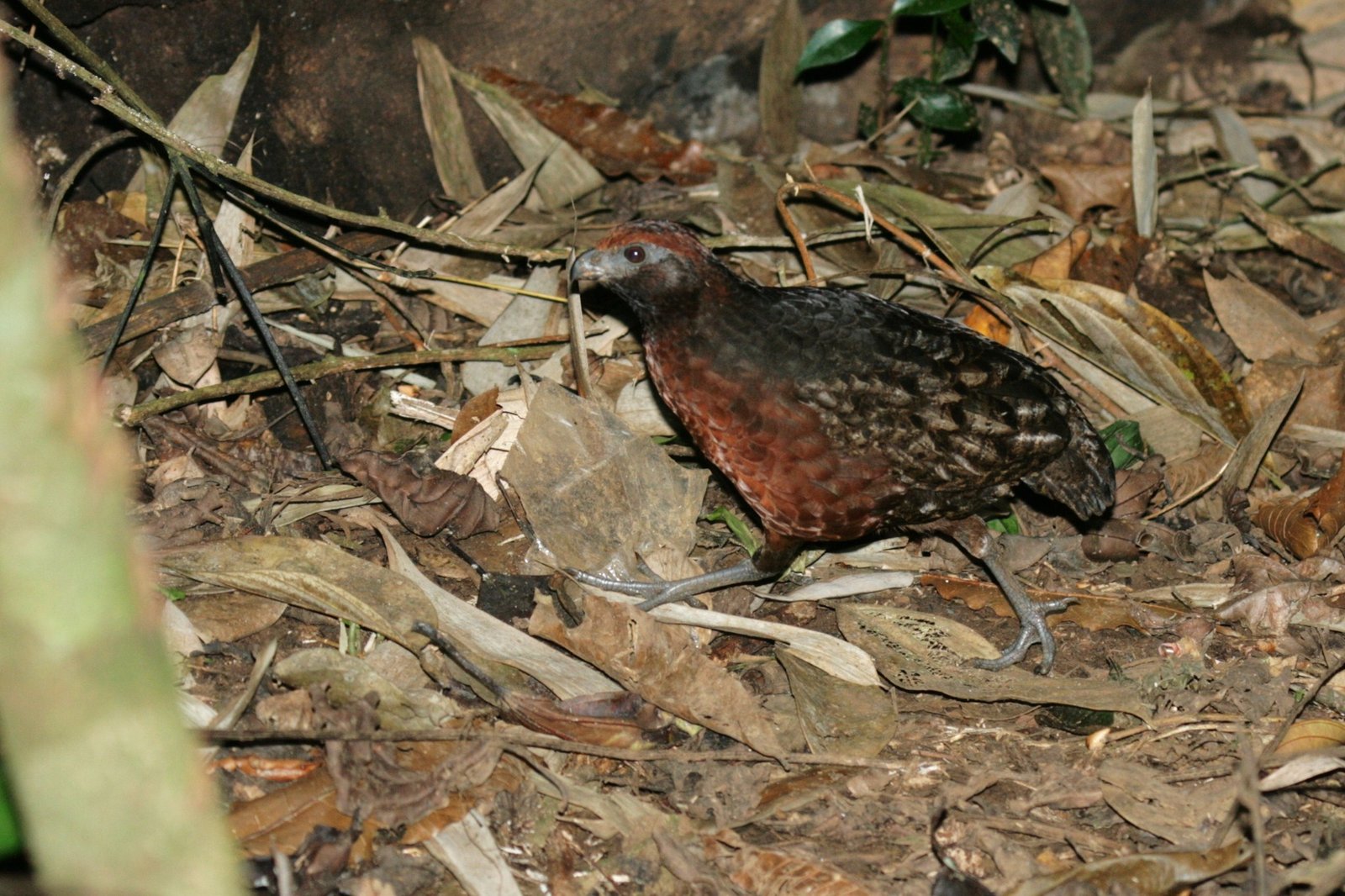
The Black-eared Wood Quail is a dark wood quail with a chestnut breast, found in humid lowland and foothill forest on the Caribbean side of Central America, from Honduras to Panama. Groups live hidden on the forest floor and are mainly heard. The species used to be lumped with Rufous-fronted Wood Quail Odontophorus erythrops of Colombia and Ecuador.
Voice
A repeated, loud, ringing duet that can also be sung by a single bird and carries far, especially at dawn. Within the group soft, chattering contact notes.
Recording: William Adsett — CC BY-NC-SA 4.0 · converted to mono · xeno-canto
Identification
23–26 cm; a stocky wood quail with a short tail and a short crest. The male has an unspotted chestnut crown and crest, a black face, black ear area and black throat, and a chestnut-rufous breast and belly. The upperparts are dark brown, finely vermiculated black, with small pale spots on the wings. Around the eye is a narrow, dark purplish-blue bare ring; the bill is black, the legs blue-black. The female is duller, with a darker head and browner underparts.
Confusion species
Marbled Wood Quail Odontophorus gujanensis is plain dark brown, without a chestnut breast, with conspicuous orange-red skin around the eye; in Costa Rica it lives mainly on the Pacific side. Black-breasted Wood Quail Odontophorus leucolaemus lives higher and has a white throat and a black breast. Tawny-faced Quail Rhynchortyx cinctus is smaller, without a crest, with a rufous-orange face and a grey breast.
Habitat
The floor of humid lowland rainforest and foothill forest, also old secondary forest, from sea level to about 1100 m. It lives in small groups that forage together in the leaf litter for seeds, fruit and invertebrates. It avoids open country and small forest remnants.
Where the bird is most at home, classified by the vegetation units of Mexico and Central America.



Range and movements
On the Caribbean side of Honduras and Nicaragua, in the Caribbean lowlands and foothills of Costa Rica, and in Panama mainly on the Caribbean side, into the Canal Zone and further east. Outside the guide area probably only in extreme north-western Colombia.
- Resident
- dark = core range, pale = thinly spread
How and when to look
In Costa Rica in the Caribbean foothills, for example in the lowest part of Braulio Carrillo, and in Panama along Pipeline Road in Soberanía. The groups run off quickly when disturbed; the best chances are early in the morning on quiet trails.
Conservation status
Near Threatened. The species is declining through the loss of lowland forest on the Caribbean side and through hunting. In large protected forests it is still locally fairly common.
Scientific name
Odontophorus melanotis | Salvin, 1865
Salvin described the species in 1865 and placed it straight away in the genus where it still stands. The genus Odontophorus was introduced in 1816 by Vieillot. Odontophorus is Greek, from odous, odontos 'tooth' and -phoros 'bearing': 'tooth-bearer', after the serrated edge of the lower mandible. melanotis is Greek, from melas 'black' and ous, ōtos 'ear', after the black ear region. The specimen the first description was based on came from Tucurrique, Costa Rica.