All species › Gamebirds › New World quail › Marbled Wood Quail
Position in the tree Birds Aves › Birds with a flexible palate Neognathae › Fowl Galloanserae
Marbled Wood Quail | Odontophorus gujanensis
Gemarmerde tandkwartel | Corcovado común
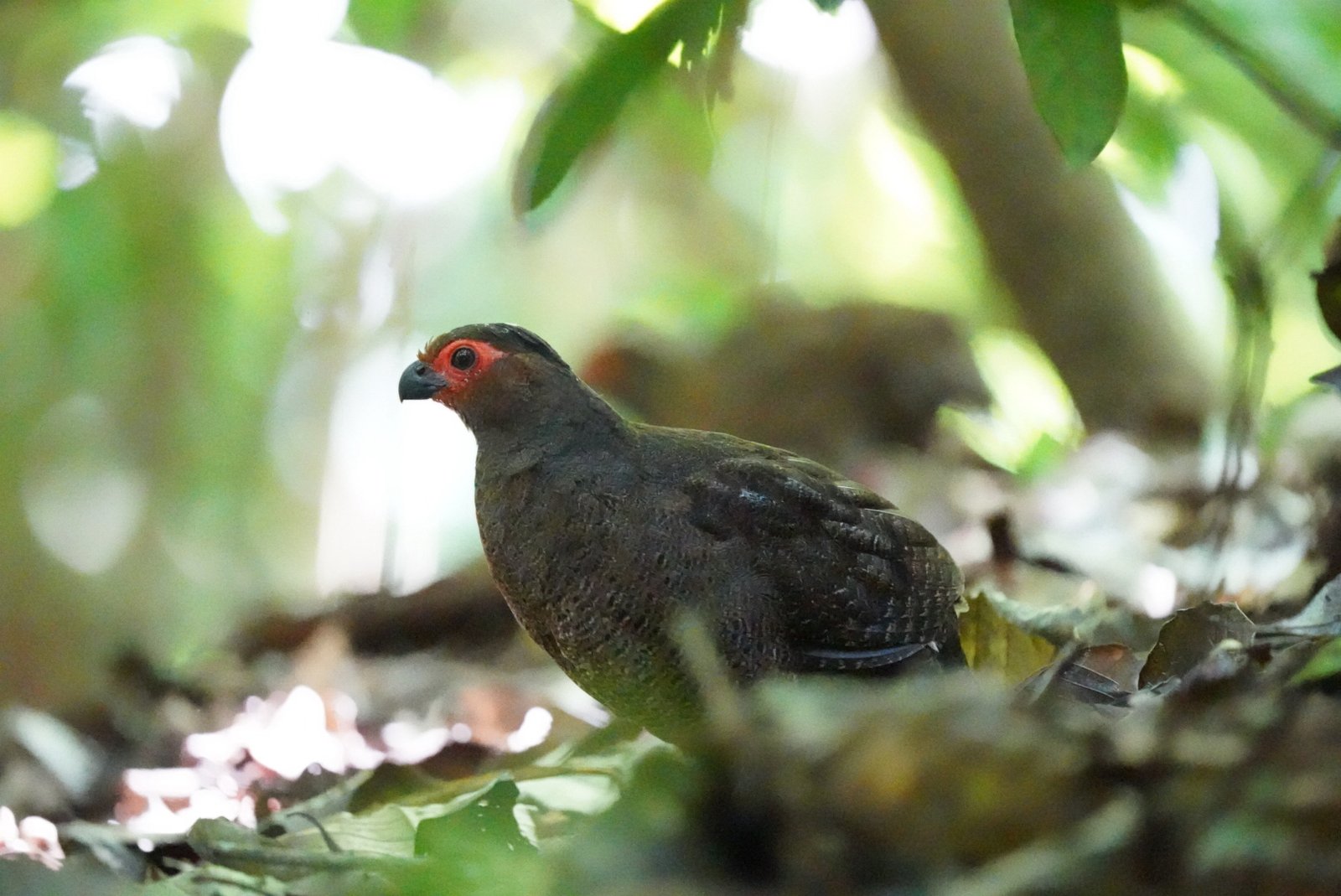
The Marbled Wood Quail is the most widespread wood quail of tropical America and reaches the northern limit of its range in Costa Rica. It is a dark brown forest-floor quail with bright orange-red skin around the eye. Groups walk hidden through lowland forest and give themselves away mainly by their rhythmic chorus at dawn.
Voice
A fast, rhythmic and rolling chorus, sung as a duet by pairs and groups and lasting for minutes, roughly korkorovado korkorovado. Heard mainly at dawn and dusk.
Recording: Jose Martin — CC BY-NC-SA 4.0 · converted to mono · xeno-canto
Identification
23–29 cm; a stocky wood quail with a short tail, a short, bushy brown crest and bare orange-red skin around the eye. The plumage is almost entirely dark brown, finely marbled black and ochre on the upperparts, with small pale spots on the wing coverts; the underparts are greyer brown and finely barred dark. The bill is blackish, short and stout, the legs grey. Male and female are almost alike. The subspecies in Costa Rica and western Panama is O. g. castigatus, in eastern Panama O. g. marmoratus.
Confusion species
Black-eared Wood Quail Odontophorus melanotis has a chestnut breast and belly and a blackish face and throat, without an orange eye-ring, and lives in Costa Rica mainly on the Caribbean side. Black-breasted Wood Quail Odontophorus leucolaemus and Spotted Wood Quail Odontophorus guttatus live higher in montane forest and have a black breast with a white throat and white teardrop spots respectively. Tawny-faced Quail Rhynchortyx cinctus is smaller, without a crest, with a rufous-orange head. Tinamous such as Great Tinamou Tinamus major are larger, without a crest and without an orange eye-ring.
Habitat
The floor of humid lowland rainforest and foothill forest, also tall secondary forest, from sea level to about 1500 m, mainly below 1000 m. It lives in groups of four to ten birds, which scratch close together in the leaf litter for seeds, fallen fruit and invertebrates. The group roosts together on a low branch.
Where the bird is most at home, classified by the vegetation units of Mexico and Central America.




Range and movements
In the guide area in Costa Rica on the Pacific side, from the Carara area and the Gulf of Nicoya south through the Valle del General to the Osa Peninsula, and in Panama in the lowlands and foothills of both slopes, east to Darién. Outside the guide area widespread in northern South America, from Colombia and Venezuela to the Guianas and Amazonian Brazil, Ecuador, Peru and Bolivia.
- Resident
- dark = core range, pale = thinly spread
How and when to look
The best chances are at Carara and in Corcovado National Park on Osa, early in the morning on quiet forest trails. The chorus carries far; when disturbed the birds walk away and rarely fly.
Conservation status
Not threatened. Fairly common in Costa Rica and Panama in large, undisturbed forests; outside protected areas vulnerable to hunting and deforestation, and gone from fragmented forest.
Scientific name
Odontophorus gujanensis | (Gmelin, 1789)
Gmelin described the species in 1789 as Tetrao gujanensis; because it was later moved to another genus, the author and year stand in brackets. The genus Odontophorus was introduced in 1816 by Vieillot. Odontophorus is Greek, from odous, odontos 'tooth' and -phoros 'bearing': 'tooth-bearer', after the serrated edge of the lower mandible. gujanensis means 'of Guiana', after the origin of the type specimen. The specimen the first description was based on came from Cayenne, French Guiana.