All species › Passerines › New World blackbirds, troupials and allies › Black-cowled Oriole
Position in the tree Birds Aves › Birds with a flexible palate Neognathae › All other modern birds Neoaves › Landbirds Telluraves › Falcons, parrots and passerines Australaves › Falcons and passerines Eufalconimorphae › Parrots and passerines Psittacopasserae
Black-cowled Oriole | Icterus prosthemelas
Zwartborsttroepiaal | Bolsero capucha negra
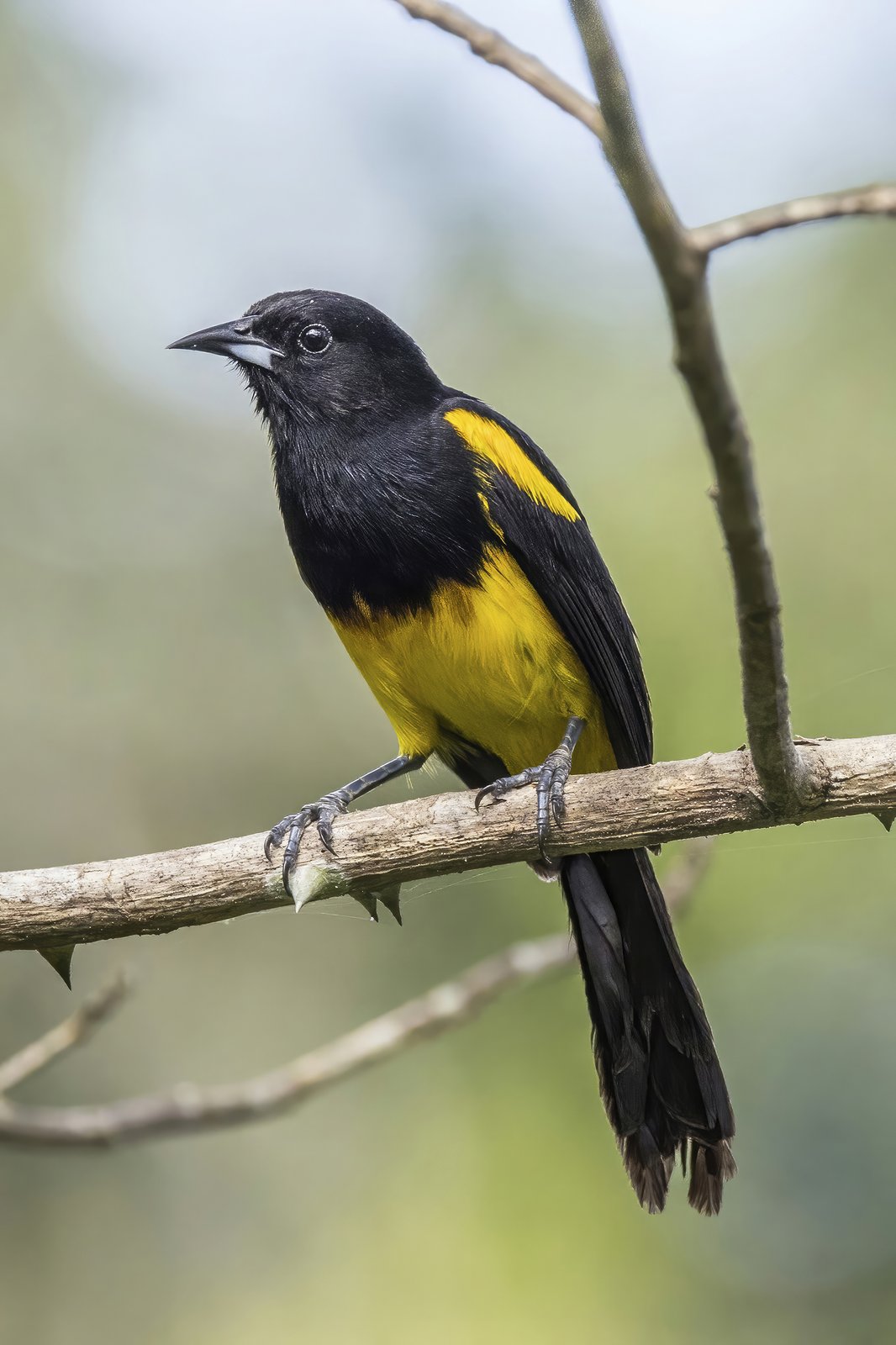
The Black-cowled Oriole is a black-and-yellow oriole of forest edges and plantations in the humid Caribbean lowlands. The male has a black hood reaching onto the breast and a yellow belly, rump and shoulder. For a long time it was regarded as one species together with the orioles of the Greater Antilles and the Bahamas. In the guide area it lives from south-eastern Mexico to western Panama.
Voice
The song is a hesitant, short series of sweet whistles, often with chattering notes in between. Calls include a dry chek and a nasal eenk.
Recording: GABRIEL LEITE — CC BY-NC-SA 4.0 · converted to mono · xeno-canto
Identification
19–21 cm. Male: head, breast, back, wings and tail black; shoulder, rump, belly and undertail coverts yellow, with a narrow chestnut border between the black breast and yellow belly. The female of the northern populations has an olive-yellow crown and back, yellow underparts and a black face and throat; in Costa Rica and Panama the female closely resembles the male. Young birds are olive-yellow with a black throat. Bill slender and slightly decurved, black with a bluish-grey base.
Confusion species
Black-vented Oriole Icterus wagleri has a black hood and black undertail coverts, is more orange-yellow and lives higher up, in drier hills and mountains. Yellow-tailed Oriole Icterus mesomelas has a yellow head and yellow in the tail. Yellow-backed Oriole Icterus chrysater has a yellow back and head. The female Orchard Oriole Icterus spurius lacks black on the head and has white wing bars.
Habitat
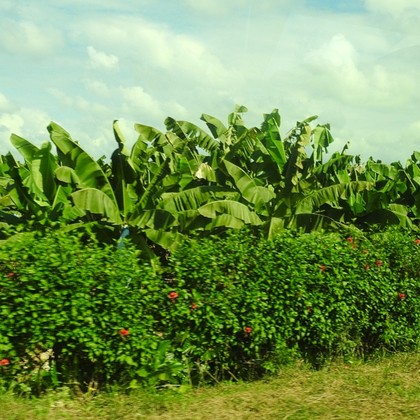
Edges and clearings of humid lowland and foothill forest, secondary forest, banana and cacao plantations, gardens and villages with trees, mostly below 1000 m. It often visits flowering trees and banana flowers for nectar; it also eats insects and fruit. The hanging nest is often sewn to the underside of a banana or palm leaf.
Where the bird is most at home, classified by the vegetation units of Mexico and Central America.




Range and movements
Caribbean slope of south-eastern Mexico (southern Veracruz, Tabasco, northern Chiapas and the south of the Yucatán Peninsula) through Belize, Guatemala, Honduras, Nicaragua and Costa Rica to western Panama (Bocas del Toro). It does not occur outside the guide area.
- Resident
- dark = core range, pale = thinly spread
How and when to look
Often seen in flowering trees along roads and in gardens around La Selva and Tortuguero in Costa Rica. Pairs feed together and give themselves away with their dry call.
Conservation status
Not threatened (LC). Fairly common and tolerant of disturbance; benefits from plantations and semi-open country with trees.
Scientific name
Icterus prosthemelas | (Strickland, 1850)
Strickland described the species in 1850 as Xanthornus prosthemelas; because it was later moved to another genus, the author and year stand in brackets. The genus Icterus was introduced in 1760 by Brisson. Icterus is from Ancient Greek ikteros, a yellow bird usually taken to be the golden oriole, the sight of which was thought to cure jaundice. prosthemelas is Greek, from prosthe 'in front' and melas 'black', after the black head and breast. The specimen the first description was based on came from Guatemala.