All species › Passerines › Cardinals and allies › Red-headed Tanager
Position in the tree Birds Aves › Birds with a flexible palate Neognathae › All other modern birds Neoaves › Landbirds Telluraves › Falcons, parrots and passerines Australaves › Falcons and passerines Eufalconimorphae › Parrots and passerines Psittacopasserae
Red-headed Tanager | Piranga erythrocephala
Roodkoptangare | Tángara cabeza roja
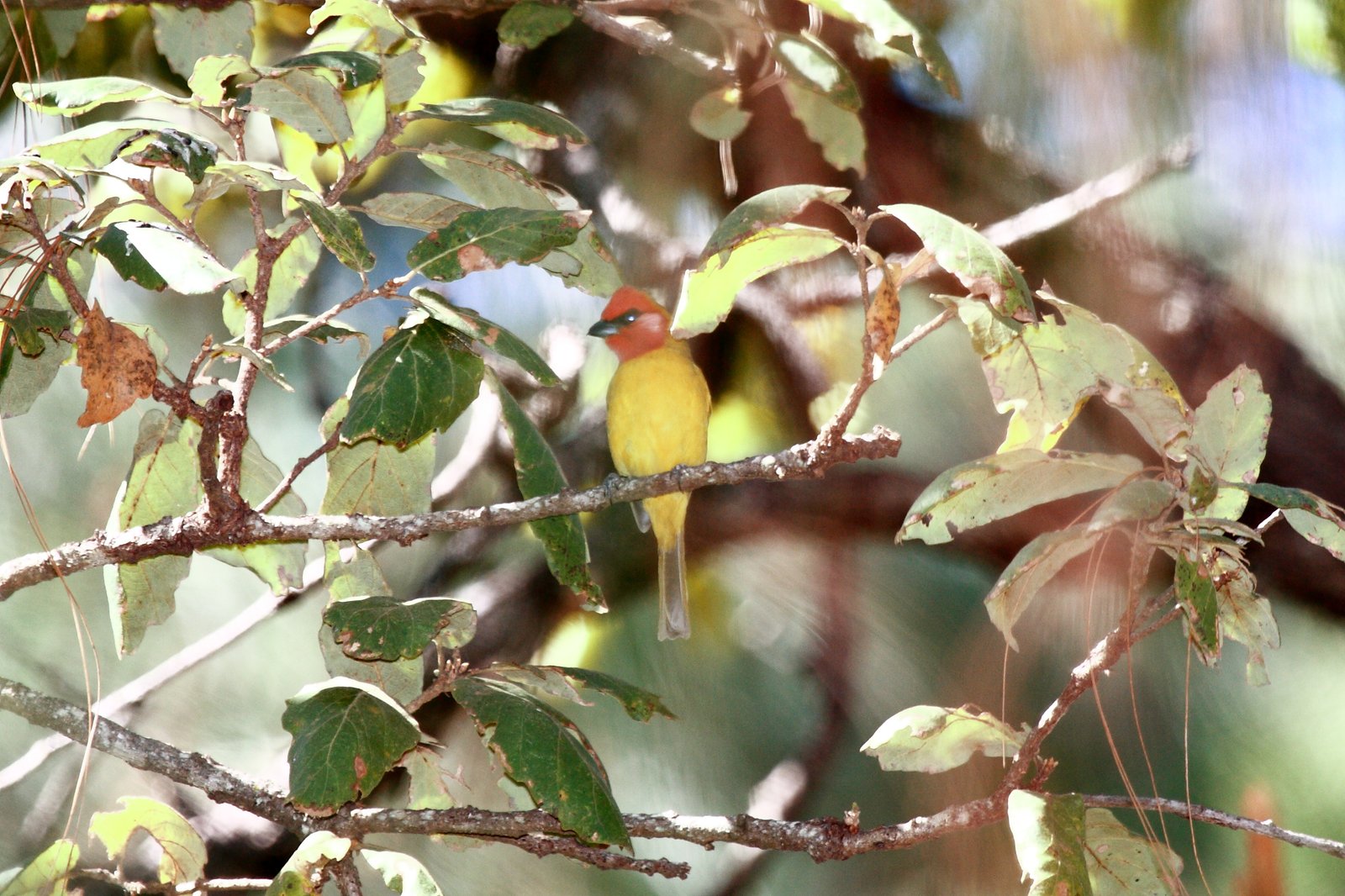
The Red-headed Tanager is a small Piranga tanager of the montane forests of Mexico. The male has a red head and throat above an olive-yellow body; the female is olive-yellow without red. The species is endemic to Mexico and lives mainly in pine-oak and humid montane forest.
Voice
The song is a fairly fast, twittering series of whistled notes, somewhat less rich than that of larger tanagers. The call is a dry chet or a short, falling whistle.
Recording: Matthew L. Brady — CC BY-NC-SA 4.0 · shortened to the first 60 s, mono · xeno-canto
Identification
14–15 cm. A small, compact tanager with a fairly short, thick grey bill. The male has a red head and throat with dark lores; back olive-grey, rump and underparts olive-yellow to yellow, belly paler. Wings and tail dark olive-grey without wing bars. The female is olive-green above and yellow below, with a yellower throat and forehead. Young males resemble the female with some orange-red on the head.
Confusion species
Hepatic Tanager Piranga flava is larger, with a dark bill, and the male has a wholly reddish body. The female Western Tanager Piranga ludoviciana has distinct wing bars. The female Summer Tanager Piranga rubra is larger, with a longer, pale bill and a warmer ochre-yellow tone.
Habitat
Pine-oak forest, oak forest and humid montane forest, especially along forest edges, in ravines and in clearings with tall trees; mainly between 1200 and 3000 m. Outside the breeding season sometimes lower. It feeds in the middle storey and canopy on insects and fruit, often in mixed flocks.
Where the bird is most at home, classified by the vegetation units of Mexico and Central America.



Range and movements
Endemic to Mexico: in the Sierra Madre Occidental from south-eastern Sonora and south-western Chihuahua through Sinaloa, Durango and Nayarit to Jalisco and Michoacán, and further south-east in the mountains of México State, Morelos, Guerrero and Oaxaca.
- Resident
- dark = core range, pale = thinly spread
How and when to look
Found in pine-oak and montane forest, for example along the Durango–Mazatlán highway at Barranca Rancho Liebre or in the mountains near Volcán de Fuego in Jalisco. It often feeds with mixed flocks in the middle storey.
Conservation status
Not threatened (LC). Locally fairly common in montane forest; declines where pine-oak forest is logged.
Scientific name
Piranga erythrocephala | (Swainson, 1827)
Swainson described the species in 1827 as Spermagra erythrocephala; because it was later moved to another genus, the author and year stand in brackets. The genus Piranga was introduced in 1808 by Vieillot. Piranga comes from the Tupi tijepiranga, the name of an unidentified small bird. erythrocephala is Greek, from eruthros 'red' and kephalē 'head', after the male's red head. The specimen the first description was based on came from Temascaltepec, Mexico.