All species › Passerines › Silky-flycatchers › Black-and-yellow Phainoptila
Position in the tree Birds Aves › Birds with a flexible palate Neognathae › All other modern birds Neoaves › Landbirds Telluraves › Falcons, parrots and passerines Australaves › Falcons and passerines Eufalconimorphae › Parrots and passerines Psittacopasserae
Black-and-yellow Phainoptila | Phainoptila melanoxantha
Geelflankzijdevliegenvanger | Capulinero negro y amarillo
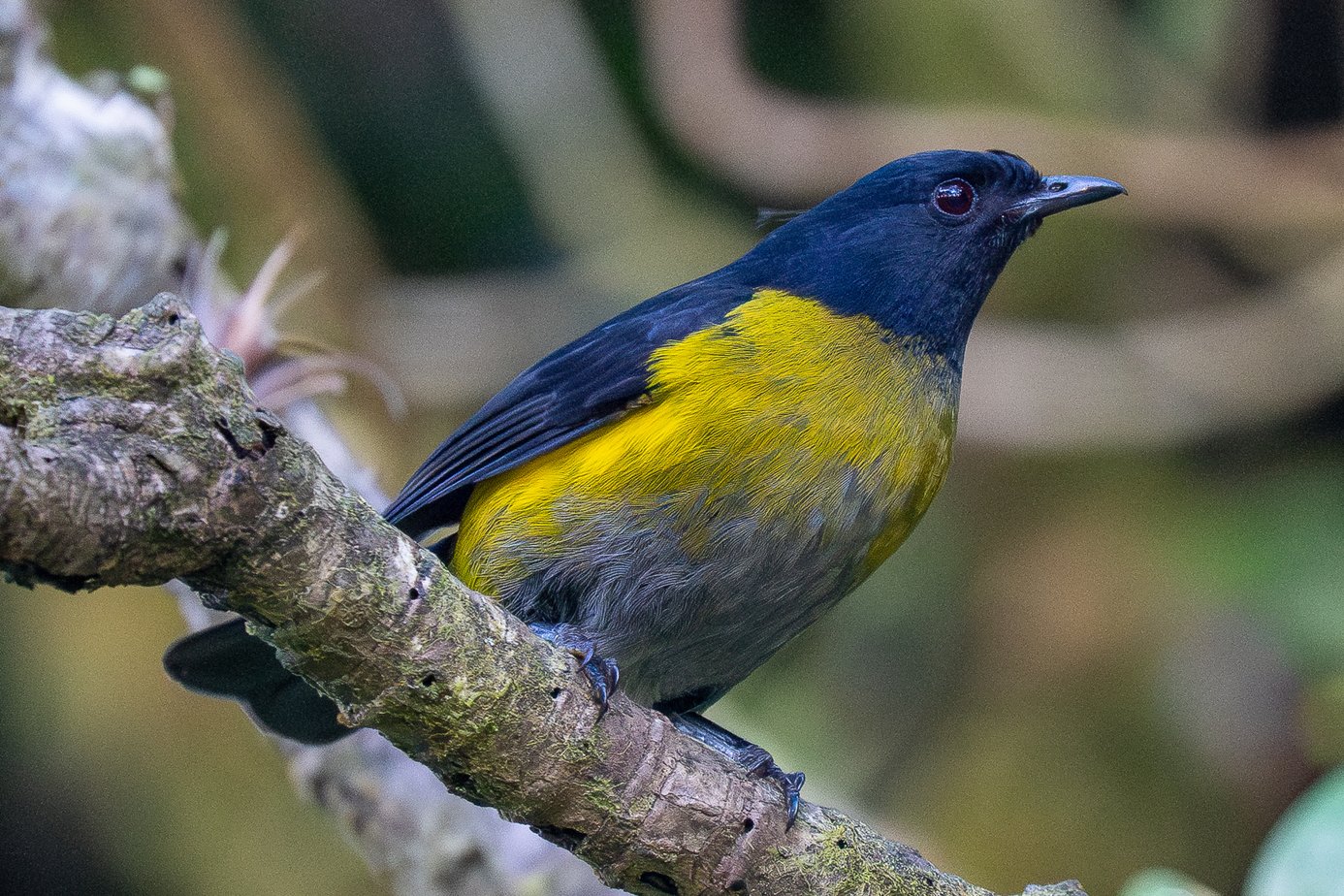
The Black-and-yellow Phainoptila is a bulky, thrush-like silky-flycatcher without a crest, with yellow flanks. It lives quietly and often inconspicuously in the middle levels of montane forest. It occurs only in the highlands of Costa Rica and western Panama.
Voice
Mostly silent. Calls with high, thin tsit notes.
Recording: Enrique Varela — CC BY-NC-SA 4.0 · converted to mono · xeno-canto
Identification
21–23 cm. Stocky, with a short, thick bill and a medium-length tail. The male is glossy blue-black on the head, back, wings and tail, with an olive-yellow rump; throat and breast olive, flanks bright yellow, belly grey. The female has a black crown, grey nape and olive-green upperparts, also with yellow flanks and a grey belly.
Confusion species
Long-tailed Silky-flycatcher Ptiliogonys caudatus is slimmer, with a crest, a much longer tail and a blue-grey body. Sooty Thrush Turdus nigrescens is plain dark brown with an orange bill and orange legs and lacks the yellow on the flanks.
Habitat
Humid montane forest and its edges, also mature secondary forest, mostly above about 1800 m, locally lower. It eats mainly berries and other fruit, as well as insects.
Where the bird is most at home, classified by the vegetation units of Mexico and Central America.


Range and movements
Only in the highlands of Costa Rica (Cordillera Central and Cordillera de Talamanca) and western Panama (mainly Chiriquí and adjacent provinces). Not outside the guide area.
- Resident
- dark = core range, pale = thinly spread
How and when to look
Best found in fruiting shrubs and trees in the montane forest of the Cordillera de Talamanca, for example around Cerro de la Muerte, and on the slopes of Volcán Barú in Panama. It often sits still for long periods.
Conservation status
Not threatened. Fairly common but inconspicuous in montane forest within a small range; dependent on the survival of that forest.
Scientific name
Phainoptila melanoxantha | Salvin, 1877
Salvin described the species in 1877 and placed it straight away in the genus where it still stands. He introduced the genus Phainoptila in that same work. Phainoptila is Greek, from phaeinos 'shining' and ptilon 'feather': 'with shining plumage'. melanoxantha is Greek, from melas 'black' and xanthos 'yellow', after the black and yellow of the male. The specimen the first description was based on came from San Francisco, Costa Rica.