All species › Passerines › New World warblers › Black-and-white Warbler
Position in the tree Birds Aves › Birds with a flexible palate Neognathae › All other modern birds Neoaves › Landbirds Telluraves › Falcons, parrots and passerines Australaves › Falcons and passerines Eufalconimorphae › Parrots and passerines Psittacopasserae
Black-and-white Warbler | Mniotilta varia
Bonte zanger | Chipe trepador
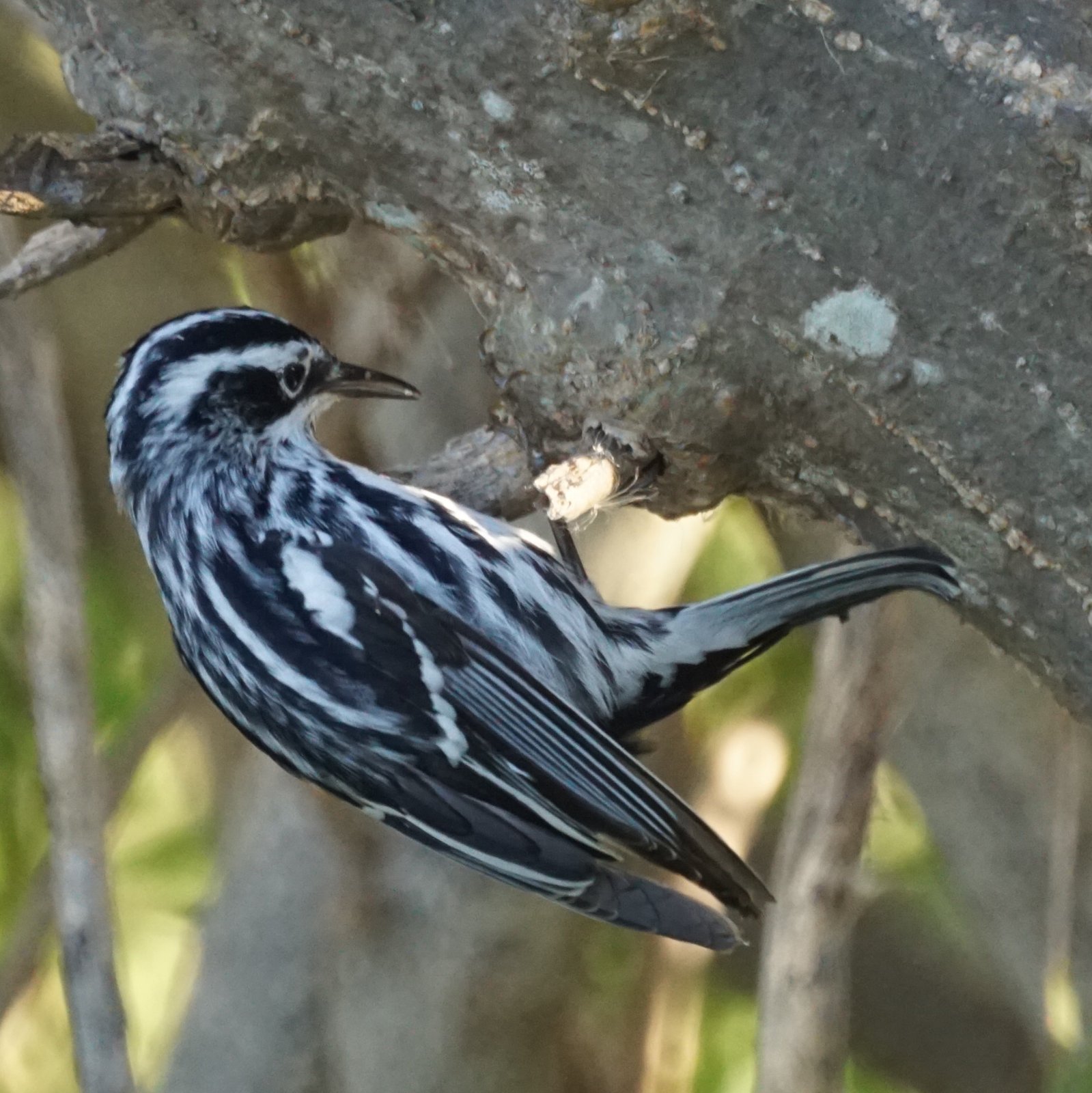
The Black-and-white Warbler is a black-and-white striped warbler that creeps over trunks and large branches like a nuthatch. It breeds in deciduous and mixed forest in Canada and the eastern United States. In the guide area it is one of the most widespread wintering warblers, in almost every forest type from the lowlands into the mountains.
Voice
The song is a high, squeaky series of repeated two-note phrases, weesy weesy weesy weesy, like a squeaking wheel. The call is a dry tsik; in flight a thin tseet. In winter mainly the call, in spring also song.
Recording: Bobby Wilcox — CC BY-NC-SA 4.0 · converted to mono · xeno-canto
Identification
11–13 cm. Streaked black and white throughout, with a white central crown stripe and a white supercilium. Two white wing bars; undertail coverts white with black spots. In breeding plumage the male has a black throat and black cheeks; in winter the throat is partly white. Female and young birds have a white throat, grey cheeks and often a faint buff wash on the flanks. Bill slightly longer and more curved than in most warblers.
Confusion species
Blackpoll Warbler Setophaga striata (breeding male, only on passage) has a solid black crown without a white central stripe and white cheeks, and forages in the foliage. Black-throated Grey Warbler Setophaga nigrescens has an unstreaked grey back and a small yellow spot in front of the eye, and does not creep over trunks.
Habitat
In winter almost any type of forest and wooded country: humid and dry lowland forest, foothill forest, cloud forest, pine-oak forest, mangrove, secondary forest, shade coffee and parks and gardens with large trees, from sea level to above 2000 m. It searches bark crevices for insects and spiders and often joins mixed flocks.
Where the bird is most at home, classified by the vegetation units of Mexico and Central America.







Range and movements
Breeds from north-western Canada to the eastern and south-eastern United States. Winters from the southern United States through Mexico, Central America and the Caribbean to northern South America. In the guide area almost everywhere except the driest desert areas of the north-west; on passage there too.
- Winter visitor (c. Oct–Mar)
- dark = core range, pale = thinly spread
How and when to look
In winter often in mixed flocks in forest and gardens; recognisable as the bird creeping over the trunk and the undersides of branches.
Conservation status
Not threatened (LC). Common and widespread; has declined slowly on the breeding grounds.
Scientific name
Mniotilta varia | (Linnaeus, 1766)
Linnaeus described the species in 1766 as Motacilla varia; because it was later moved to another genus, the author and year stand in brackets. The genus Mniotilta was introduced in 1816 by Vieillot. Mniotilta is Greek, from mnion 'moss' and tillō 'to pluck': 'moss-plucker', after its foraging for insects on mossy trunks and branches. varia is Latin for 'variegated', after the black-and-white striped plumage. The specimen the first description was based on came from Hispaniola (Santo Domingo).