All species › Birds of prey › Kites, Old World vultures, eagles and hawks › Black-and-white Hawk-Eagle
Position in the tree Birds Aves › Birds with a flexible palate Neognathae › All other modern birds Neoaves › Landbirds Telluraves › Raptors, owls, kingfishers and woodpeckers Afroaves › Hawks and owls Hieraves
Black-and-white Hawk-Eagle | Spizaetus melanoleucus
Zwart-witte kuifarend | Águila blanquinegra
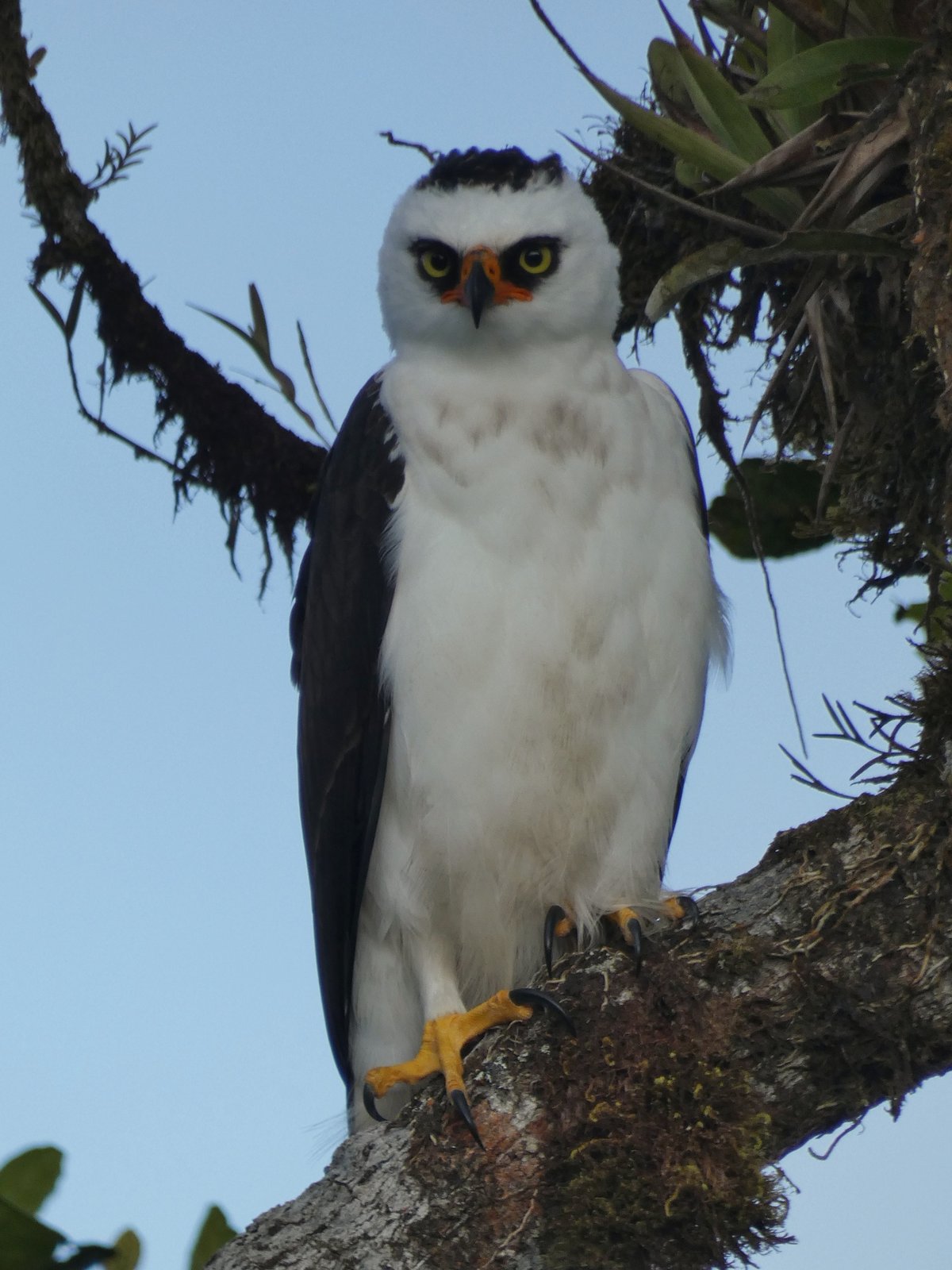
The Black-and-white Hawk-Eagle is a medium-sized forest eagle with a white head and underparts, a black back and a black mask around the eye. It is rare throughout the guide area and is usually seen circling high above the forest. It hunts mainly medium-sized and large birds, such as toucans, parrots, curassows and pigeons, which it seizes from the canopy in a fast stoop. In the guide area it is resident from southern Mexico to Panama.
Voice
Seldom heard. A high, whistled kwee-wheeer and a series of short, sharp notes, mainly in flight and around the nest.
Recording: Douglas Meyer — CC BY-NC-SA 3.0 · shortened to the first 60 s, mono · xeno-canto
Identification
51–61 cm, compact and powerful, with broad wings and a medium-length tail. Head, neck and underparts are white; there is a black mask around the eye and a small black patch with a short crest on the crown. The cere is bright orange-red, the eye yellow to orange. Back and wings are black, the tail black with three or four grey bands. The legs are feathered white to the toes. In flight the body and underwing coverts are almost entirely white, and from above a white leading edge to the wing is visible. Young birds have brownish-tinged upperparts with pale feather edges. Male and female are alike.
Confusion species
Young Ornate Hawk-Eagles Spizaetus ornatus have a longer crest, barred flanks and thighs and no black mask. Pale-morph young Grey-headed Kites Leptodon cayanensis have a black crown cap, a smaller bill, bare yellow legs and a longer tail. The White Hawk Pseudastur albicollis has a dark eye, a short white tail with one black band and black markings on the wings.
Habitat
Humid lowland and foothill forest, including the rainforest of Darién, gallery forest, forest edges and clearings, especially where old forest borders semi-open country. It often perches high on a bare branch at the forest edge or circles high over the forest, dropping onto prey in the canopy. The nest is a large stick platform high in a tree.
Where the bird is most at home, classified by the vegetation units of Mexico and Central America.





Range and movements
A rare and patchily distributed resident from southern Mexico to Panama: in Mexico mainly in Chiapas, Oaxaca, Campeche, Quintana Roo and Veracruz, with scattered records on the Pacific side in Jalisco and Nayarit; further in Belize, Guatemala, Honduras, Nicaragua, Costa Rica and Panama, most numerous in Belize and Panama. Outside the guide area in tropical South America south to northeastern Argentina.
- Resident
- Winter visitor (c. Oct–Mar)
- Passage (Mar–Apr, Oct–Nov)
- dark = core range, pale = thinly spread
How and when to look
The best chance is from a viewpoint over lowland forest during the morning, for example in Belize or along the Panama Canal, where the soaring raptors can be watched. From below it stands out as an almost entirely white eagle with dark wingtips and a banded tail.
Conservation status
Not threatened. Rare in the guide area and sensitive to the loss of large tracts of continuous lowland forest.
Scientific name
Spizaetus melanoleucus | (Vieillot, 1816)
Vieillot described the species in 1816 as Buteo melanoleucus; because it was later moved to another genus, the author and year stand in brackets. The genus Spizaetus was introduced in 1816 by Vieillot. Spizaetus is Greek, from spizias 'hawk' and aetos 'eagle': 'hawk-eagle'. melanoleucus is Greek, from melas 'black' and leukos 'white', after the black back and wings against the white head and underparts. The specimen the first description was based on came from the Guianas (not specified further).