All species › Birds of prey › Kites, Old World vultures, eagles and hawks › Ornate Hawk-Eagle
Position in the tree Birds Aves › Birds with a flexible palate Neognathae › All other modern birds Neoaves › Landbirds Telluraves › Raptors, owls, kingfishers and woodpeckers Afroaves › Hawks and owls Hieraves
Ornate Hawk-Eagle | Spizaetus ornatus
Bonte kuifarend | Águila elegante
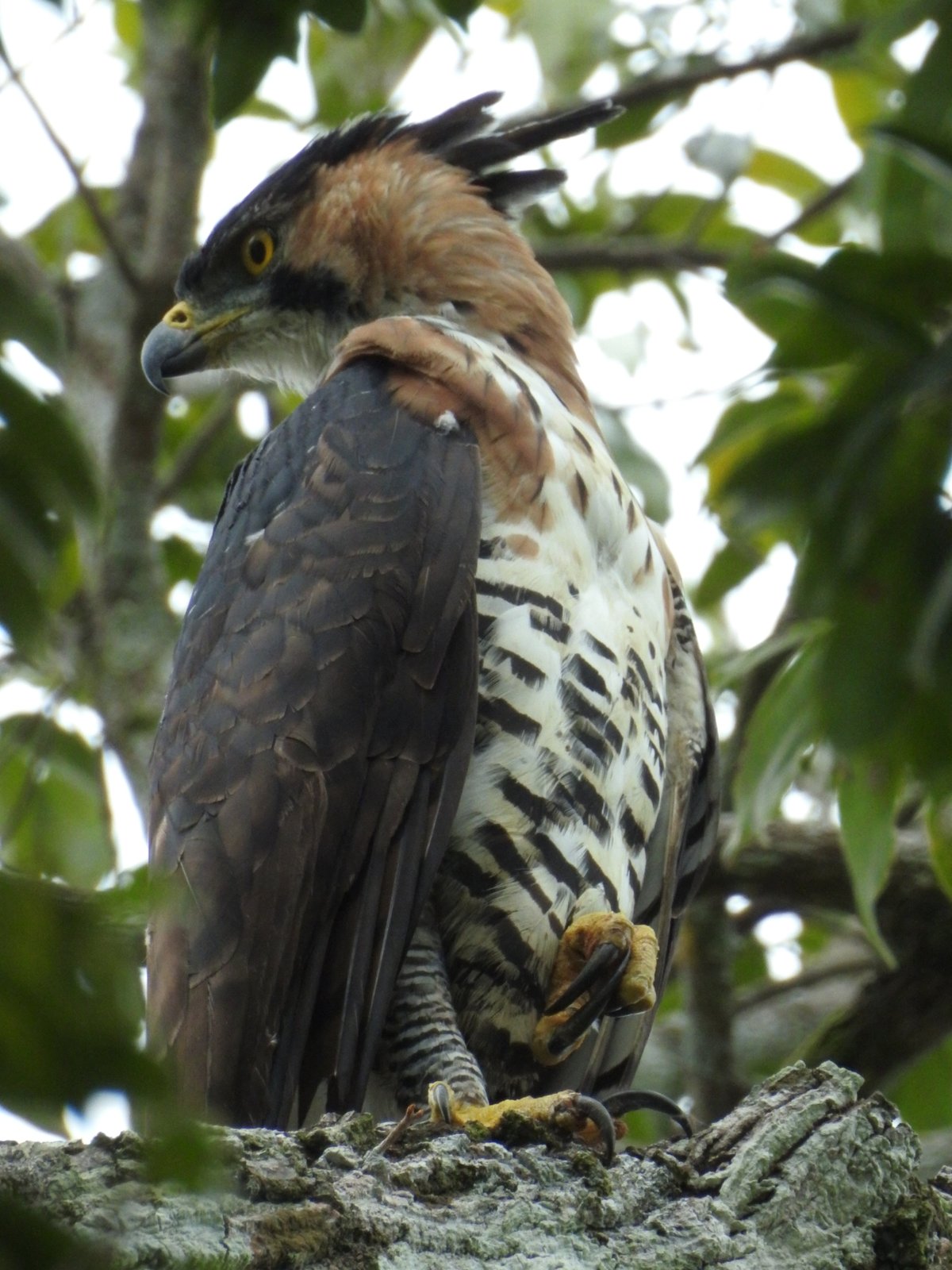
The Ornate Hawk-Eagle is a powerful forest eagle with a long, erectile black crest, a rufous-orange neck, a white throat and black-and-white barred flanks and thighs. It lives in large tracts of continuous humid forest, where it takes birds such as curassows, guans, chachalacas and toucans and mammals up to the size of an agouti. In the guide area it is resident from eastern and southern Mexico to Panama, but has become scarce through deforestation.
Voice
A loud, whistled series, whee-whee-whee-wheep-wheep, or a long note followed by short ones, wheeoo-whip-whip-whip, mainly in flight over the forest and around the nest.
Recording: Jacob Wijpkema — CC BY-NC-SA 4.0 · shortened to the first 60 s, mono · xeno-canto
Identification
56–68 cm, with broad, rounded wings, a long tail and powerful legs feathered to the toes. Adults have a black crown with a long, pointed black crest, rufous-orange sides to the head and neck, a white throat with a black malar stripe and a white breast. Flanks, belly and thighs are densely barred black and white. The upperparts are blackish-brown, the tail has three or four black bands. The eye is yellow to orange. In flight the underwings and body are finely barred. Young birds have a white, crested head, white underparts with some barring on the flanks and thighs and brown upperparts; after fledging they can often be seen near the nest for a long time. Male and female are alike; the female is larger.
Confusion species
Adults are distinctive with their rufous-orange neck and long crest. The Black-and-white Hawk-Eagle Spizaetus melanoleucus resembles the young Ornate Hawk-Eagle but has a black mask around the eye, an orange-red cere, a short crest and unbarred flanks. The Collared Forest Falcon Micrastur semitorquatus is slimmer, with short wings, a long tail, a dark crescent on the cheek and bare legs.
Habitat
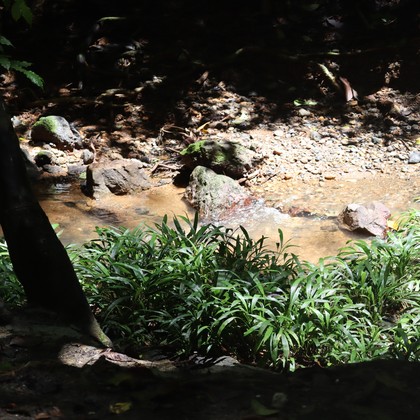
Large tracts of continuous humid lowland, foothill and montane forest, including cloud forest and the rainforest of Darién, and tall seasonal forest on the Yucatán Peninsula. It hunts from a perch in the forest or from the air and circles high over the forest during the morning. The nest is a large stick platform high in a tree that rises above the canopy.
Where the bird is most at home, classified by the vegetation units of Mexico and Central America.





Range and movements
Resident on the Gulf side of Mexico from southern Tamaulipas and San Luis Potosí, south through Veracruz, Oaxaca, Chiapas and the Yucatán Peninsula, with scattered records on the Pacific side in Jalisco and Colima; further through Belize, Guatemala, Honduras, Nicaragua and Costa Rica to Panama. Very scarce in El Salvador. Outside the guide area in tropical South America south to northern Argentina.
- Resident
- dark = core range, pale = thinly spread
How and when to look
At Tikal in Guatemala the species breeds in the forest around the ruins, and birds can sometimes be seen at the nest there. Elsewhere it circles over large forests in southern Mexico, Belize, Costa Rica and Panama in mid-morning, often calling loudly.
Conservation status
Near Threatened. The species depends on large tracts of continuous forest and is declining throughout its range through deforestation; in the guide area it has disappeared locally and is also hunted.
Scientific name
Spizaetus ornatus | (Daudin, 1800)
Daudin described the species in 1800 as Falco ornatus; because it was later moved to another genus, the author and year stand in brackets. The genus Spizaetus was introduced in 1816 by Vieillot. Spizaetus is Greek, from spizias 'hawk' and aetos 'eagle': 'hawk-eagle'. ornatus is Latin for 'adorned', after the crest and the colourful rufous, black and white plumage. The specimen the first description was based on came from Cayenne, French Guiana.