All species › Falcons › Falcons and caracaras › Aplomado Falcon
Position in the tree Birds Aves › Birds with a flexible palate Neognathae › All other modern birds Neoaves › Landbirds Telluraves › Falcons, parrots and passerines Australaves › Falcons and passerines Eufalconimorphae
Aplomado Falcon | Falco femoralis
Aplomadovalk | Halcón fajado
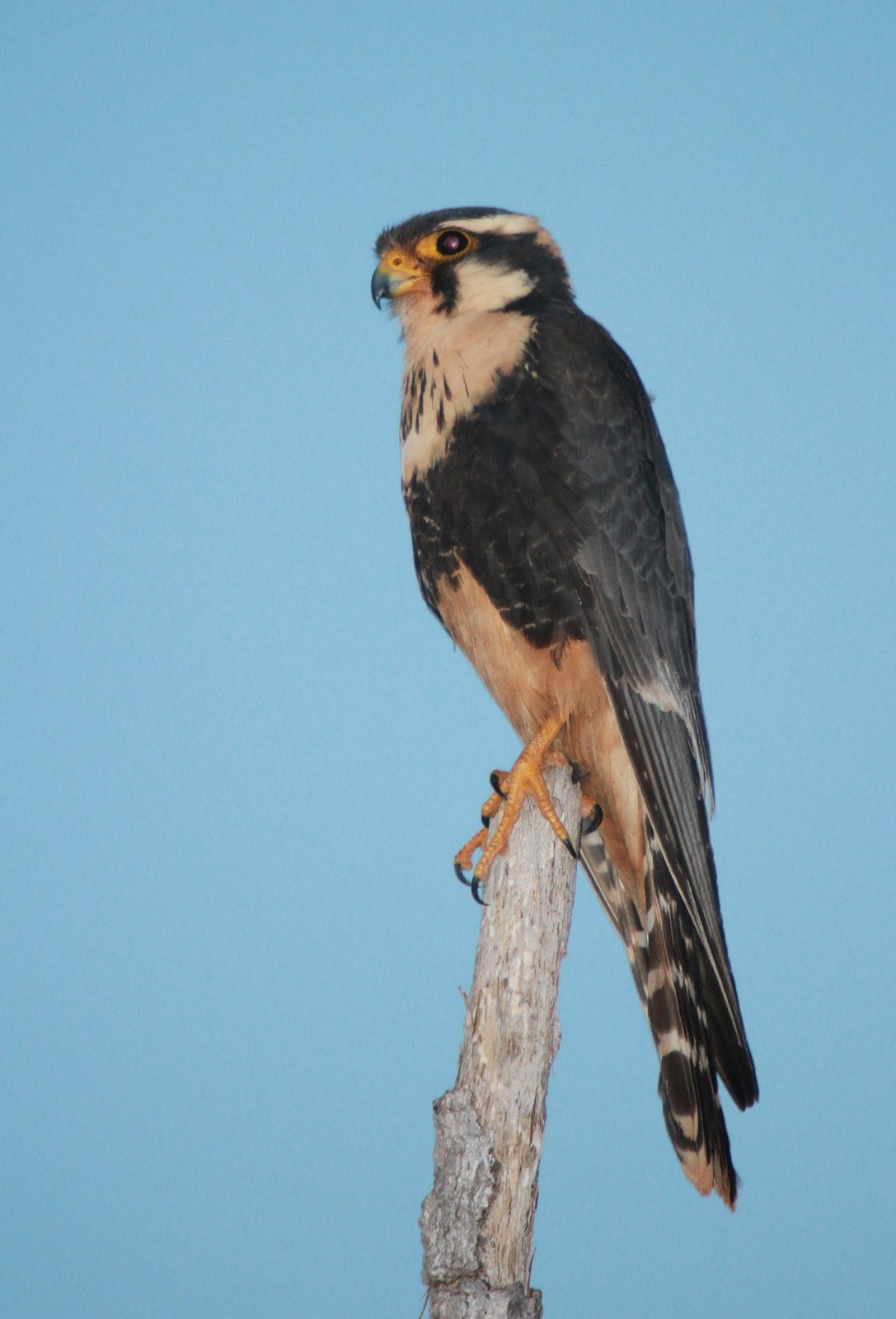
The Aplomado Falcon is a slender falcon with long wings and a long tail that lives in open grassland and savanna. It hunts birds and large insects from a post or treetop or in low, fast flight, often in pairs that chase prey together, and readily follows grass fires to catch flushed prey. In the guide area it is a local resident from northern Mexico to Panama.
Voice
A shrill, repeated kek-kek-kek or kee-kee-kee, mainly around the nest; also wailing calls.
Recording: JAYRSON ARAUJO DE OLIVEIRA — CC BY-NC-SA 4.0 · converted to mono · xeno-canto
Identification
30–40 cm, slender, with long wings and a long tail. Slate grey above. A white to buff eyebrow runs from the forehead to the back of the head, and a black stripe behind the eye and a narrow black moustache frame the white cheek. Throat and breast are white to buff, the flanks and a broad band across the belly black finely barred white, and the lower belly, thighs and undertail coverts cinnamon. The tail is black with narrow white bars. Young birds are browner, with dark streaks on the breast. The female is larger than the male.
Confusion species
The Bat Falcon Falco rufigularis and Orange-breasted Falcon Falco deiroleucus have a black hood without a white eyebrow, a black vest on the breast and a shorter tail. The Peregrine Falcon Falco peregrinus is heavier and has a shorter tail, a broad moustache and no black belly band. The American Kestrel Falco sparverius is smaller and rufous above.
Habitat
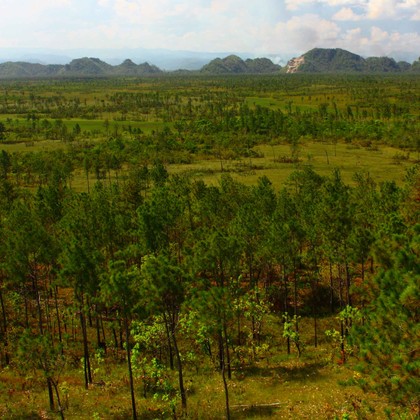
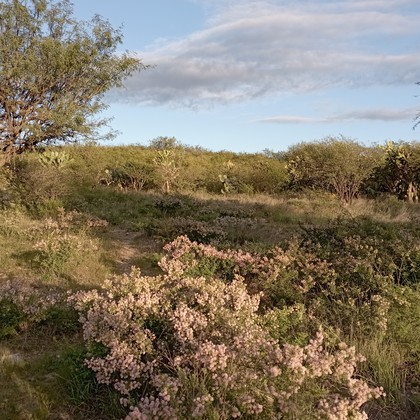
Open grassland and savanna with scattered trees or yuccas, pine savanna, semi-desert grassland, wet grassland and marsh edges, and pasture, from sea level to about 2000 m. It nests in old nests of other birds in a tree or yucca, or on a power pylon. It hunts from a perch or in a low chase.
Where the bird is most at home, classified by the vegetation units of Mexico and Central America.



Range and movements
Local resident. In northern Mexico now only in the grasslands of northern Chihuahua; elsewhere mainly on the coastal plain of Veracruz, Tabasco and Campeche, in savannas of Chiapas and the Yucatán Peninsula, in the pine savannas of Belize, where it is most often seen, and in the savannas of Petén in Guatemala. Rare and local in Honduras and Nicaragua. In the Pacific lowlands of Panama, especially around the Bay of Panama, increasing in recent decades; also recorded more and more often in Costa Rica. Outside the guide area in the southern United States (after reintroduction) and in much of South America.
- Resident
- dark = core range, pale = thinly spread
How and when to look
In Belize best looked for in the pine savannas along the roads north and west of Belize City, where pairs sit on dead trees or pylons. After a grass fire several birds sometimes hunt over the burnt ground.
Conservation status
Not threatened. In northern Mexico and the United States strongly declined through loss of grassland and DDT; the northern population is small and protected.
Scientific name
Falco femoralis | Temminck, 1822
Temminck described the species in 1822 and placed it straight away in the genus where it still stands. The genus Falco was introduced in 1758 by Linnaeus. Falco is Late Latin for 'falcon', from falx, falcis 'sickle', after the sickle-shaped claws of the bird. femoralis is Latin, from femur 'thigh': 'of the thighs', after the rufous thighs and lower belly. The specimen the first description was based on came from Brazil.