All species › Parrots › African and New World parrots › Barred Parakeet
Position in the tree Birds Aves › Birds with a flexible palate Neognathae › All other modern birds Neoaves › Landbirds Telluraves › Falcons, parrots and passerines Australaves › Falcons and passerines Eufalconimorphae › Parrots and passerines Psittacopasserae
Barred Parakeet | Bolborhynchus lineola
Catharinaparkiet | Perico barrado
The Barred Parakeet is a small, stocky green parakeet of montane forest, with fine black bars over the entire plumage and a short, pointed tail. It lives in flocks that wander irregularly through the mountains and gather where bamboo seeds en masse; as a result it may be absent from a site for years and then suddenly numerous. In the guide area it occurs from southern Mexico to western Panama.
Voice
A soft, melodious chatter and a fine, repeated chee-chee or chirr, mainly in flight; flocks are often heard before they are seen, as they pass high and fast.
Recording: Fabrice Schmitt — CC BY-NC-SA 4.0 · converted to mono · xeno-canto
Identification
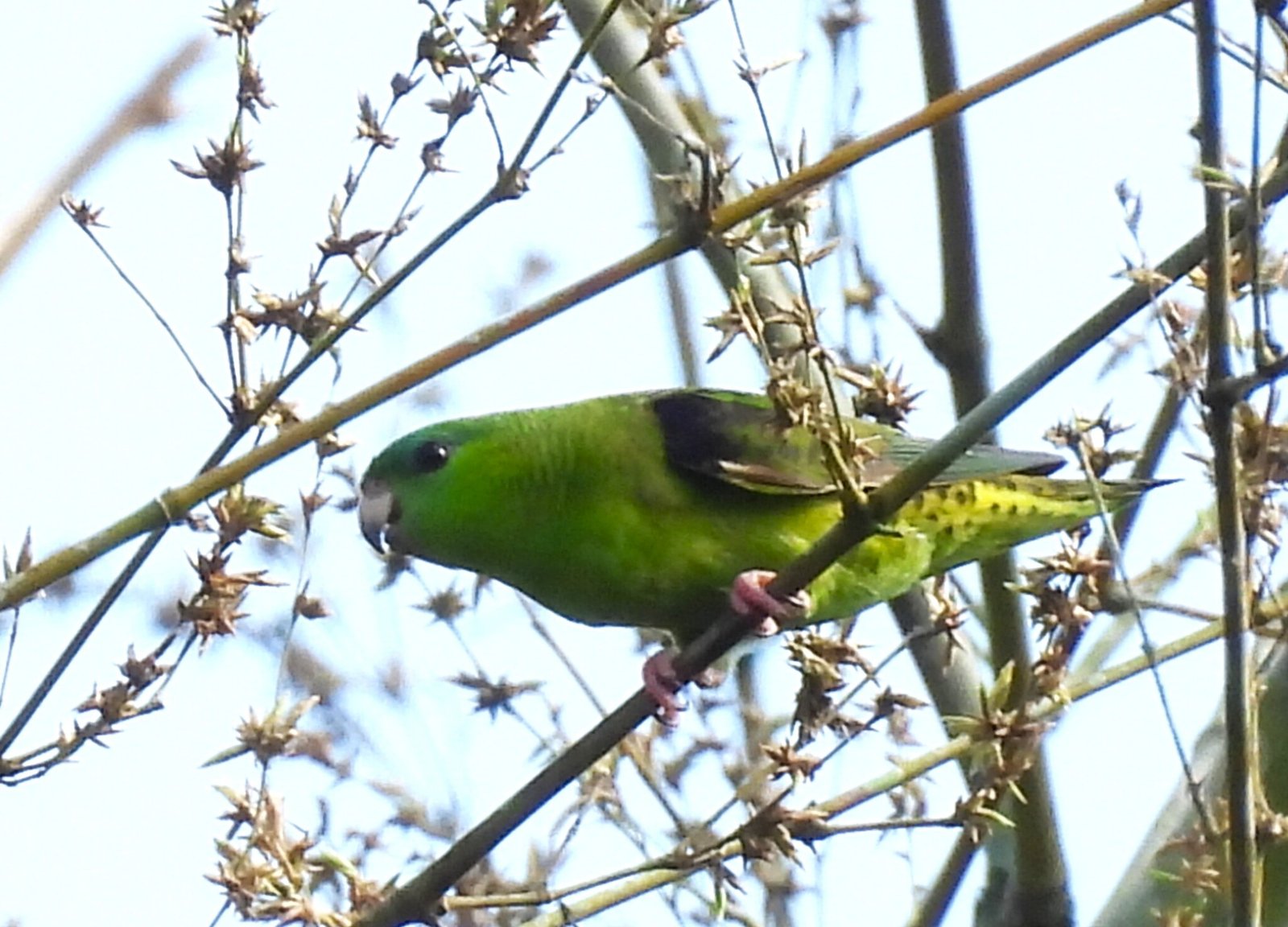
16–17 cm. Mostly green, slightly yellower below, with narrow black bars on the back, flanks and underparts that show at close range as a fine scaly pattern. The lesser wing coverts form a black shoulder patch. The tail is short and pointed, green with black tips. The bill is pale horn and the legs pink. The sexes are similar; the male usually has more black. Flight fast and direct, in tight groups that pass high over the forest.
Confusion species
Red-fronted Parrotlet Touit costaricensis and Blue-fronted Parrotlet Touit dilectissimus are the same size but have a short, square tail, red or blue on the head and red on the wing, and lack the barring. Orange-chinned Parakeet Brotogeris jugularis lives lower down, has an orange chin spot and brown shoulders and is unbarred. Sulphur-winged Parakeet Pyrrhura hoffmanni is larger, with a long, reddish tail and yellow in the wing.
Habitat
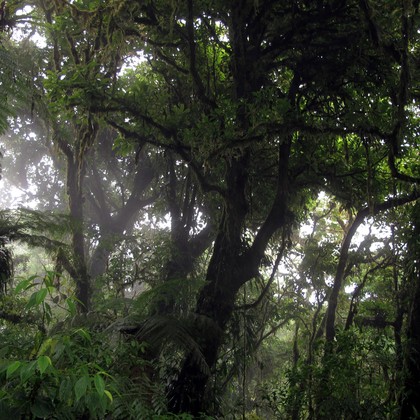
Cloud forest and montane rainforest, especially where bamboo (Chusquea) grows, and pine-oak forest; mostly between 1000 and 3000 m, sometimes lower. Also forest edges and clearings with fruiting trees. It feeds mainly on bamboo seed, also on seeds, flowers and fruit, and forages quietly in the canopy or in the bamboo. It nests in a tree cavity.
Where the bird is most at home, classified by the vegetation units of Mexico and Central America.




Range and movements
Local in the mountains of southern Mexico (Veracruz, Oaxaca and especially Chiapas), Guatemala, Honduras, El Salvador (scarce) and Nicaragua, and in the highlands of Costa Rica and western Panama (Chiriquí, Bocas del Toro and Veraguas). Everywhere irregular and highly variable in numbers. Outside the guide area in the Andes, from Venezuela and Colombia to Peru and Bolivia.
- Resident
- dark = core range, pale = thinly spread
How and when to look
In years when bamboo flowers and sets seed, flocks appear in the montane forests of Costa Rica and Chiriquí, for example around Cerro de la Muerte and Volcán Barú. Usually seen only as groups flying over; the fine chatter above the forest gives them away.
Conservation status
Not threatened. Because of its wandering behaviour the population is poorly known. Sensitive to the loss of montane forest.
Scientific name
Bolborhynchus lineola | (Cassin, 1853)
Cassin described the species in 1853 as Psittacula lineola; because it was later moved to another genus, the author and year stand in brackets. The genus Bolborhynchus was introduced in 1857 by Bonaparte. Bolborhynchus is Greek, from bolbos 'bulb' and rhunkhos 'bill', after the short, bulbous bill. lineola is Latin for 'little line', after the fine black barring across the green plumage. The specimen the first description was based on came from Puente Nacional, Veracruz, Mexico.