All species › Passerines › New World sparrows › Baird's Junco
Position in the tree Birds Aves › Birds with a flexible palate Neognathae › All other modern birds Neoaves › Landbirds Telluraves › Falcons, parrots and passerines Australaves › Falcons and passerines Eufalconimorphae › Parrots and passerines Psittacopasserae
Baird's Junco | Junco bairdi
Bairds junco | Junco de Baja California
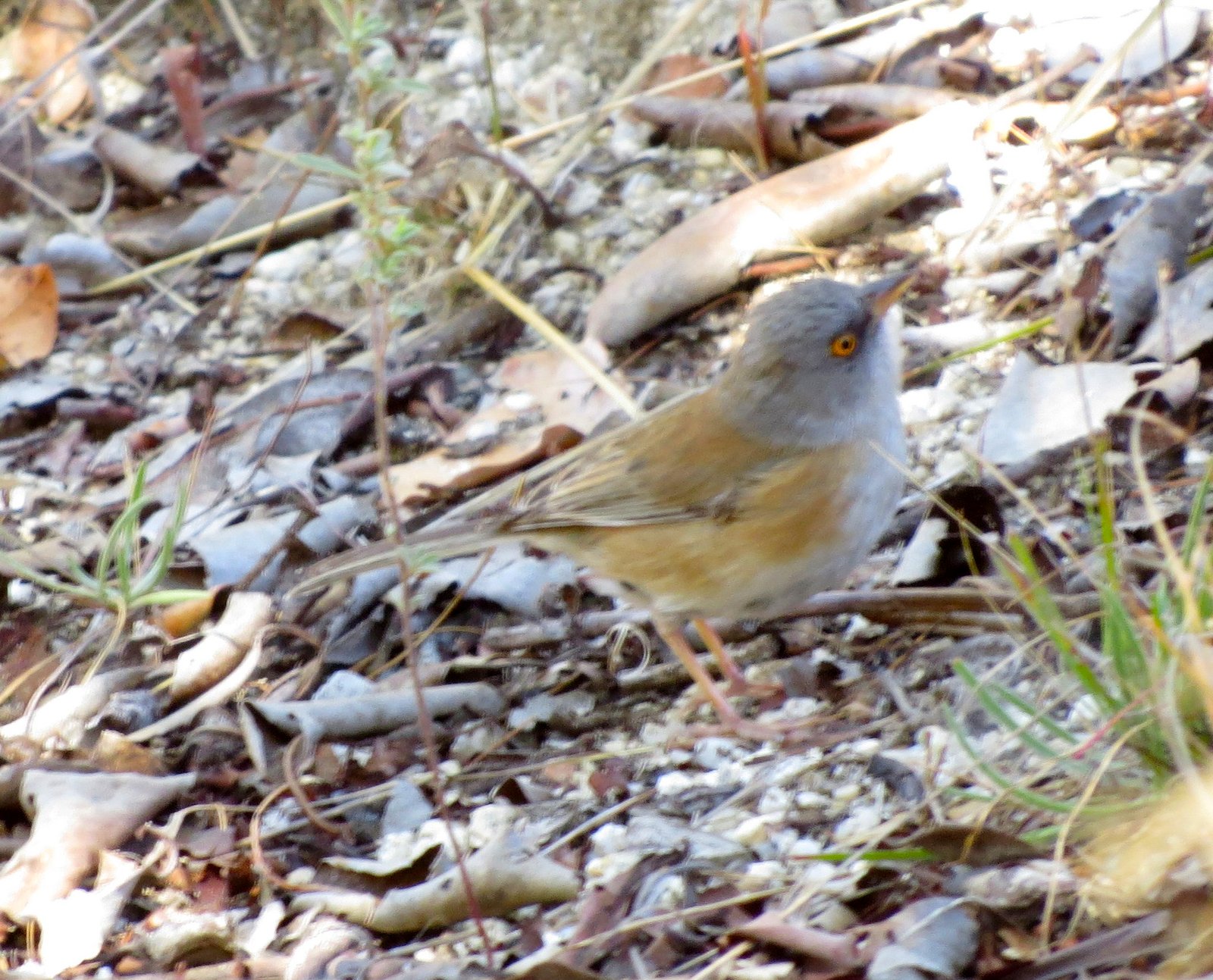
Baird's Junco is a small junco found only in the Sierra de la Laguna, at the southern tip of Baja California Sur. It resembles the Yellow-eyed Junco, of which it was long treated as a subspecies; several taxonomic lists now treat it as a separate species.
Voice
The song is a short series of clear, alternating notes and trills, simpler in structure than that of Yellow-eyed Junco. Call a thin tseet.
Recording: Isain Contreras Rodríguez — CC BY-NC-SA 4.0 · converted to mono · xeno-canto
Identification
14–15 cm. Iris yellow. Head and neck grey with dark lores, back rufous, breast and flanks pale cinnamon to buff-brown, belly white. Upper mandible dark, lower mandible pale. Outer tail feathers white. Smaller and paler than Yellow-eyed Junco, with more warm brown on breast and flanks.
Confusion species
Yellow-eyed Junco Junco phaeonotus of the mainland is larger and has a greyer breast and flanks; the ranges do not overlap. Dark-eyed Junco Junco hyemalis has dark eyes and does not occur in the Sierra de la Laguna.
Habitat
Oak and pine-oak forest in the highest parts of the Sierra de la Laguna, roughly above 1500 m, with clearings and abundant leaf litter. It forages on the ground for seeds and insects.
Where the bird is most at home, classified by the vegetation units of Mexico and Central America.

Range and movements
Endemic to the Sierra de la Laguna in southern Baja California Sur. Found nowhere else.
- Resident
- dark = core range, pale = thinly spread
How and when to look
Seen only after a long climb to the upper parts of the Sierra de la Laguna, where it is fairly common in clearings in the pine-oak forest.
Conservation status
Near Threatened (NT). The range is very small and confined to a single mountain range. Forest fires, grazing by livestock and climate change are potential threats.
Scientific name
Junco bairdi | Ridgway, 1883
Ridgway described the species in 1883 and placed it straight away in the genus where it still stands. The genus Junco was introduced in 1831 by Wagler. Junco comes from Latin iuncus meaning 'rush'. bairdi honours the American zoologist Spencer Fullerton Baird (1823–1887), secretary of the Smithsonian Institution. The specimen the first description was based on came from La Laguna (Sierra de la Laguna), Baja California Sur, Mexico.