All species › Passerines › New World warblers › American Redstart
Position in the tree Birds Aves › Birds with a flexible palate Neognathae › All other modern birds Neoaves › Landbirds Telluraves › Falcons, parrots and passerines Australaves › Falcons and passerines Eufalconimorphae › Parrots and passerines Psittacopasserae
American Redstart | Setophaga ruticilla
Amerikaanse roodstaart | Chipe flameante
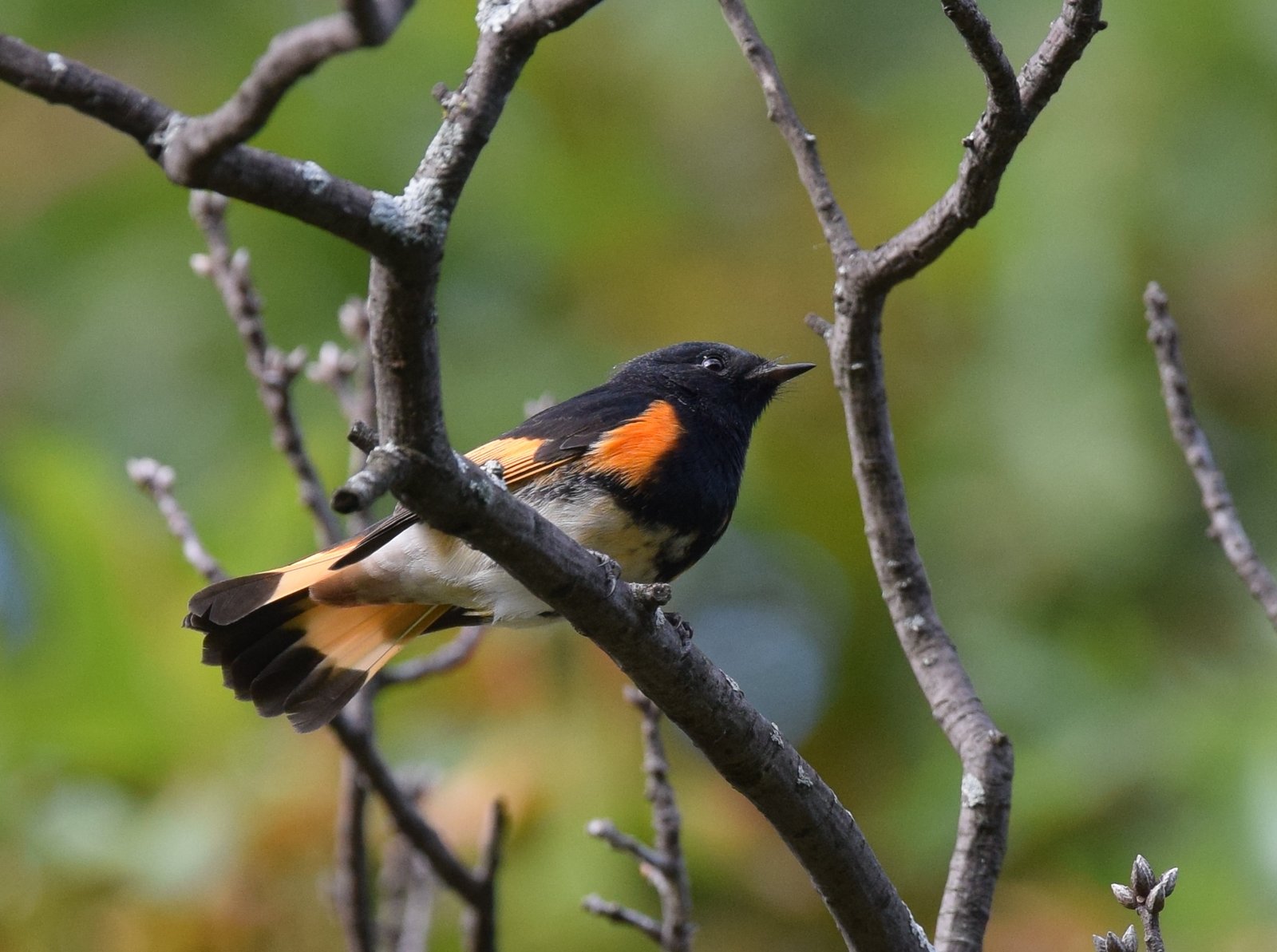
The American Redstart is a small, active warbler that often fans its tail and wings, showing orange or yellow patches. It breeds in North America and in the guide area is a common winter visitor and passage migrant in forest, forest edges, mangroves and gardens. Despite its name it is not related to the redstarts of the Old World.
Voice
The song is a series of high, thin notes that varies between males, often ending in an emphatic final note, roughly tsee-tsee-tsee-tsee-tsweeoo; in the guide area heard mainly in spring. The call is a sharp, rather sweet chip.
Recording: Scott Olmstead — CC BY-NC-SA 4.0 · converted to mono · xeno-canto
Identification
11–13 cm. Slender, with a long, often fanned tail and a fairly broad, flat bill. The adult male is glossy black with orange patches on the sides of the breast, an orange wing band and orange patches at the base of the outer tail feathers; the belly is white. The female has a grey head, olive-grey back, white underparts and yellow patches in the same places as the male. First-year males resemble the female, with an orange-yellow wash on the breast sides and sometimes scattered black feathers.
Confusion species
Painted Whitestart Myioborus pictus and Slate-throated Whitestart Myioborus miniatus also fan their tails, but have white outer tail feathers and a red or yellow belly without orange patches on wing and tail; they are residents of montane forest. Females can resemble grey flycatchers, but the yellow tail pattern of the American Redstart is always visible when the tail opens.
Habitat
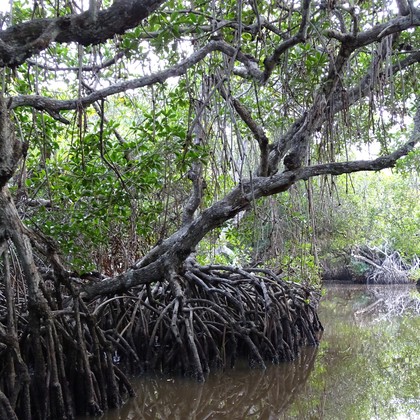
In winter humid and dry lowland forest, forest edges, secondary forest, riverside forest, mangroves, shade coffee and wooded gardens, mainly in the lowlands and foothills. It catches insects with short flights and leaps from branches and leaves, often in mixed flocks with other warblers.
Where the bird is most at home, classified by the vegetation units of Mexico and Central America.





Range and movements
Breeds across much of Canada and the eastern and north-western United States. In the guide area it winters from Baja California Sur and northern Mexico, mainly along both coasts, throughout Central America to Panama, and beyond in the Caribbean and northern South America. On migration throughout the guide area, in northern Mexico mainly as a passage migrant.
- Winter visitor (c. Oct–Mar)
- dark = core range, pale = thinly spread
How and when to look
In winter often in mangroves, coastal forest and parks with large trees, where the fanning of the tail allows the bird to be followed even among leaves.
Conservation status
Not threatened (LC). Widespread and numerous, but the breeding population has declined since the 1960s, partly through habitat loss on the breeding and wintering grounds.
Scientific name
Setophaga ruticilla | (Linnaeus, 1758)
Linnaeus described the species in 1758 as Motacilla ruticilla; because it was later moved to another genus, the author and year stand in brackets. The genus Setophaga was introduced in 1827 by Swainson. Setophaga is Greek, from sēs, sētos 'moth' and -phagos '-eating': 'moth-eater'. ruticilla is New Latin for 'redstart', from rutilus 'red' and the diminutive -cilla; the tail has orange patches. The specimen the first description was based on came from Virginia, United States.