All species › Swifts › Swifts › American Black Swift
Position in the tree Birds Aves › Birds with a flexible palate Neognathae › All other modern birds Neoaves › Birds of the elements Elementaves › Nightjars and swifts Strisores
American Black Swift | Cypseloides niger
Zwarte gierzwaluw | Vencejo negro
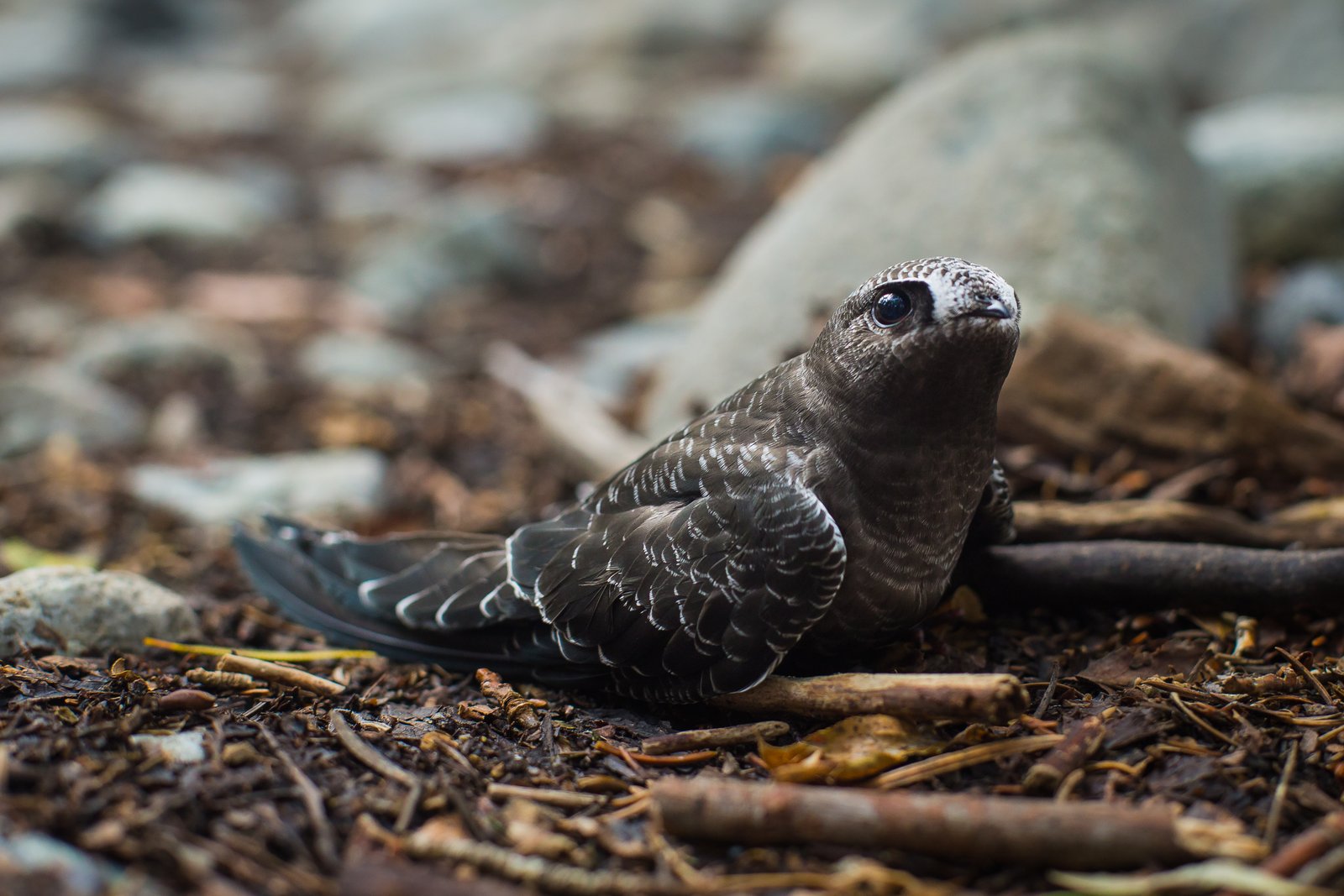
The American Black Swift is a large, all-dark swift that nests by waterfalls and on damp rock faces in the mountains. In the guide area it breeds locally in the highlands of Mexico and in Costa Rica, with scattered records in between. North American birds migrate through Mexico and Central America to wintering grounds in the western Amazon basin; much less is known about the birds of the guide area.
Voice
Usually silent. At the nest and in flocks a soft, sharp chipping or twittering, plik-plik-plik.
Recording: Richard E. Webster — CC BY-NC-SA 4.0 · shortened to the first 60 s, mono · xeno-canto
Identification
15–18 cm, large and all blackish, with long, fairly broad, sickle-shaped wings and a fairly long tail that is slightly forked in the male and square or slightly notched in the female. In good light a fine whitish frosting on forehead and lores can be seen. The underparts are hardly paler than the upperparts. Juveniles have white fringes to the feathers of the underparts. Birds from Costa Rica are on average smaller than those from the north. The flight often includes gliding, with slower wingbeats than in the smaller swifts.
Confusion species
White-collared Swift Streptoprocne zonaris is much larger and has a white collar. White-chinned Swift Cypseloides cryptus and White-fronted Swift Cypseloides storeri are more heavily built, with broader wings and a shorter, square tail. Spot-fronted Swift Cypseloides cherriei and Chestnut-collared Swift Streptoprocne rutila are smaller, with a shorter tail; female and juvenile Chestnut-collared Swifts without a collar are the most similar. Chimney Swift Chaetura pelagica and Vaux's Swift Chaetura vauxi are much smaller, with a paler throat and a short, stubby tail.
Habitat
Hunts high over montane forest, cloud forest, pine-oak forest and valleys, often lower in cloudy and rainy weather; on migration also over lowlands. Feeds on flying insects. Nests on damp, shaded ledges beside or behind waterfalls and in wet gorges, often in the spray of falling water; the nest is a cup of moss and plant material with mud. The clutch is a single egg.
Where the bird is most at home, classified by the vegetation units of Mexico and Central America.






Range and movements
In Mexico in the breeding season locally in the mountains, mainly in Veracruz, Puebla, Oaxaca and Chiapas, in the central highlands around Mexico City and along the Sierra Madre Occidental from Sonora and Chihuahua through Durango, Sinaloa and Nayarit to Jalisco and Michoacán; how far all these birds breed there is not everywhere clear. Further scattered records in Guatemala, El Salvador, Honduras and Nicaragua. In Costa Rica in the Cordillera Central, the Cordillera de Tilarán and the Talamanca, and in western Panama, mainly in Chiriquí. Outside the guide area from south-east Alaska and British Columbia to the western United States, in the Antilles, and in winter in South America.
- Resident
- Summer visitor (c. Apr–Sep)
- Passage (Mar–Apr, Oct–Nov)
- dark = core range, pale = thinly spread
How and when to look
In Costa Rica around waterfalls and gorges in the mountains, such as the Poás Volcano area and Monteverde, and in Mexico at waterfalls in the mountains of Veracruz and Oaxaca. Flocks often hunt low ahead of approaching showers and are then best recognised by size, uniform black plumage and longer tail. Migrants are mainly expected in April–May and September–October.
Conservation status
Vulnerable. The global listing stems mainly from the steep decline of the North American breeding population, probably partly due to fewer insects and changes in rainfall and water flow at the nest sites. The birds in the guide area are little studied and their numbers and trends are unknown.
Scientific name
Cypseloides niger | (Gmelin, 1789)
Gmelin described the species in 1789 as Hirundo nigra; because it was later moved to another genus, the author and year stand in brackets. The genus Cypseloides was introduced in 1848 by Streubel. Cypseloides combines Cypselus, an old genus name for swifts (Greek kupselos), with Greek -oidēs 'resembling': 'swift-like'. niger is Latin for 'black', after the uniformly blackish plumage. The specimen the first description was based on came from Hispaniola.