All species › Passerines › New World warblers › Altamira Yellowthroat
Position in the tree Birds Aves › Birds with a flexible palate Neognathae › All other modern birds Neoaves › Landbirds Telluraves › Falcons, parrots and passerines Australaves › Falcons and passerines Eufalconimorphae › Parrots and passerines Psittacopasserae
Altamira Yellowthroat | Geothlypis flavovelata
Geelkruinmaskerzanger | Mascarita de Altamira
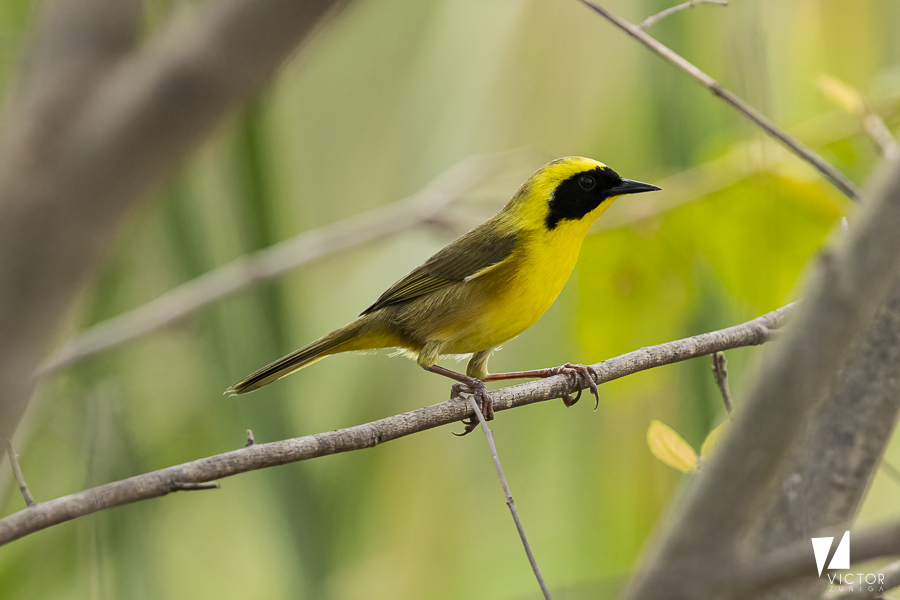
The Altamira Yellowthroat is a yellowthroat with a small range in the marshes of the Gulf coastal plain of north-eastern Mexico. The male has a black mask topped by a broad yellow band across the forecrown. It is a resident found only in Mexico.
Voice
The song is a full, rolling and varied warble, less rigidly repeated than in Common Yellowthroat. The call is a dry tchek.
Recording: Richard E. Webster — CC BY-NC-SA 4.0 · shortened to the first 60 s, mono · xeno-canto
Identification
13–14 cm. Slightly larger and heavier-billed than Common Yellowthroat. Upperparts olive-green, underparts entirely bright yellow. The male has a black mask across forehead, lores and cheek, bordered above by a broad yellow band that extends across the forecrown; the hindcrown is olive. The female lacks the mask, has an olive head with a yellowish eyebrow and eye-ring and is also yellow below.
Confusion species
Common Yellowthroat Geothlypis trichas, which winters in the same marshes, has a whitish to grey border above the mask, a dull belly and a finer bill. Grey-crowned Yellowthroat Geothlypis poliocephala has a grey head without a broad mask and a thick, bicoloured bill, and lives in drier grassland. Olive-crowned Yellowthroat Geothlypis semiflava is very similar but lives only on the Caribbean slope from Honduras to Panama.
Habitat
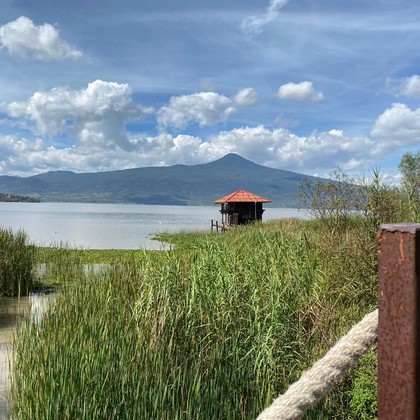
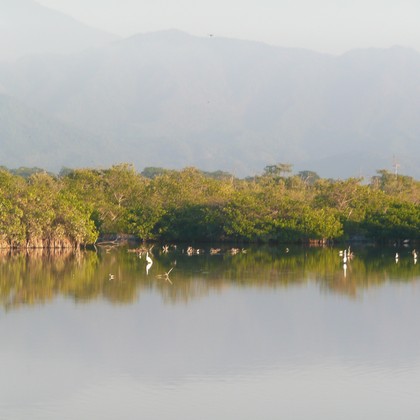
Freshwater and brackish marshes with cattail, reeds and sedges, lagoon edges and wet grassland on the coastal plain, mainly below 200 m. It forages low in dense vegetation for insects.
Where the bird is most at home, classified by the vegetation units of Mexico and Central America.
Range and movements
Endemic to Mexico: the Gulf coastal plain of southern Tamaulipas, eastern San Luis Potosí and northern Veracruz.
- Resident
- dark = core range, pale = thinly spread
How and when to look
In the breeding season males sing from the tops of reeds or cattails along lagoons and marshes around Tampico; in winter the species is quieter and seen less often.
Conservation status
Near Threatened (NT). The small range and dependence on marshes make the species vulnerable; drainage, burning, grazing and the spread of farmland and building degrade its habitat.
Scientific name
Geothlypis flavovelata | Ridgway, 1896
Ridgway described the species in 1896 and placed it straight away in the genus where it still stands. The genus Geothlypis was introduced in 1847 by Cabanis. Geothlypis is Greek, from gē 'ground' and thlupis, an unidentified small bird: 'ground warbler', after its life low in dense cover. flavovelata is Latin, from flavus 'yellow' and velatus 'veiled, covered', after the yellow band above the black mask. The specimen the first description was based on came from Altamira near Tampico, Tamaulipas, Mexico.