All species › Swifts › Hummingbirds › Allen's Hummingbird
Position in the tree Birds Aves › Birds with a flexible palate Neognathae › All other modern birds Neoaves › Birds of the elements Elementaves › Nightjars and swifts Strisores
Allen's Hummingbird | Selasphorus sasin
Allens kolibrie | Zumbador de Allen
Allen's Hummingbird breeds in a narrow strip along the coast of California and south-western Oregon. The migratory birds of the nominate form winter in the highlands of central Mexico and leave again for the north early in the year. The subspecies sedentarius is resident and has spread from southern California into north-western Baja California.
Voice
The call is a hard, dry chip, rapidly repeated in chases and mixed with squeezed, twittering notes. In the display dive the male makes a sharp, high whine with its tail feathers; in flight the wings produce a high, whining buzz.
Recording: Cin-Ty Lee — CC BY-NC-SA 4.0 · converted to mono · xeno-canto
Identification
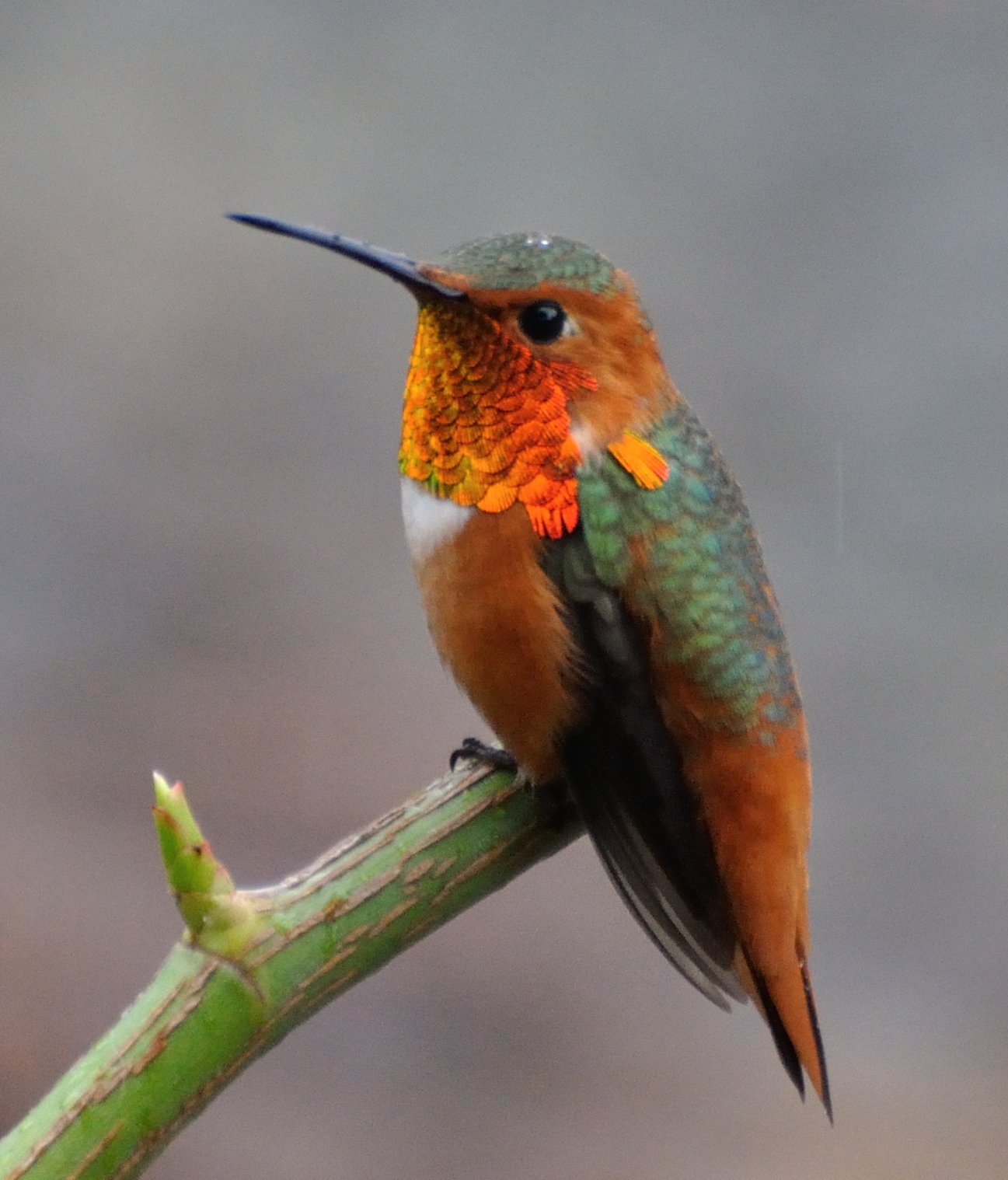
8–9 cm, with a straight, fairly short black bill. The male has a green back and crown, rufous flanks, rump and tail, a white breast and a metallic orange-red throat that flashes from gold to scarlet. The female is green above, with rufous flanks, a rufous tail base, white tips to the outer tail feathers and usually a few orange-red feathers in the centre of the throat. Young birds resemble the female. The tail feathers are narrow, the outermost almost needle-like.
Confusion species
Rufous Hummingbird Selasphorus rufus is the most similar species. The male usually has a rufous back, but some males have a green back and can then only be told by their broader tail feathers. Females and young birds cannot be separated in the field. Calliope Hummingbird Selasphorus calliope is smaller and shorter-tailed, with little rufous. Broad-tailed Hummingbird Selasphorus platycercus is larger, with a rose-red throat in the male.
Habitat
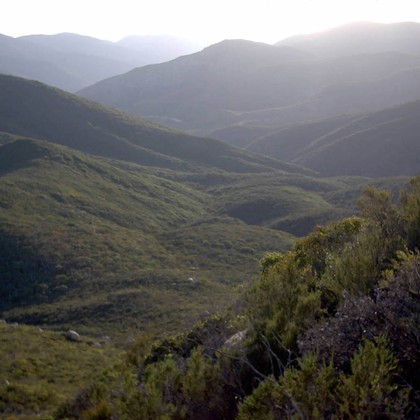
In winter in pine-oak forest, forest edges, scrub and gardens with flowering plants in the highlands, between about 1000 and 2500 m, and on the Pacific side also in dry forest. In north-western Baja California in coastal scrub, chaparral, parks and gardens with flowering plants and feeders.
Where the bird is most at home, classified by the vegetation units of Mexico and Central America.




Range and movements
The nominate form winters mainly in the highlands of central Mexico, from Jalisco, Michoacán and Guanajuato to Morelos and the State of México, and in autumn passes along the Pacific side through Sinaloa, Nayarit and Colima. In the far north-west of Baja California, around Tijuana, birds are present year-round, probably of the subspecies sedentarius. The breeding range otherwise lies outside the guide area, along the coast of California and south-western Oregon.
- Winter visitor (c. Oct–Mar)
- dark = core range, pale = thinly spread
How and when to look
In the highlands of Morelos, Michoacán and Jalisco, mainly from October to January, at flowering shrubs along forest edges. Green-backed males with an orange-red throat at this time and place are usually this species; females and young birds can often only be recorded as Selasphorus.
Conservation status
Least Concern. Counts point to a decline in the migratory nominate form. The subspecies sedentarius, by contrast, is spreading in towns and gardens.
Scientific name
Selasphorus sasin | (Lesson, 1829)
Lesson described the species in 1829 as Ornismya Sasin; because it was later moved to another genus, the author and year stand in brackets. The genus Selasphorus was introduced in 1832 by Swainson. Selasphorus is Greek, from selas 'light, flame' and -phoros 'bearing': 'light-bearer', after the fiery, glittering throat. sasin is the name for this hummingbird in the language of the Nuu-chah-nulth (Nootka) of Vancouver Island. The specimen the first description was based on came from San Francisco, California.