All species › Passerines › New World blackbirds › Yellow-shouldered Blackbird
Yellow-shouldered Blackbird | Agelaius xanthomus
Geelschoudertroepiaal | Mariquita
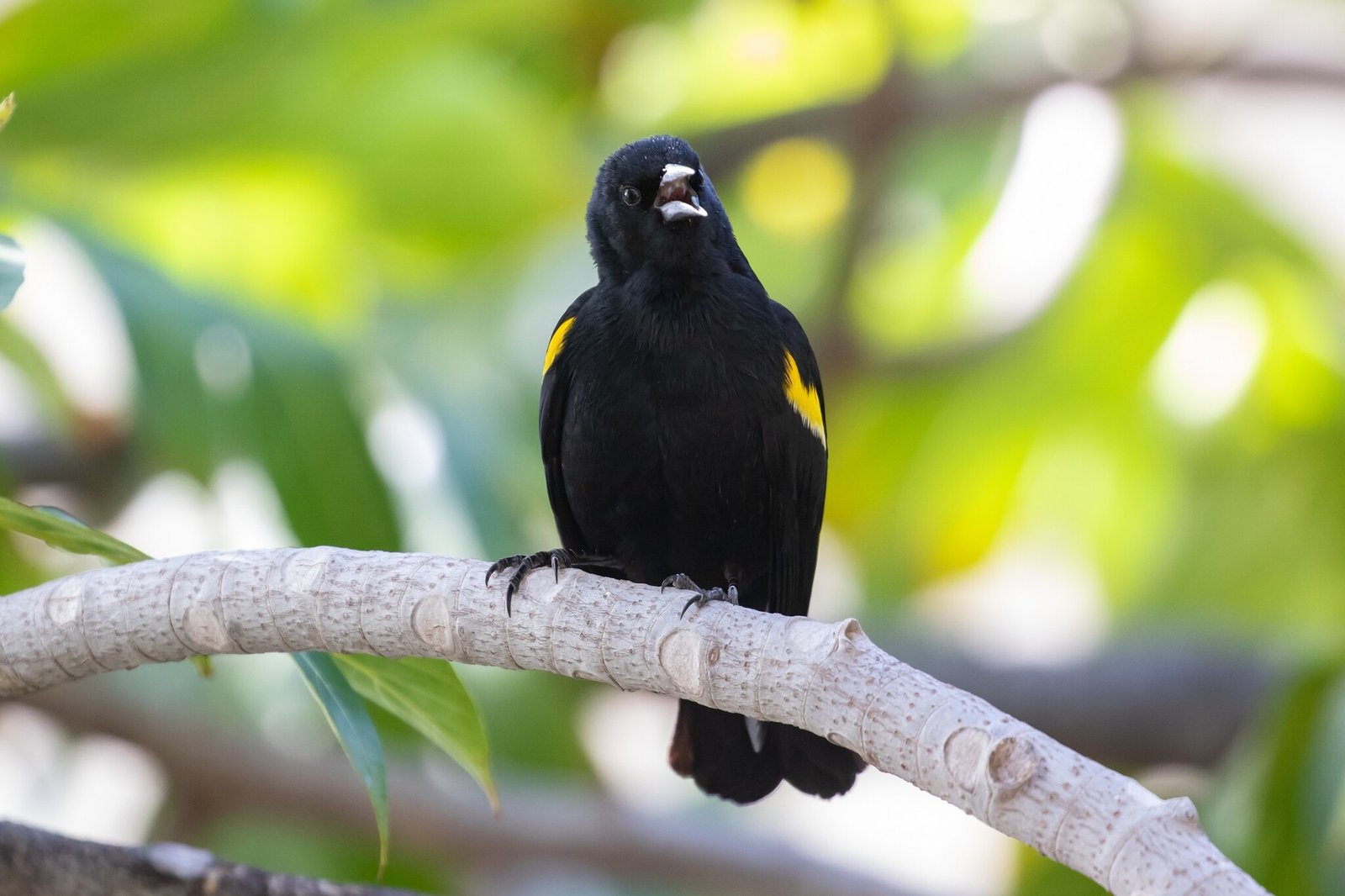
The Yellow-shouldered Blackbird is a blackbird endemic to Puerto Rico and the islands of Mona and Monito. It was once widespread in the lowlands of Puerto Rico, but declined sharply in the twentieth century through habitat loss and brood parasitism by the Shiny Cowbird. In Puerto Rico it is called mariquita or capitán.
Voice
The song is a short, harsh, buzzy phrase, lacking the gurgling quality of Red-winged Blackbird. The call is a dry chuk; groups also give a soft chatter.
Recording: Rainforest Connection — CC BY-NC-SA 4.0 · converted to mono · xeno-canto
Identification
20–23 cm; the male is clearly larger than the female. Both sexes are glossy black with a small yellow shoulder patch with a white lower border; on perched birds sometimes only a narrow yellow line shows. Eyes dark, bill pointed and black. Juveniles are duller black with a brownish belly and a smaller shoulder patch. Birds on Mona (subspecies monensis) have a smaller yellow patch.
Confusion species
The male Shiny Cowbird Molothrus bonariensis has a purple gloss, a shorter, thicker bill and no yellow shoulder; the female is grey-brown. Greater Antillean Grackle Quiscalus niger is larger, with a yellow eye and a long, keel-shaped tail. Puerto Rican Oriole Icterus portoricensis is black with yellow shoulders, rump and undertail coverts and has a longer tail and a curved bill.
Habitat
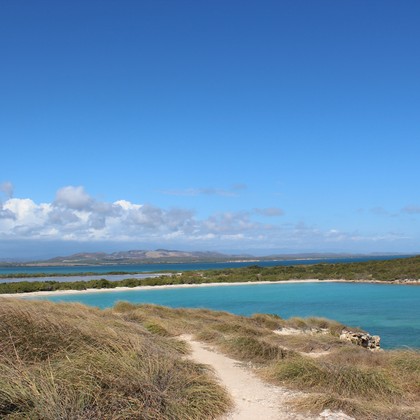
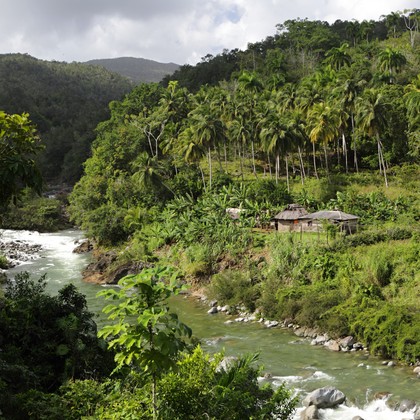
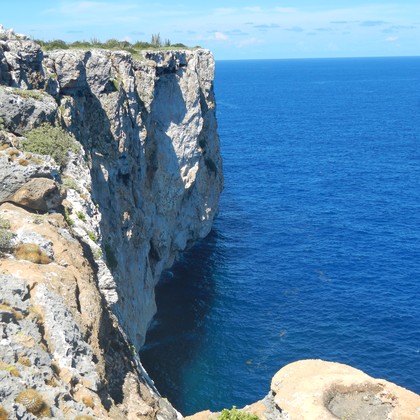
Mainly coastal lowlands: mangroves, salt flats and mudflats, dry coastal forest, pastures and coconut plantations, and locally built-up areas. It forages in tree crowns and on the ground for insects, seeds and nectar. It nests in a range of settings: in red mangroves on offshore cays, in black mangroves, in palms and trees in pastures and coconut plantations, and on Mona on cliffs and in rock crevices.
Where the bird is most at home, classified by the vegetation types of the Caribbean.




Range and movements
Only in Puerto Rico. On the main island now in three core areas: the south-west (around Cabo Rojo, Boquerón and La Parguera), the south, and the area of the former Roosevelt Roads naval station in the east; formerly also on Vieques. Also on Mona and Monito. It does not occur outside Puerto Rico.
- Resident
- dark = core range, pale = thinly spread
How and when to look
The best sites are the salt flats and mangroves near Cabo Rojo and Boquerón in the south-west, where birds are often seen at feeders and coconut palms around houses. Groups are most active in the morning.
Conservation status
Endangered. The main-island population fell from about 2,000 birds in 1976 to 300 in 1982 and recovered after conservation measures to about 1,250 pairs; Mona holds 220–400 birds. The main threats are brood parasitism by the Shiny Cowbird, loss of coastal habitat and predation by rats. Conservation includes cowbird trapping and the provision of nest boxes.
Scientific name
Agelaius xanthomus | (Sclater, 1862)
Sclater described the species in 1862 as Icterus xanthomus; because it was later moved to another genus, the author and year stand in brackets. The genus Agelaius was introduced in 1816 by Vieillot. Agelaius is Greek, from agelaios 'gregarious, of a flock', after the birds feeding and roosting in large flocks. xanthomus is Greek, from xanthos 'yellow' and ōmos 'shoulder', after the yellow shoulder patch. The specimen the first description was based on came from Puerto Rico (originally given in error as 'Mexico').