All species › Passerines › New World blackbirds › Shiny Cowbird
Shiny Cowbird | Molothrus bonariensis
Glanskoevogel | Tordo renegrido
The Shiny Cowbird is a South American brood parasite that lays its eggs in the nests of other birds. From Trinidad and Tobago and mainland South America it spread during the twentieth century through the Lesser Antilles to Puerto Rico (1955), the Dominican Republic (1972) and Cuba (1982), reaching Florida in 1985. On several islands it has become a threat to rare endemic songbirds.
Voice
The male's song is a series of bubbling, liquid notes ending in a high whistle, often delivered with fluffed plumage and a bow to the female or while circling above her. The call is a short chuk; groups also give a soft chatter.
Recording: Cristian Pinto Fernandez — CC BY-NC-SA 4.0 · shortened to the first 60 s, mono · xeno-canto
Identification
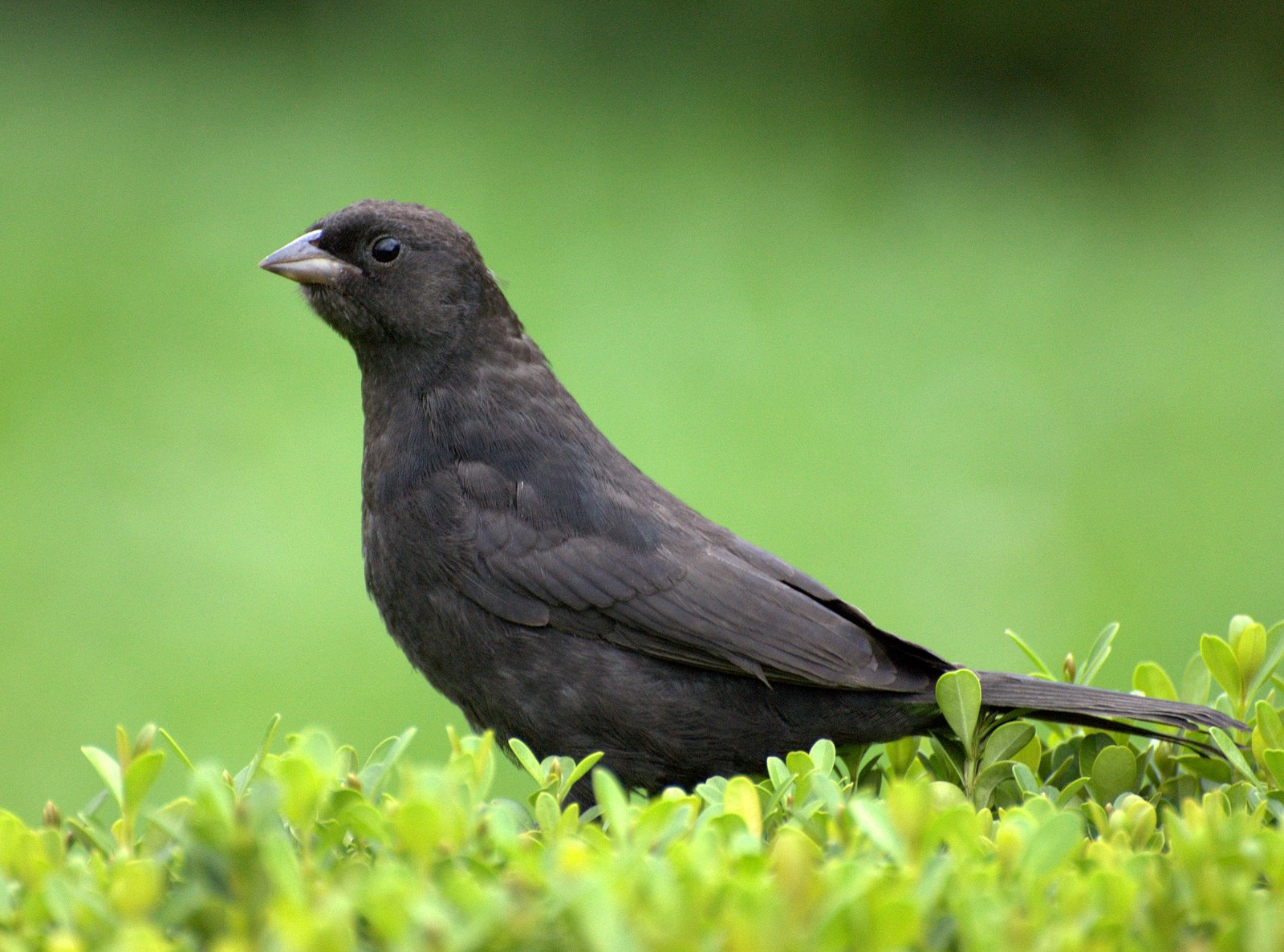
18–22 cm, with a short, conical bill. The male is all black with a purple-blue gloss. The female is smaller and dull grey-brown, slightly paler below, with a faint pale supercilium, a flat crown and a slightly longer and finer bill than other cowbirds. Juveniles resemble the female but are lightly streaked below; young males moult patchily into black.
Confusion species
Brown-headed Cowbird Molothrus ater, a vagrant from North America, has a thicker bill; the male has a brown head and the female is greyer. Carib Grackle Quiscalus lugubris and Greater Antillean Grackle Quiscalus niger are larger, with a yellow eye and a longer, keel-shaped tail. Cuban Blackbird Ptiloxena atroviolacea is larger, with a longer, more pointed bill. Tawny-shouldered Blackbird Agelaius humeralis and Yellow-shouldered Blackbird Agelaius xanthomus have a coloured shoulder patch and a more slender bill. On Trinidad and Tobago, Giant Cowbird Molothrus oryzivorus is much larger, with a red eye and an erectile neck ruff.
Habitat
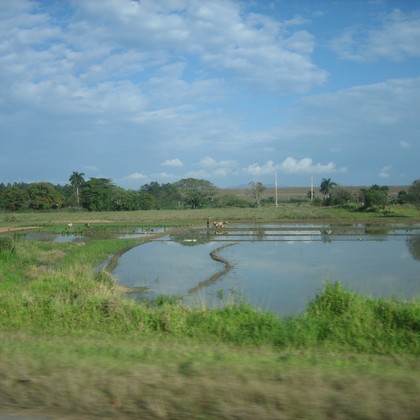
Open and man-made country: pastures with livestock, fields, rice fields, gardens, villages, open scrub and forest edges; closed forest and high mountains are avoided. It feeds on the ground on seeds and insects, often in flocks and near cattle. It builds no nest: the female lays her eggs in the nests of other species, more than 250 host species worldwide. The eggs hatch a day or two before those of the host.
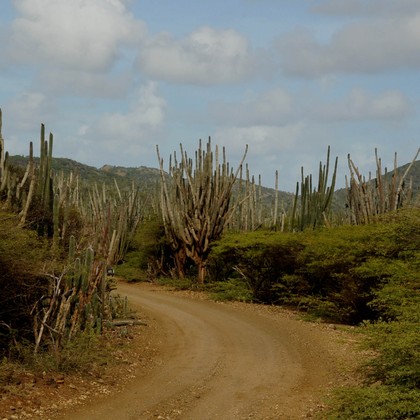
Where the bird is most at home, classified by the vegetation types of the Caribbean.





Range and movements
Resident on Trinidad and Tobago, almost all islands of the Lesser Antilles, the Virgin Islands, Puerto Rico with Mona, Hispaniola (Haiti and the Dominican Republic) and Cuba. Scarce to rare on Jamaica, the Cayman Islands and in the Bahamas. Outside the region throughout almost all of South America east of the Andes, and in small numbers in the south-eastern United States.
- Resident
- dark = core range, pale = thinly spread
How and when to look
Flocks are found around grazing cattle, in farmyards and in parks. A singing male fluffing its feathers and bowing is diagnostic of the species.
Conservation status
Not threatened. Through its parasitism the species is itself a threat to vulnerable hosts, including the Yellow-shouldered Blackbird Agelaius xanthomus in Puerto Rico, where cowbirds are trapped in conservation programmes.
Scientific name
Molothrus bonariensis | (Gmelin, 1789)
Gmelin described the species in 1789 as Tanagra bonariensis; because it was later moved to another genus, the author and year stand in brackets. The genus Molothrus was introduced in 1832 by Swainson. Molothrus is Greek, from mōlos 'struggle' and thrōskō 'to impregnate', perhaps after the brood parasitism or the males' courtship contests. bonariensis means 'of Buenos Aires', where the species was described from. The specimen the first description was based on came from Buenos Aires, Argentina.