All species › Passerines › Tanagers › Yellow-bellied Seedeater
Yellow-bellied Seedeater | Sporophila nigricollis
Geelbuikdikbekje | Semillero ventriamarillo
Yellow-bellied Seedeater is one of the most widespread seedeaters of Central and South America, a bird of grassland, fallow land and rough pasture. In the Caribbean it is resident on Trinidad and, in the southern Lesser Antilles, on Grenada and Carriacou.
Voice
The song is a short, musical series of slurred whistles, often ending in a higher, accented note. Calls are dry chip notes.
Recording: Marco Andrés Urvina Alejandro — CC BY-NC-SA 4.0 · converted to mono · xeno-canto
Identification
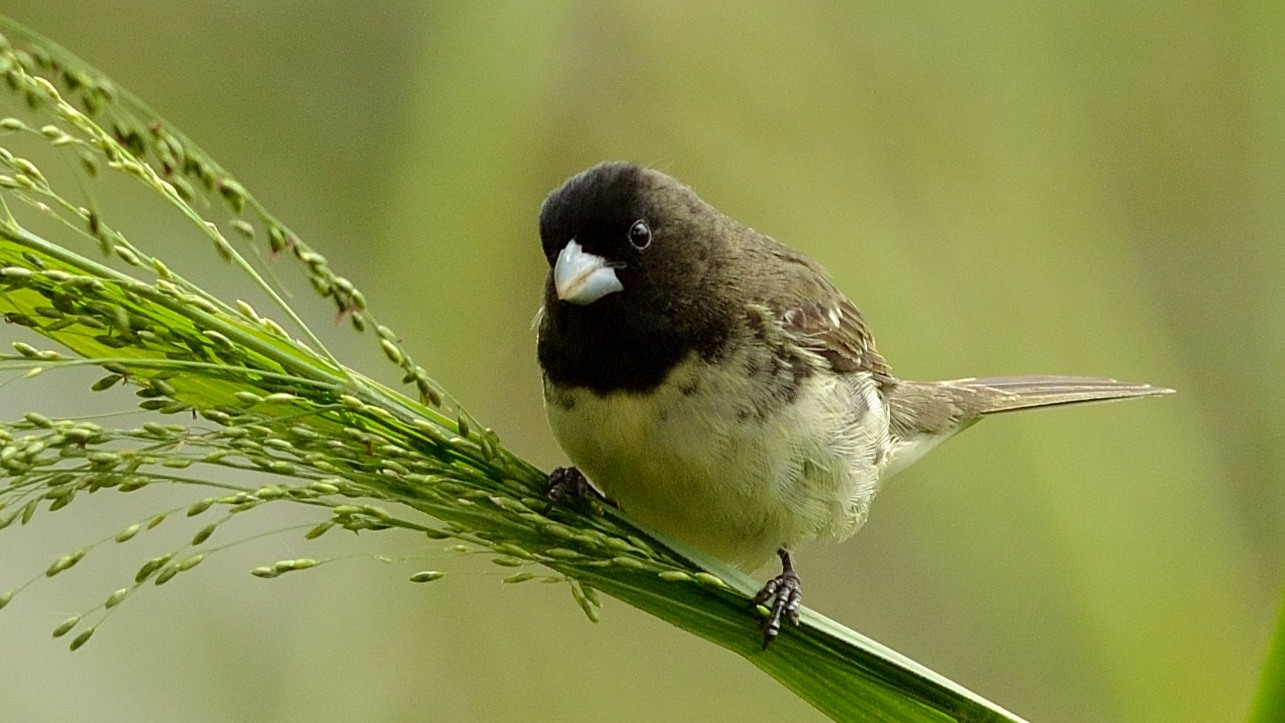
9–10 cm, small, with a short, thick bill that is blue-grey in the male. The male has a black head and throat, sharply demarcated from the pale yellow breast and belly; the upperparts are dull olive, greyer in some birds. The female is warm buffy brown, slightly paler below with a pale belly, and has a blackish bill.
Confusion species
The male cannot be confused with any other seedeater in the region: Lesson's Seedeater Sporophila bouvronides is black and white with a white cheek patch, Chestnut-bellied Seed Finch Sporophila angolensis much heavier with a chestnut belly. Male Black-faced Grassquit Melanospiza bicolor also has a black head, but also a blackish belly and a more pointed bill. Females closely resemble those of other seedeaters; female Black-faced Grassquit is greyer olive with a more pointed bill.
Habitat
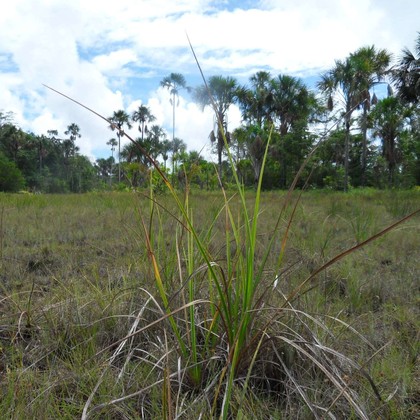
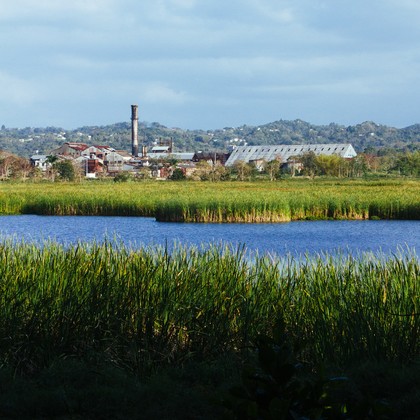
Open grassland, fallow fields, weedy old pastures, clearings and sometimes forest edges; also along roads and at the edges of villages with seeding grasses. It feeds on grass seeds, often in small groups outside the breeding season.
Where the bird is most at home, classified by the vegetation types of the Caribbean.


Range and movements
Resident on Trinidad, Grenada and Carriacou. Not known with certainty from Tobago. Elsewhere from Costa Rica and Panama through almost all of South America except Chile and Uruguay; in Argentina only as a vagrant.
- Resident
- dark = core range, pale = thinly spread
How and when to look
In rough grassland and fallow land on Trinidad, and on Grenada and Carriacou in pastures and roadside verges with tall grass. Singing males sit at the top of a grass stem or bush, where the black hood and yellow belly are visible.
Conservation status
Not threatened. A common species that benefits from deforestation and overgrown farmland.
Scientific name
Sporophila nigricollis | (Vieillot, 1823)
Vieillot described the species in 1823 as Pyrrhula nigricollis; because it was later moved to another genus, the author and year stand in brackets. The genus Sporophila was introduced in 1844 by Cabanis. Sporophila is Greek, from sporos 'seed' and philos 'lover': 'seed-lover'. nigricollis is Latin, from niger 'black' and collum 'neck', after the male's black head and throat. The specimen the first description was based on came from Brazil.