All species › Passerines › Tanagers › Grey Seedeater
Grey Seedeater | Sporophila intermedia
Blauwgrijs dikbekje | Semillero gris
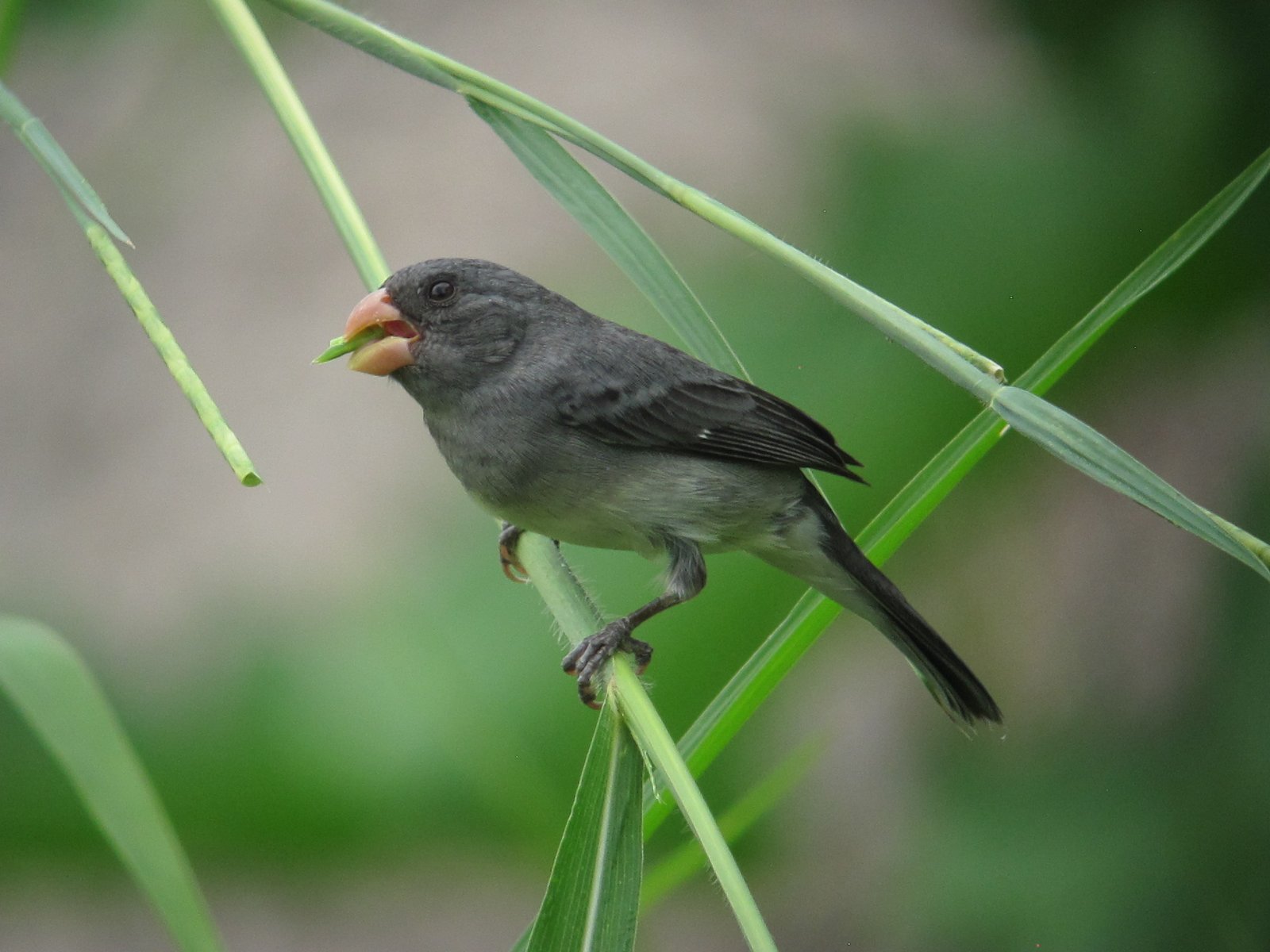
Grey Seedeater is a fairly large, grey seedeater of open country in northern South America. On Trinidad, where it is called picoplat, it is one of the most widely kept cage birds because of its song. Trapping and habitat loss have reduced the wild population there so much that some lists treat the species as extirpated. Trinidad birds were described as a separate subspecies, insularis.
Voice
The song is a lively series of musical twitters, chips and trills, often starting with chu-chu-chu; some birds mimic other species. The call is a questioning tseep.
Recording: Jerome Fischer — CC BY-NC-SA 4.0 · shortened to the first 60 s, mono · xeno-canto
Identification
11–12 cm, with a thick, rounded bill. The male is mid-grey with a bluish cast on the head, nape and upperparts, with blackish wings edged grey, a white patch on the closed wing and a blackish tail. The throat is grey, the breast slightly darker grey, the belly whitish. The bill is pinkish orange. The female is warm brown above, with a pale cinnamon throat, breast and flanks and a paler buff belly; her bill is blackish. Juveniles resemble the female.
Confusion species
Male Yellow-bellied Seedeater Sporophila nigricollis may have a grey back, but has a black head and throat and a yellow belly. Male Ruddy-breasted Seedeater Sporophila minuta is rufous below. Females closely resemble those of other seedeaters; Grey Seedeater is larger, with a heavier bill.
Habitat
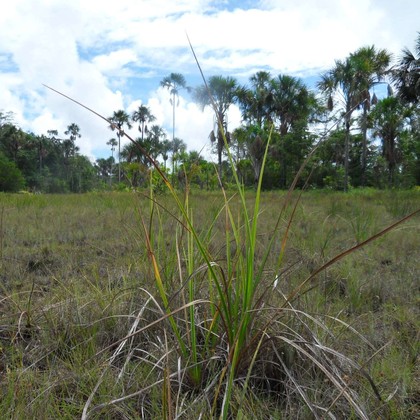
Open country: grassland, clearings and forest edges, vacant lots, parks and gardens, on the mainland to over 1000 m. Males sing from an exposed perch.
Where the bird is most at home, classified by the vegetation types of the Caribbean.



Range and movements
On Trinidad a scarce to rare resident. AviList treats it as extirpated there, but two birds were photographed in December 2023, and Birds of the World describes it as scarce to uncommon. Because so many are kept in cages, the origin of records is often uncertain. Not known from Tobago. Elsewhere in Colombia, Venezuela, Guyana and northern Brazil.
- Resident
- dark = core range, pale = thinly spread
How and when to look
The best chances are in rough grassland and along forest edges in the lowlands of Trinidad. Any grey seedeater with a pinkish-orange bill is worth checking; photographs and sound recordings help to judge its origin.
Conservation status
Not threatened globally. On Trinidad it has declined sharply through trapping, also outside the permitted season, smuggling and habitat loss; a draft wildlife conservation bill lists it there as critically endangered.
Scientific name
Sporophila intermedia | Cabanis, 1851
Cabanis described the species in 1851 and placed it straight away in the genus where it still stands. The genus Sporophila was introduced in 1844 by Cabanis. Sporophila is Greek, from sporos 'seed' and philos 'lover': 'seed-lover'. intermedia is Latin for 'intermediate', as the species stands between related seedeaters in its features. The specimen the first description was based on came from Puerto Cabello, Venezuela.