All species › Passerines › Tanagers › Bananaquit
Bananaquit | Coereba flaveola
Suikerdiefje | Reinita común
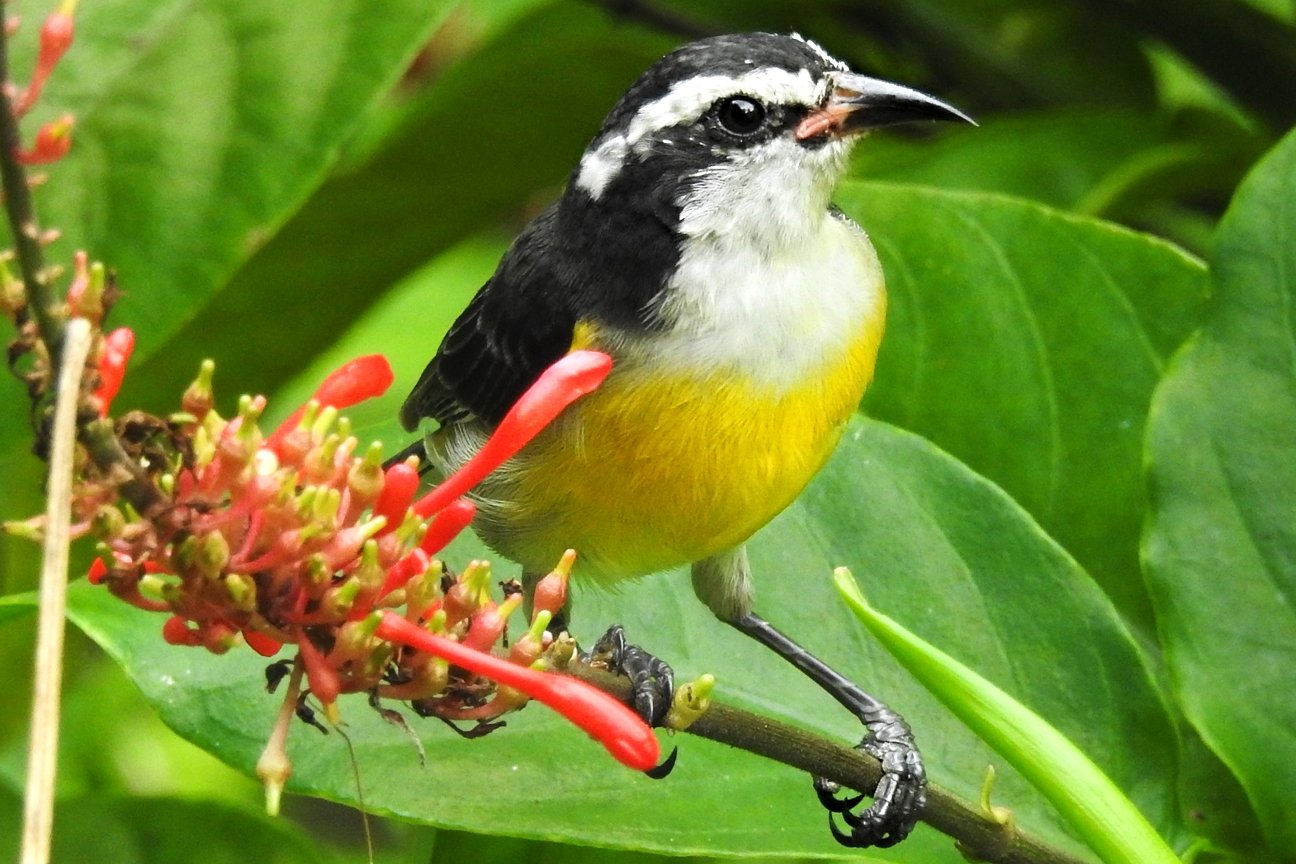
The Bananaquit is one of the commonest and most visible birds in the Caribbean. It is small, restless and tame, visiting flowers, fruit and sugar bowls on terraces and in gardens. The species comprises dozens of subspecies; genetic studies recognise three groups, of which the Bahamian group and the South American–Lesser Antillean group have been proposed as separate species.
Voice
The song is a high, thin, buzzy series of hissing and squeaky notes, such as tsee-tsee-tseeee-tsee, varying from island to island and given throughout the day. The call is a short, sharp tsip.
Recording: José María Loaiza B. — CC BY-NC-SA 4.0 · converted to mono · xeno-canto
Identification
10–13 cm, with a short tail and a thin, decurved, pointed bill. Upperparts and head are blackish to dark slate, with a distinctive white supercilium. The throat is grey, white in the Bahamas. Breast, belly and rump are yellow, and there is a small white spot at the base of the primaries. A pink or red spot at the gape is often visible. The sexes are alike. Juveniles are duller and more olive-grey, with a yellowish supercilium and throat. On Grenada and St Vincent a dark morph, almost entirely sooty black, occurs alongside the normal form.
Confusion species
The combination of white supercilium, yellow breast and curved bill is unique in the region. Northern Parula Setophaga americana has a blue-grey back, white wing bars and a straight bill; Magnolia Warbler Setophaga magnolia has streaked flanks and a white tail band. The dark morph recalls a male Lesser Antillean Bullfinch Loxigilla noctis or St. Lucia Black Finch Melanospiza richardsoni, but both have a short, conical seed-eater's bill.
Habitat
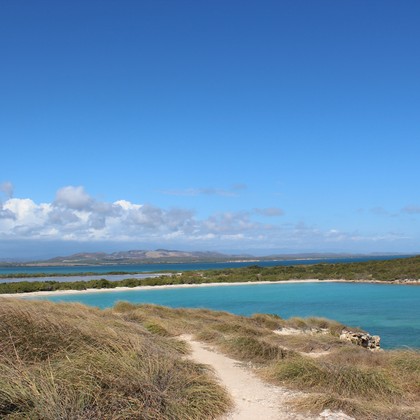
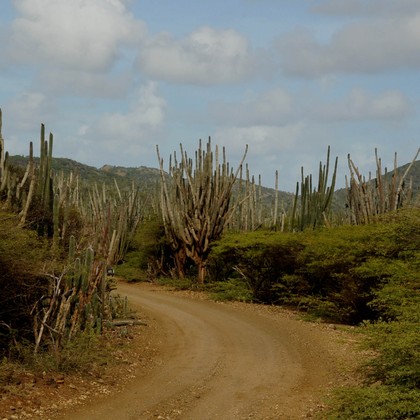
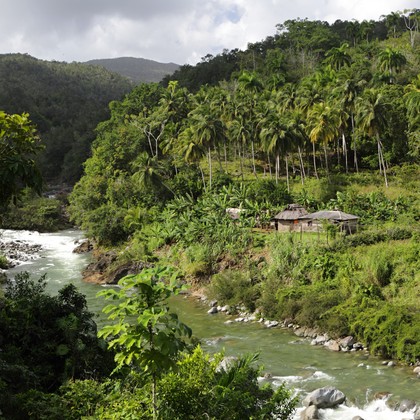
Almost anywhere with flowers: gardens, parks, hotel grounds, dry scrub, coastal woodland, mangroves, plantations and forest edges, from sea level into the mountains; inside closed forest mainly along edges and in clearings. It feeds on nectar, fruit, small insects and spiders. It cannot hover and always perches beside the flower; it often pierces the base of the corolla from the side, taking nectar without pollinating. The nest is a globular structure with a side entrance, and separate roosting nests are also built. It breeds almost year-round.
Where the bird is most at home, classified by the vegetation types of the Caribbean.




Range and movements
Resident in the Bahamas, the Turks and Caicos Islands, the Cayman Islands, Jamaica, Hispaniola (Haiti and the Dominican Republic), Puerto Rico, the Virgin Islands, all islands of the Lesser Antilles, the ABC Islands, San Andrés and Trinidad and Tobago. In Cuba it is not a regular breeder and occurs as a rare visitor; Bahamian birds also occasionally reach Florida. Outside the region from southern Mexico through Central America to northern Argentina.
- Resident
- dark = core range, pale = thinly spread
How and when to look
Present almost everywhere; a sugar bowl or flowering shrub at a hotel or beach bar attracts birds within minutes. On Grenada and St Vincent small groups are worth checking for the dark morph. In Cuba any record is worth noting.
Conservation status
Not threatened. The species is very common on most islands and benefits from gardens, flowering ornamentals and feeding stations.
Scientific name
Coereba flaveola | (Linnaeus, 1758)
Linnaeus described the species in 1758 as Certhia flaveola; because it was later moved to another genus, the author and year stand in brackets. The genus Coereba was introduced in 1809 by Vieillot. The origin of Coereba is uncertain; possibly from a Tupí name (guirá) for a small black-and-yellow bird. flaveola is a diminutive of Latin flavus 'golden-yellow', after the yellow breast and rump. The specimen the first description was based on came from Jamaica.