All species › Passerines › Tanagers › White-lined Tanager
White-lined Tanager | Tachyphonus rufus
Zwarte tangare | Tangara filiblanca
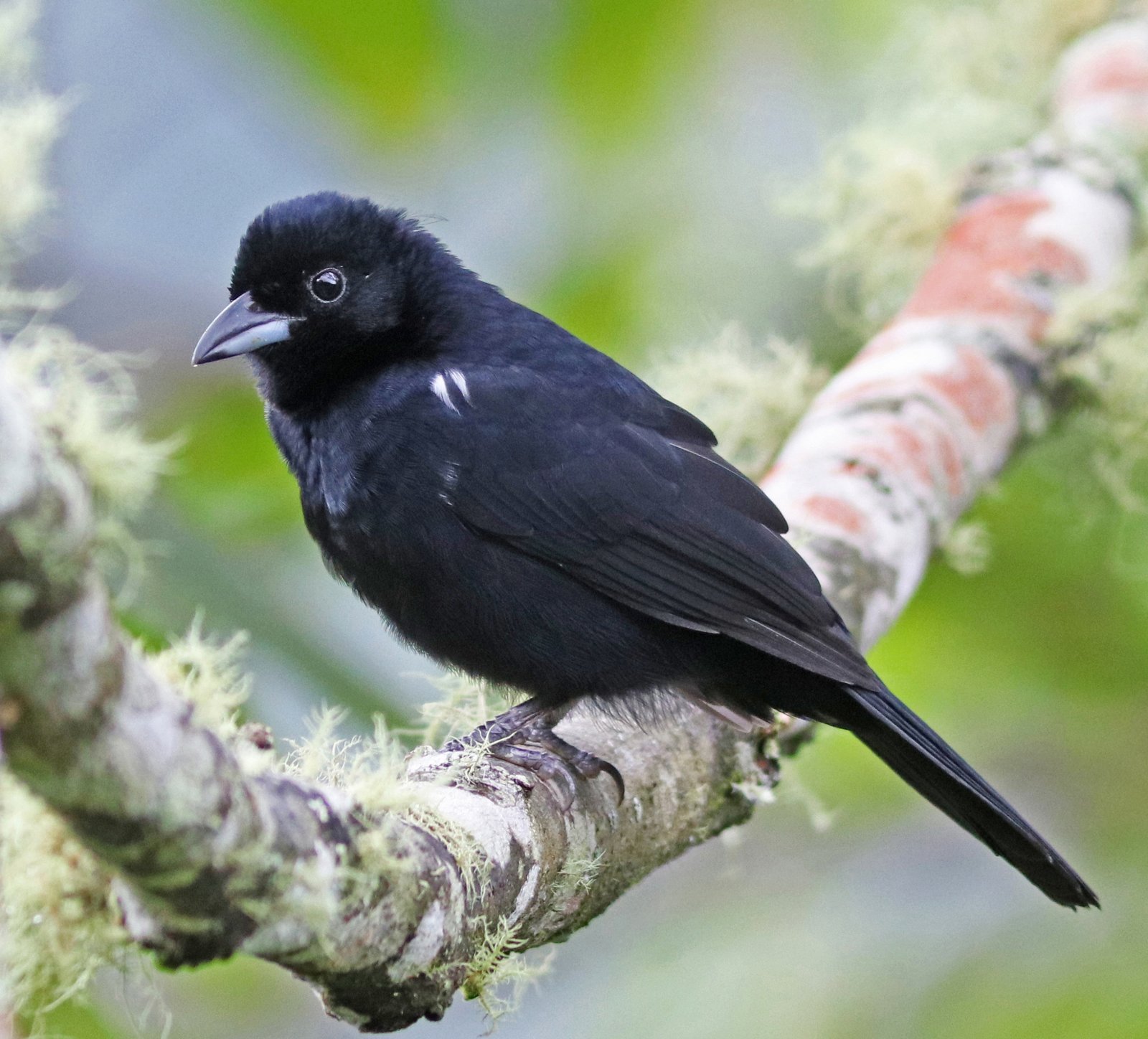
The White-lined Tanager is one of the most familiar tanagers of gardens, yards and forest edges on Trinidad and Tobago. Male and female differ so much that they could pass for two species: he is glossy black, she is plain rufous. The English name refers to the white line along the bend of the wing, visible mainly in flight. In Trinidad and Tobago the male is called Parson, and the species is kept as a cage bird for its song.
Voice
The call is a short, sharp chip. The song consists of simple whistled notes repeated quickly and monotonously, often at length from a sheltered perch.
Recording: JAYRSON ARAUJO DE OLIVEIRA — CC BY-NC-SA 4.0 · converted to mono · xeno-canto
Identification
17–19 cm, slim, with a fairly long tail and a stout, pointed bill that is mostly black, with a blue-grey base to the lower mandible. The male is entirely glossy black. The underwing coverts are white, and there is a small white patch at the bend of the upperwing; perched, often only a narrow white line shows, while in flight the white flashes clearly. The female is uniform rufous, slightly paler below. Juveniles resemble the female; young males acquire black feathers gradually.
Confusion species
Male Shiny Cowbird Molothrus bonariensis is purplish-glossed black, with a shorter, conical bill and no white in the wing. Carib Grackle Quiscalus lugubris has a yellow eye and a longer, wedge-shaped tail. Male White-shouldered Tanager Loriotus luctuosus is smaller, with a large white shoulder patch that is visible even when perched. The rufous female may suggest female Silver-beaked Tanager Ramphocelus carbo, which is darker and redder brown with a darker belly, and Red-crowned Ant Tanager Habia rubica, which is browner and has a yellow crown stripe.
Habitat
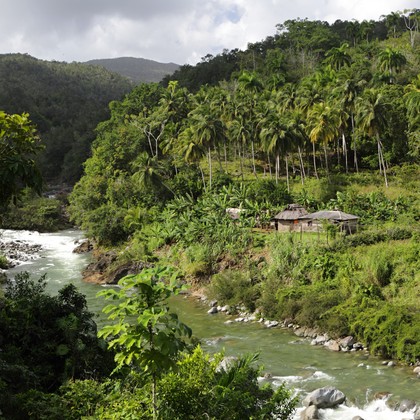
Semi-open country: forest edges, clearings and secondary forest, cacao and fruit plantations, yards and gardens, from the lowlands into the hills. Rather restless but not shy. Pairs hold territories and rarely join mixed flocks. The diet is mainly fruit, supplemented with nectar and insects such as beetles, ants and grasshoppers. The nest is a fairly bulky cup in a tree or shrub; the female usually incubates three eggs. In courtship the male opens and closes his wings, showing the white of the underwing.
Where the bird is most at home, classified by the vegetation types of the Caribbean.





Range and movements
In the region only on Trinidad and Tobago, common on both islands. Elsewhere from Costa Rica and Panama through much of South America to northern Argentina.
- Resident
- dark = core range, pale = thinly spread
How and when to look
Almost any garden or forest edge on Trinidad and Tobago is worth checking, for example around the Asa Wright Nature Centre in the Northern Range, where the birds also visit feeders. Pairs tend to stay together; a plain rufous bird accompanied by a black one is almost certainly a pair of this species.
Conservation status
Not threatened. The species has a large range and benefits from semi-open, man-made landscapes. On Trinidad and Tobago birds are trapped for the cage-bird trade; little is known about the effect on numbers.
Scientific name
Tachyphonus rufus | (Boddaert, 1783)
Boddaert described the species in 1783 as Tangara rufa; because it was later moved to another genus, the author and year stand in brackets. The genus Tachyphonus was introduced in 1816 by Vieillot. Tachyphonus is Greek, from takhus 'fast' and phōneō 'to speak': 'fast talker'. rufus is Latin for 'rufous, red', after the rufous female. The specimen the first description was based on came from Cayenne, French Guiana.