All species › Passerines › Tanagers › Silver-beaked Tanager
Silver-beaked Tanager | Ramphocelus carbo
Fluweeltangare | Tangara picoplata
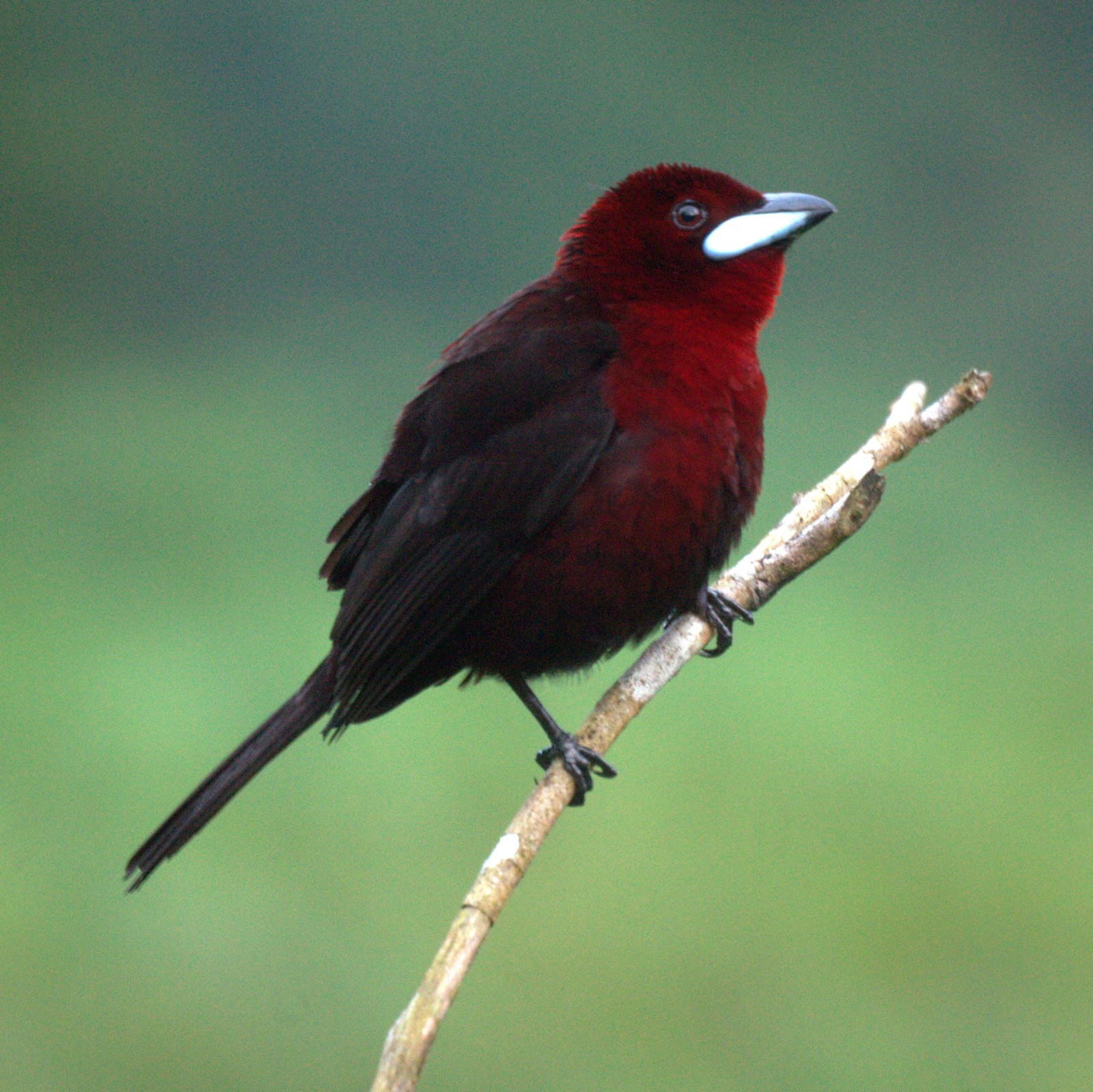
The Silver-beaked Tanager is a common, noisy tanager of forest edges, plantations and gardens on Trinidad. The male stands out for its dark, velvety plumage and swollen silvery-white lower mandible, which seems to glow in the shade of the undergrowth. The species often lives in small, active groups.
Voice
Calls are a hard metallic chep and a loud tchink, often given in pairs, and a thin, rising wheezy note. The song is a quiet, rather wheezy series of short, repeated phrases.
Recording: Juan Freile — CC BY-NC-SA 4.0 · converted to mono · xeno-canto
Identification
16–17 cm, with a heavy, broad-based bill. In the male the upper mandible is dark blue-grey and the enlarged lower mandible silvery white with a black tip. The plumage is very dark crimson, almost black in most lights, with the throat and breast more obviously deep red; wings and tail are blackish. The female has an all-dark, brownish bill and is dark reddish-brown, with dull brown wings and rufous-brown underparts with a greyish wash on the breast. Juveniles resemble the female.
Confusion species
Female White-lined Tanager Tachyphonus rufus is brighter and more uniform rufous, without a dark belly, and has a slimmer bill. Red-crowned Ant Tanager Habia rubica is browner, with a yellow crown stripe, and keeps more to the forest interior. The male is distinguished in the region by its silvery-white lower mandible and dark reddish plumage.
Habitat
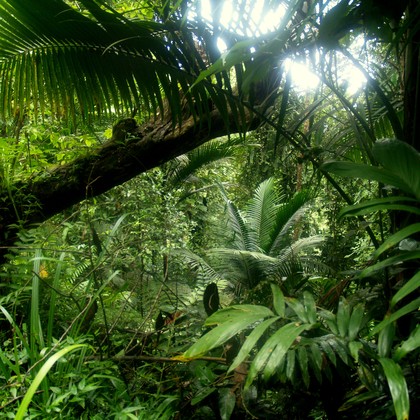
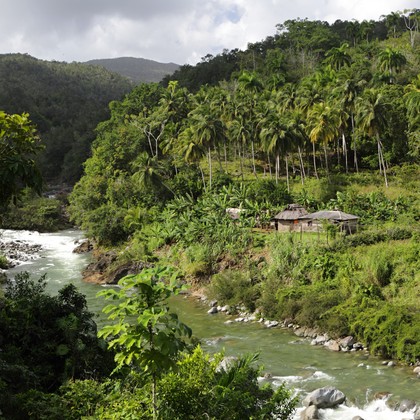
Semi-open country: forest edges, clearings, secondary forest, shrubbery along streams, plantations, yards and gardens. It forages in noisy groups of sometimes ten or more birds, from the ground up to about twelve metres, and higher in fruiting trees. It eats mainly fruit, including Melastomataceae berries, and arthropods gleaned from foliage. On Trinidad the breeding season runs from December to September. The nest is a deep cup of dead leaves and fibres, usually low in a bush; pairs sometimes nest close together or are helped by other birds in feeding the young.
Where the bird is most at home, classified by the vegetation types of the Caribbean.




Range and movements
In the region only on Trinidad, where it is common in the lowlands and hills. It is absent from Tobago. Trinidad birds are assigned to the subspecies magnirostris. Elsewhere across much of South America east of the Andes, from Colombia and Venezuela to Bolivia, Paraguay and Brazil. Isolated reports from the Dominican Republic and Martinique probably involve escaped cage birds.
- Resident
- dark = core range, pale = thinly spread
How and when to look
On Trinidad almost anywhere shrubbery borders open ground, for example at the Asa Wright Nature Centre, where the birds also visit feeders. The groups give themselves away by their hard calls; a good view of the bill confirms a male.
Conservation status
Not threatened. The species is common across much of its range and adapts well to secondary growth and farmland.
Scientific name
Ramphocelus carbo | (Pallas, 1764)
Pallas described the species in 1764 as Lanius (Carbo); because it was later moved to another genus, the author and year stand in brackets. The genus Ramphocelus was introduced in 1805 by Desmarest, A-G. Ramphocelus is Greek, from rhamphos 'bill' and koilos 'hollow, concave', after the conspicuous silvery lower mandible. carbo is Latin for 'charcoal', after the male's very dark, velvety plumage. The specimen the first description was based on came from Suriname.