All species › Passerines › Tanagers › White-shouldered Tanager
White-shouldered Tanager | Loriotus luctuosus
Witschoudertangare | Tangara hombriblanca
The White-shouldered Tanager is a small, restless forest tanager that is often part of mixed foraging flocks in the middle storey. In the Caribbean it occurs only on Trinidad, with a subspecies that also lives in north-eastern Venezuela. It was formerly placed in the genus Tachyphonus; BirdLife uses Islerothraupis.
Voice
The song is a thin, high, repeated seet. Calls include a sharp, high note and a rising swee with a low chep.
Recording: Juan Freile — CC BY-NC-SA 4.0 · converted to mono · xeno-canto
Identification
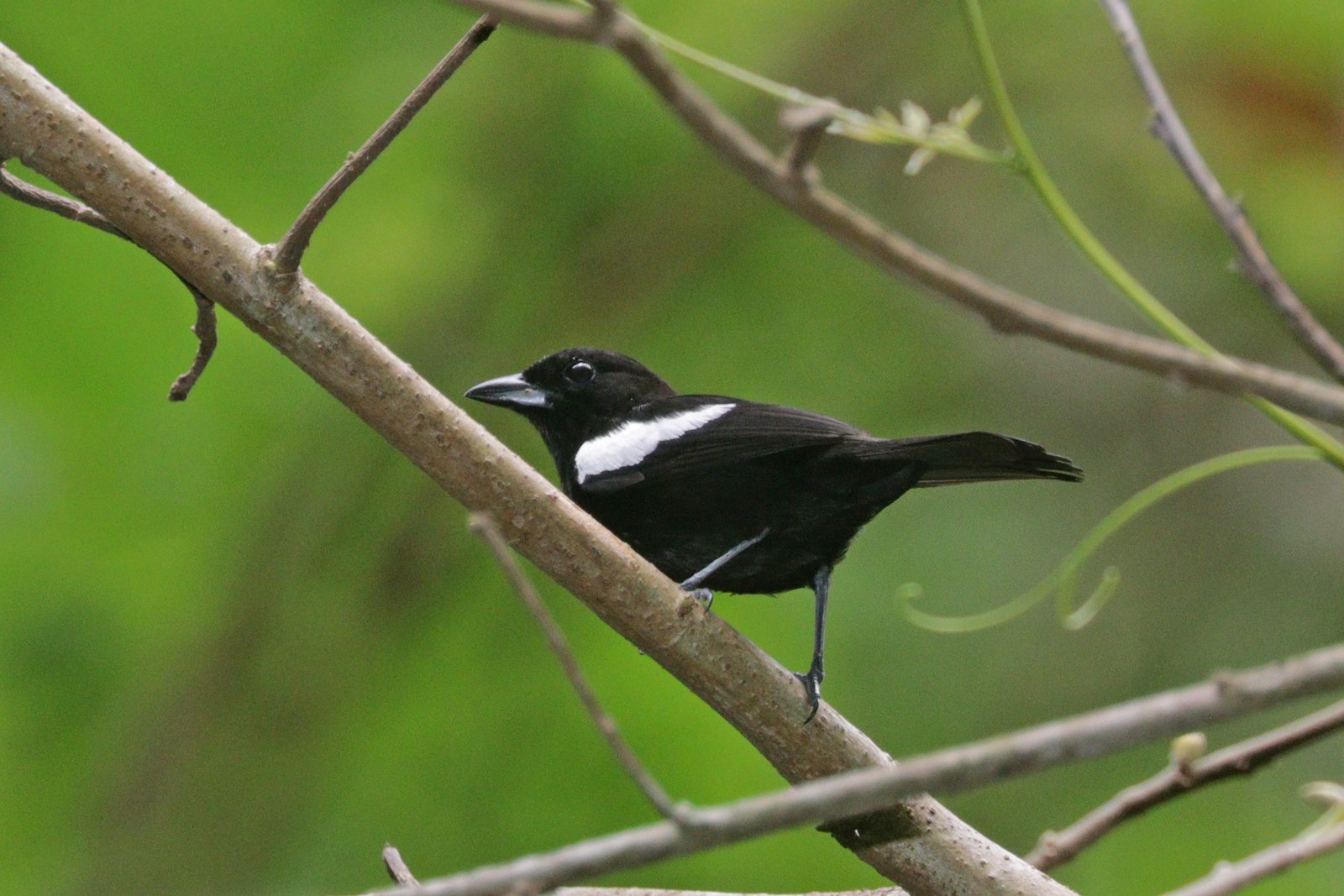
13–14 cm, slim, with a fairly long tail and a pointed, blackish bill. The male is almost entirely glossy black, with a large white shoulder patch that is clearly visible at rest, and white underwing coverts. The female has a grey head, olive-green nape and upperparts, a greyish-white throat and yellow underparts with an olive tinge on the breast. Juveniles resemble the female but are duller and more uniform.
Confusion species
Male White-lined Tanager Tachyphonus rufus is larger and also black, but in a perched bird the white on the wing usually shows only as a thin line and shows mainly in flight; the female is plain rufous. Female White-shouldered Tanagers may suggest a vireo or warbler, but the grey head contrasting with the olive-green back and the yellow belly is distinctive.
Habitat
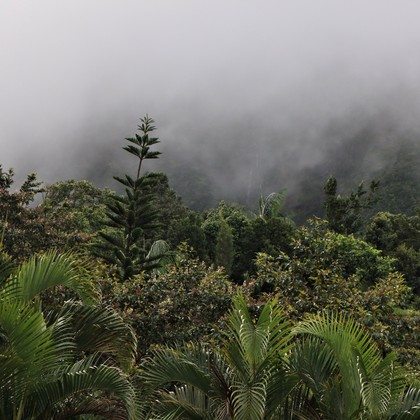
Moist lowland and hill forest, mature second growth, forest edges and shaded cacao plantations. It forages mainly in the middle storey, in pairs or family groups, often in mixed flocks with other tanagers, searching for insects among the leaves and on branches; it also eats fruit.
Where the bird is most at home, classified by the vegetation types of the Caribbean.



Range and movements
Within the Caribbean only on Trinidad, where it is fairly common in wooded areas; it is absent from Tobago. Two reports from the Dominican Republic are probably errors. Outside the region from Honduras through Central America to the Amazon Basin of Bolivia and Brazil; the Trinidad subspecies, flaviventris, also occurs in north-eastern Venezuela.
- Resident
- dark = core range, pale = thinly spread
How and when to look
Mixed flocks in the forest of the Northern Range are the best place. The male's white shoulder patch shows even in shade; females stand out by the contrast between the grey head and the yellow underparts.
Conservation status
Not threatened. A widespread species that also occurs in mature second growth and at forest edges.
Scientific name
Loriotus luctuosus | (d'Orbigny, ACVMD & de Lafresnaye, 1837)
D'Orbigny, ACVMD & de Lafresnaye described the species in 1837 as T[achyphonus] luctuosus; because it was later moved to another genus, the author and year stand in brackets. The genus Loriotus was introduced in 1821 by Jarocki. Loriotus comes from French loriot 'oriole', the name for the Old World orioles. luctuosus is Latin for 'mournful', after the male's black plumage. The specimen the first description was based on came from Guarayos, Bolivia.